How to create a marketing plan for an early-stage startup (Part 1).
Updated 02/07/2024
There’s a lot of confusion about how to create a marketing plan for an early-stage startup.
Maybe it is a reluctance to put structure in whilst you’re finding your feet or a misconception that you’re going to have to part with some precious budget.
Whatever the reason, here’s a starting point to create a marketing plan to help move your startup onto its next phase of growth.
This is all based on activities that have worked in the past for me and the businesses I’ve worked in. Every startup is different. For example, if you’re in SaaS, it will be different to say, if you’re in eCommerce. Either way, I am hoping to show you all the good stuff you need to think about.
Creating a marketing plan for your
early-stage startup
I want to take you through the initial steps of creating a marketing plan for your startup, with the aim of showing you that marketing ain’t just about popping up some Facebook ads. It’s so much bigger than that.
> A quick note on my approach.
A lot of the difficulty startups face when it comes to marketing - in my opinion - is that their expectations about what marketing can do - or should do - are aligned towards what performance marketing is.
A startup founder may ask an intern to create a few posts for social media, say with a testimonial on, and after a month or so, they’ll get frustrated that this hasn’t turned into sales. (Of course it didn’t work, they’re using a tactic with a branding message, and expecting it to generate results, irrespective of what point their customer is in the buying cycle).
Then, they look at the bank balance, see there’s 3 months’ cash and automatically think - “yeah, marketing doesn’t work”.
It isn’t the intern’s fault. It’s not your fault. You just may not be accustomed to the different parts that make up a marketing strategy.
>> Startups need the right mix of brand and performance marketing when creating a marketing plan <<
What’s the difference? Okay, so brand marketing is around who you are. It’s a set of shortcuts that can:
1) Be used by anyone in your business to ensure everyone’s on the same page
2) Help audiences to get who you are, what you stand for and how you’d deal with a situation.
It’s why...
someone chooses you over a competitor
someone chooses a competitor over you
someone is happy to pay more to use you, they want that association.
(Oh, and if you’ve got plans to sell at some point, there’d be a valuation of the brand. It’s the brand that makes you unique and is the reason why someone may wish to acquire you).
Marketing is more about taking this brand work and how you reach audiences and generate sales. Performance marketing is when you pay to get results.
“If cash is short, why don’t I just focus on the latter?” I hear you cry!
For performance marketing to work - and I mean, really work - you need the brand part.
For example, if you’re presented with adverts for two sets of identical shoes, the only difference being the brand, you’re going to be swayed by the brand of a company when making your purchasing decision.
Are they credible? Do they have a website? Who’s used them previously? Is there a refund policy?
I’ve worked at startups where my role was purely performance marketing driven. Yes we had a brand and a logo, but we didn’t really have a clear value proposition or way to genuinely serve a customer.
This meant my lead quota increased, quarter by quarter. We were getting the interest, but we couldn’t convert as many people as we needed because the brand, the story, our why, our positioning was all out of kilter.
This meant acquisition got SUPER expensive.
To create a marketing plan for an early-stage startup, it’s important to:
Understand the context of your startup
Build and articulate your company’s brand, purpose, why
Carry out customer research
Start building out an anticipated customer journey with a specific focus
👋 Love the blog but need actual human help?
Don't you worry. Beyond the free advice, I work directly with early-stage founders to sort out their growth. You can bring me in as a fractional CMO to build and grow your foundations, lean on me for a methodical approach to see if there's a market for your product with my startup validation services before you spend a fortune building the wrong thing, or design a custom go to market strategy to launch aligned to the stage you're at.
1. Understand the context of your startup
Ask yourself these two questions:
What stage is the startup at?
(This will determine what type of marketing you do)
What type of market are you operating in?
(Are you re-segmenting a market with your niche take? Creating a new category?)
Your answers will determine what you’re going to get involved with, the types of metrics you need to work towards, and your budget, people and resources.
When working in an early stage startup, you have to accept that a flurry of sales isn’t necessarily going to happen over night. Actually, it may not even happen for a few months.
The thing is, that’s fine. At this stage, you’re trying to get as much feedback and insight so when you do turn on the marketing tap, you’re increasing your chances of putting your budget in the right channels.
Let’s look at the stages of a startup, based on Steve Blank.
There are four: Stages include: customer discovery, customer validation, customer creation, build company.
So if I am at stage 1, i.e. customer discovery - my metric can’t be sales. Which means my marketing metrics aren’t necessarily about lead quotas or customer lifetime value. It may also mean it’s not about running an Instagram campaign and driving conversions.
My output - and the one metric that really matters - is all about customer research. The metric goes from 5 sales a week to 30 customer interviews a month.
What type of market are you operating in?
Okay, so I’ve written about this previously when talking about startup positioning.
When Careercake started out, we initially thought we were creating a new category, but in actual fact, when we looked at competitors and the way people described us, we were in fact re-segmenting an existing market by creating a niche.
In our case it was creating content for a particular age group - something our competitors weren’t.
By understanding what market you are in will affect who your competitors are, how you position yourself and what you may end up spending if you truly want to be a market leader.
(This is something that’s particularly useful if your founder starts shouting ‘Let's Take on Amazon!’)
2. Build and articulate your company’s brand, purpose, why
The idea here is that you’re giving the brand a personality, a code. It’s something that will provide your employees and customers with a set of short cuts.
If you’re all over the place and have different ways to describe you, you’re going to look less credible, less safe… why would someone trust you?
Before we go any further, note that this work is going to change. A lot. Every time you get to know your customers, see what they want and react - it’s all intel that you’ll pull through and adapt into your brand work.
Start this process off by running a brand workshop - an exercise that’s geared towards ensuring everyone is on the same page. (Check out the 3 hour brand sprint).
Key elements include:
Story
What’s your story? What’s your why? Why do you do what you do? —Calling Mr Sinek.
A good output of this is getting to a point where everyone is singing from the same hymn sheet - they know how to describe the company to others.
Values
I don’t mean just coming up with four words and shoving them on an office wall. Rather, I mean if your brand was a person, how would they deal with an awkward client? How would they treat an ill member of staff? How would you expect your team to scout for new business? How do you want others to describe your brand if you weren’t in the room?
Tone of voice
This is important because it’ll give your team a set of guidelines on how to communicate. Take innocent for example. Most people know how they talk to customers. Or, take Jacquard - if you ever want a masterclass in personality through a brand’s tone of voice, sign up to their newsletter.
How you’d apply this is… let’s say you get a marketing assistant in and they are in charge of writing a newsletter. If they’ve got an idea of how to write in your language, it’ll speed things up. They’ll know the pictures they’re okay to post, if it’s okay or not okay to respond to internet trolls. That kind of thing.
—-
There are other elements to explore, such as your mission statement, which I personally really enjoy working on on as it gives a sense of direction and aspiration.
The downside to this work (and what this looks like)
I’ve worked on products and initially you get the founder go, “yeah, I LOVE IT!” But then they don’t go on to use it. Or, the marketer spends ages creating a range of sales literature with the right fonts and imagery only to find a salesperson has ‘put their spin on it’.
If you’re seeing this, then you’ve got a problem. Maybe they don't understand the value and WHY the brand needs to be presented in a certain way or maybe they’re so used to being the sole person. Tackle this issue straight away, the sooner the better.
To learn more about startup branding, check out this blog.
3. Carry out customer research: what do the market, the opportunity, and buying motivations look like?
Here is where we need to get you looking at the size of the opportunity, who could buy from you and why they may buy from you. It helps you to understand if there’s a business model that you can actually make money from.
The steps are to work out your TAM, SAM, and SOM. (Ya, what?)
TAM (total addressable market) - e.g. total demand for a product
SAM (serviceable addressable market) e.g. who can you actually service
SOM (share of market) - i.e. who’s actually going to buy from you based on segmentation
For more info, check out TAM, SAM and SOM from Hubspot.
This will give you a starting point to build out sales and marketing strategies.
Next up: why would they buy from you?
There’s so much customer discovery to do in an early stage startup. Ultimately, you want to work towards uncovering what someone’s motivations are when buying you (or when they leave and go to a competitor).
You know that buyer persona exercise you were probably told to do at the start? You know:
‘Sally is married to boring Barry and they have 3 kids, and Sally likes yoga and shopping at Waitrose.’
Blah blah blah.
It’s an is an okay starting point in understanding who you audience is but in no way does it help you to understand what’s going through Sally’s head when she buys a subscription to Gusto.
A good way to think about it is by watching this short video.
Watch: Clay Christensen: The "Job" of a McDonald's Milkshake
You have to watch this video.
Based on the Jobs to Be Done framework, Christensen is tasked with increasing sales of milkshakes for McDonald’s.
When discovering why someone buys a milkshake his team realises it’s not what features the milkshake has (flavour, size etc) that determines the purchase, it’s about what job you’re hiring the milkshake to do for you.
(If you don’t have time to watch it, in essence, customers were ‘hiring’ milkshakes as a companion on a long commute. See, it’s totally worth watching).
4. Start building out an anticipated customer journey with a specific focus on who you think is going to be the highest value
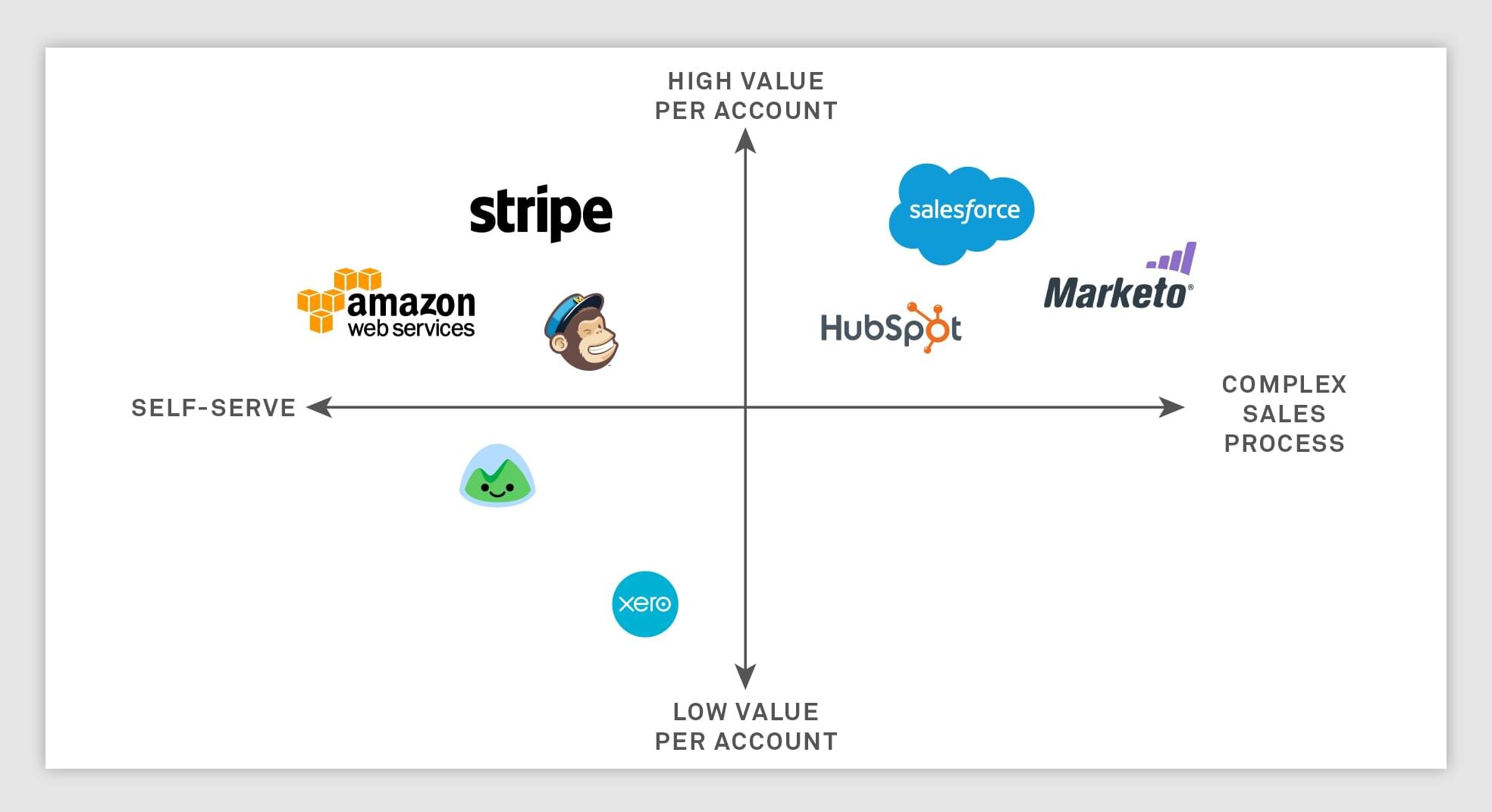
From Intercom’s Guide to Pricing
This is super important if you’re working with someone who falls into the camp of ‘we can sell to everyone!’
Not every customer is equal.
Some will generate you more sales than others. Some will be super easy to serve, others may require a direct sales person to go in and present. Others may need a customer success person to on-board them. All of which has implications on time and acquisition costs.
To get started, you need to understand the customer’s journey and experience with you to inform wider things like pricing, marketing costs etc. Don’t worry, if you’re super early, base a lot of it on guesses until you can collect the data.
Intercom’s article on Picking Your Pricing Model includes a great way to think about serving customers (see above).
Think about your customers or customers you’d like to serve and:
- how they’d buy from you
- the average order size and frequency of order
- their engagement rates with your product.
Then, map out their experience with you from initial enquiry, throughout the sales funnel and right through to retention.
In an early-stage startup, the key for you is RETENTION.
Nail this, and you’re on your way to optimising for a very profitable relationship. It’s not about acquisition at this point. It’s treating your early adopters like royalty, understanding the minimum number of features to ship and how to communicate this in marketing.
Do you want more info?
Check out the startup marketing template for one-person marketing teams or get in touch to learn more about my services.
“To be successful, you must match the way you market your products with the way your prospects learn about and shop for your products.” – CEO of Hubspot, Brian Halligan

About the Author
Lucy Heskins
Growth advisor and fractional CMO who helps early-stage startups scale without the usual tears, tantrums, or burning through piles of investor cash. When she isn't shouting into the void about product validation and go-to-market strategy, she's usually sharing brutal-but-fair startup marketing reality checks on LinkedIn.