What traction really looks like in an early-stage startup (a case study). Includes real tears.
Being part of the journey of growing an early-stage startup through the traction phase is tough. It can also have an impact on marketing, mental health & growth. Here’s my early-stage startup journey from an employee perspective.
“Ah, yeah! We totally increased our conversions by, like, 1000X!”
“Just got my MRR up to £2mill”.
I used to fall into the trap of comparing myself and our performance to Twitter claims like this.
I didn’t get that people filter this stuff on social media.
They choose to highlight the good parts and keep the crappy days hidden. It’s an unfair benchmark to compare yourself too.
Rarely do people talk about the mistakes you make along the way or the frustration you feel when you get another ‘no’. No one talks about the pain you feel when you realise you’re still not doing the job you were meant to be doing.
The traction phase - the part where you’re looking for the holy grail - product-market-fit - can be one of the most stressful things you can get involved in.
You’re not just validating an idea in a “normal environment”, the stress is tenfold.
You’re in a race to get to insights as soon as you can, before the cash (or the patience of your investors) runs out.
What does traction look like in an early-stage startup?
I am going to talk about how our startup, Careercake, tackled and experienced the traction phase.
Disclaimer time! I’m not saying that this is the blueprint, nor am I claiming that we achieved total product-market-fit because I’m not sure if I think that exists.
I don’t think it exists because how customers derive value from your product changes over time.
How our customers use Careercake to support their teams has changed dramatically compared to 12 months ago. You’ve always got to be talking to customers to understand how your product makes their job easier and more simple which can impact the markets you go after. In my opinion, anyway.
[Check out the startup marketing template I used as a one-person marketing team here?]
Brian Balfour says a startup goes through three phases of growing: traction, transition and growth.
In the article he sums up the different stages and the criteria you ought to work towards, shown below.
👋 Love the blog but need actual human help?
Don't you worry. Beyond the free advice, I work directly with early-stage founders to sort out their growth. You can bring me in as a fractional CMO to build and grow your foundations, lean on me for a methodical approach to see if there's a market for your product with my startup validation services before you spend a fortune building the wrong thing, or design a custom go to market strategy to launch aligned to the stage you're at.

Brian Balfour
Let’s focus on the traction part.
It’s the part where you’re looking for product-market-fit (whatever your definition of this is). The founder has done the initial leg-work, now it’s time to validate whether their vision and the way to solve a problem is a viable business model.
No pressure then, eh?
Building traction in Careercake
By the time I joined the team back in 2017, MVPs 1.0 and 2.0 had been built, some key learnings had been made and they’d just secured investment.
We had a few paying customers, including one enterprise customer who still uses us today, but now it was time to get focused and find our real home in the ecosystem we were looking to compete in.
This phase took us around 18 months.
Before we set out, this is what we were meant to be looking out for, based on Balfour’s criteria.
Goal: Do we truly understand our audience? Is there a need for our product? Is there a viable business model to underpin this? Is there part of could we make a return selling our product?
Metric: What keeps those few customers around? How could we optimise the offering to increase engagement and renewal rates?
Volume: How many users could we get signed up, converted past the trial stage, and renewing each month? How could we grow this user number, whilst keeping an eye on the fact we were a startup with not much cash in the bank?
Channels: Which channels should we focus our time, effort and resources on, without committing to a big spend?
Optimisation: What could we learn from testing our proposition? What could we learn from leading with this message first? Or by promoting this [video topic] instead?|
Team: What was the team’s makeup? Where did our strengths lay, and did this align to what the startup needed?
Okay, now we’ve got an idea of the criteria we are working towards.
Next up, let’s look a little further into the marketing aspect - ‘cos that’s what you’re here for, right?
What early stage marketing traction looks like
Below shows you the stage I joined Careercake and the typical marketing activity required. Check out this article from Costanoa Ventures on b2b early stage startup marketing.

Getting started with traction in an early-stage startup: an actual story
I’ve written previously about joining Careercake as employee number one and, in particular, the stuff you really should know when joining a startup. I joined as the startup moved from the “Founder Selling” phase to the product-market-fit validation phase.
The stages startup traction: what we went through, in pursuit of so-called product market fit
Okay, I am going to be honest. The pursuit of traction was one of the most challenging things I believe either of us (myself and the CEO, Aimee) have gone through, professionally speaking.
You need a thick skin; you learn a lot about yourself when you hear yet another rejection. You have to find reasons to be happy and to keep motivated.
Plus, I don’t know whether it’s because we are a women-led business, but I found that you get a lot of people (men) who offer their advice without listening to what we have to say.
Don’t get me wrong, I value advice - I truly do, if it comes from a good place - but I learned you can choose which advice you listen to.
During this phase, my primary role was to help identify how we move - as close as we could - to achieving what we saw as the first stage of product-market-fit. This involved ripping up everything. I meant, building on what we’d already learned. Ahem.
18 months of proving or disproving assumptions, nearly running out of cash, anxiety lows. You name it.
What the traction phase actually looked like for our early-stage startup (with examples)
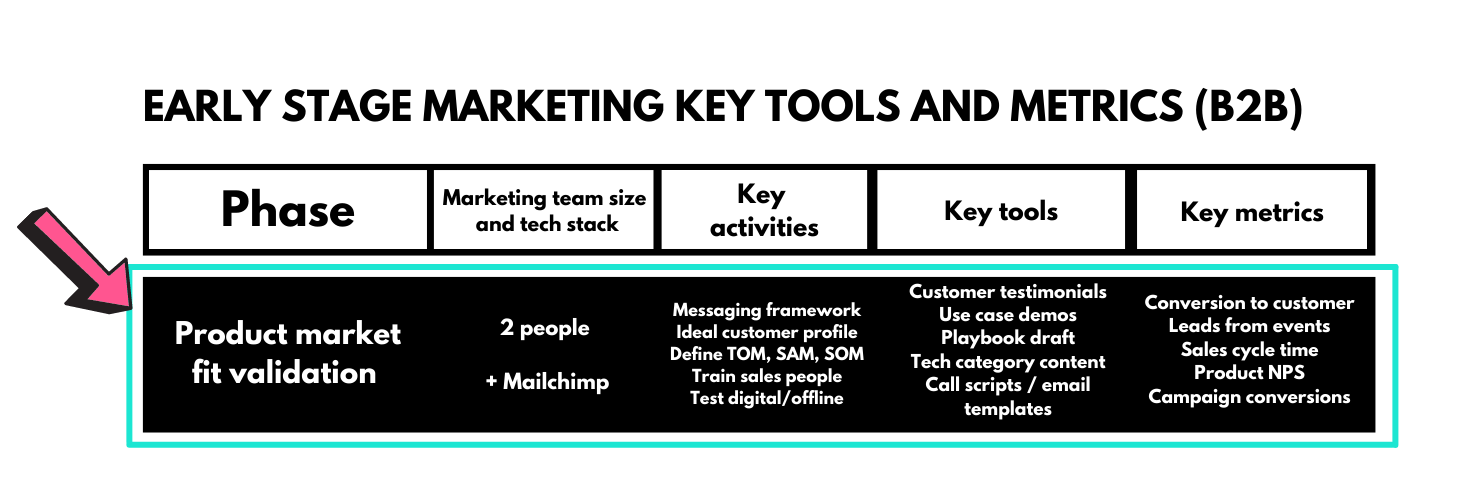
The things to look out for from a marketing perspective
At MVP stage we knew roughly who the customer was and how they bought. However, after looking at the market business potential, the odds weren’t in our favour. Plus, in pursuit of trying to make money, we were trying to be all things to all people. We weren’t focusing.
A route we considered was to enter the b2b commercial markets, selling into the L&D and HR functions. The thinking here was to test whether the problem we were solving was serious enough and would people part with their cash. To learn if it was something on the agendas of three industries in particular.
Customer research - the good, the bad, and the eeeeek.
We knew our content solved a problem: building the confidence of the young workforce enough to go for job opportunities. 12 million views on YouTube and our handful of paying customers helped us to see this. But we felt there was potential to extend this further, supporting them further along in the employee lifecycle.
This part of our path to product-market-fit validation involved arranging customer interviews with, on average, 15 people a month over the course of six months. We turned our attention to see where our product would fit, where the problem of engaging younger workers in the workforce lay.
Very quickly you realise that the traditional buyer persona checklist you're told to create when studying for a CIM qualification is tired and outdated. You can’t do anything with it. You need to understand how to run customer interviews with the aim of understanding how to unlock value.
In terms of marketing activity then, we were able to sort the following:
TOM, SAM and SOM agreed (size of market, serviceable market)
Unlock WHY people buy and turn into messaging frameworks
This led to a sales narrative, positioning document and initial scripts for our telesales team
Initial testing of messaging on email marketing, landing pages and low touch advertising
How we worked towards our traction criteria
Metric:
What kept our b2b customers around? For us, it was positioning that unlocked this. By positioning ourselves as a ‘Netflix of learning’ but without the long lead times. Our b2b customers loved the idea of helping us to shape the topics we recorded for their library of content. This iterative approach meant we could remain relevant as new trends came up.
We had a 100% renewal rate, which changed to 80% after 3.5 years as we found which customers we should and shouldn’t pursue.
Volume:
From a volume perspective, we chose to switch from looking at the number of b2c and b2b users, and instead, looked at how to increase the number of b2b2c users on the platform. We figured, increase this, keep them engaged and that way the b2b customer can show that it was working. Plus, we didn’t have much cash to focus on acquisition.
We increased activation rates and engagement from 4% to 26% within 6 months.
Yes, Lucy, but WHAT DID THAT LOOK LIKE????? I hear you cry!
Engagement looked like this:
Users activating their pass within 7 days after an organisation had purchased it on their behalf
Users from key segments watching 5 courses in days 1-4, and then returning a fortnight later
Users watching at least 75% of a video
Users, when surveyed, clearly indicating they felt more confident in a particular area and where more likely to go forward for x (x being a promotion, having a difficult conversation with their boss etc)
Channels:
We tested more channels than we should have - hey, everyone’s gotta start somewhere.
We realised it was three different channels that we seemed to get new sales enquiries that turned into something profitable / worth pursing. These channels were/are: YouTube, sales and partnerships.
These were areas we were kinda comfortable in and our audience used. The sales was perhaps the least effective and the biggest investment, but crucial in terms of learning what the market was doing.
Optimisation:
We were realistic - we knew we didn't have the traffic and the conversions to conduct a/b testing, so we had to approach it from a macro-level. This ranged from testing value propositions on landing pages, as well as what video titles to include in cold outreach emails.
We learned terminology to use and keep away from, and which titles and nurture sequence would get a prospect on the phone.
(There’s often a frustration people feel when, having sent out an outreach email, or sent a LinkedIn request, that it doesn’t result in something tangible immediately. It’s all about the sale. We learned it is all about getting to the next stage. Someone accepting your request, someone agreeing to talk with you, someone agreeing to help you contribute to a white paper.)
Team:
The team remained pretty much the same. Having the investment meant we were in a position to be able to keep things extremely lean and spend more time researching.
We have on hand a good developer and designers, still to this day. Here I learned, you don’t want people with ego; you want people who share the same values and work at the same pace as you. As long as you respect them too, of course.
Lessons learned when looking for traction in early stage startups
Always focus on retention
I’ve worked at a startup where the mantra was ‘throw at it and see what sticks’. And you know what? It sucks. You’re not good at any one thing. Focusing just on acquisition without having invested in learning how to retain customers is just like a leaky bucket. I talk about validating market demand and the signals required here.
Build it and they will come is a bad approach
If you work with a founder who truly believes this, trust me when I say I don’t think you’re going to be working there in 12 months. Or, if you are, you’re going to be seriously frustrated with your role. Startups that focus solely on product and not go to market are 12 months behind.
Just because you have a crap few months, do not get sucked into growth hacking
Especially if you are going through the traction stage, you shouldn’t give in to the magic beans promised by growth hackers. Seriously, you can’t A/B test properly. Your site probably doesn’t have enough conversions to make good judgements. Think on a macro basis.

About the Author
Lucy Heskins
Growth advisor and fractional CMO who helps early-stage startups scale without the usual tears, tantrums, or burning through piles of investor cash. When she isn't shouting into the void about product validation and go-to-market strategy, she's usually sharing brutal-but-fair startup marketing reality checks on LinkedIn.