

The Startup Marketing Template for the 1 Person Marketing Team
“I’m a one-person marketing team!”
*Smiles through gritted teeth.
If you’ve ever been the sole marketer, you’ll know that it can be a pretty stressful role to occupy.
Not only are you managing the founder’s plans for world domination, but chances are, you’ve been pulled from one thing to another, you’ve constantly had to tell people what marketing is, and battling for marketing “budget” was commonplace.
I’ve been the “one-person marketing team” in three startups. When I reflect on my time in these roles, I think back to a time of anxiety; a feeling of uncertainty and that feeling that all marketers have: there is always more to do.
That’s because in an early-stage startup there’s always a ton of validation work going on. Whether it’s the market, the product, the channels you’re using… There's always work to be done, campaigns to test, hypotheses to validate.
What I was missing from this time was a blueprint that would help me provide strategic marketing insight.
Something that told me to stick to my marketing guns when needed (pew! pew!) and something that would also tell me to open my mind about trying new things.
Quick plug, if you like your content in picture form why not check out episode 4 of my comic, The Startup Marketing Plan.
👋 Love the blog but need actual human help?
Don't you worry. Beyond the free advice, I work directly with early-stage founders to sort out their growth. You can bring me in as a fractional CMO to build and grow your foundations, lean on me for a methodical approach to see if there's a market for your product with my startup validation services before you spend a fortune building the wrong thing, or design a custom go to market strategy to launch aligned to the stage you're at.
Considerations when creating an MVP marketing strategy
In this edition, I’ve put together the startup marketing template I used in startup number three, the one that was acquired in the customer development phase.
I’ve made a point of really hammering the strategy part because you need this as the context to justify why you’re going to recommend using particular channels or why you’re going to talk to specific segments.
Tactics without justification is what bugs your founder.
(Say it louder for the back!)
You’ll likely get a lot from this overview if you:
Have a handful of paying customers but you don’t know what’s working and why.
Understand or are open to the fact that your focus ain’t acquisition, it’s acquisition AND retention. These are the must-haves. Dems da rules.
Get that you can’t create a well-polished document lasting 12 months. This is for a 3-6 month sprint.
Are happy to drive this with the involvement with sales and product too.
What’s covered in this article:
- marketing strategy questions
- marketing audit
- identifying your ICP
- message market fit
- considering your go-to-market motion
- thoughts on channel selection
- thoughts on measurement and testing
- example: 90 day objectives to use in a plan
- example: outcomes
- example: some startup metrics to get you thinking
- a short example of what to include in your one-two page plan.
This startup marketing template works best in the following circumstances.
Startup stage: Moving from founder selling phase to the Product Market Fit validation phase.
Marketing team: Likely to move from the founder to 1+ marketer + agency.
Tech stack: website, hubspot, mailchimp, hotjar, otter, canva, Sparktoro, Typeform
Key activities: customer research, TAM, SAM, SOM, ideal customer profile, messaging, channel selection, customer acquisition selection, campaigns, onboarding comms, reporting.
Early-stage startup marketing strategy: the (more often than not) squiggly path to product market fit.
Well, before you can commit to this you need to ensure you’ve been told the business strategy. Is it to further develop your brand within a specific market vertical? Or, are you trying to get more of the same customers in new segments? Whichever your answer, this will dictate a lot of your work in the next steps.
Marketing audit
Actually, scrap that, let’s call it a growth audit. How are you currently doing? What’s potentially in the way of your growth?
Here are a few questions to ask yourself:
Acquisition
Which channels are the most effective in attracting your ideal customers (e.g. which attract those who hang about for longer?)
Is your customer acquisition model right for your market type? (e.g. is freemium actually working or is it cannibalising your existing efforts?)
Is your audience building actually any good?
Activation
What’s your website traffic to sign up conversion rates?
Is your free trial to paid revenue looking healthy? What’s it like for your three main customer segments?
Is your onboarding driving people to the particular feature that will likely get them to adopt the product sooner?
Retention
Are their marketing campaigns in place to remind customers of how your product helps them to achieve their desired goal?
Marketing operations
To what extent does the current marketing activity (content, campaigns) reach buyers at the different stages of the buying process? E.g. problem unaware, problem aware, product aware?
Action: If I were you at this point, I would create a customer experience map, detailing the steps your customers take from the moment they realise they need your product right through to sign up and then use your product. But that’s just me, obvs.
Identifying the ideal client profile (ICP)
This is the part where we dig into who the ideal customer is. This is important because, not only will it give you focus, but once you realise important things such as the size of the market, you’ll know later on down the line which strategies to use.
For example, did you know that the size of the market is likely to dictate what customer acquisition hook you use, for example, whether you should explore things like usage-based pricing or freemium. Of course you did, you’re so clever.
The steps involved are:
Understand the market opportunity - TAM, SAM, SOM
Create buyer personas, validated with effective Jobs To Be Done and quantitative research
Identify true competitors and the reason for the “switch”
The market
Who are you marketing to? And why? I like to use this combination of frameworks to understand the market you’re playing in and the beachhead you should be focusing on.
Here’s a little article I wrote on how to choose the right market for your startup if you want to get super geeky. It digs into your market and things like TAM, SAM and SOM.
Customer profile
Here, I want you to arrange, at a minimum, ten interviews with your “best fit” customers. These are those who pay the most to get the job done the best, who are a joy to serve (‘cos life is too short to work with horrible people. I meant, those who aren’t aligned) and… here’s the important bit, who have bought from you recently.
These interviews, using the Jobs to be Done framework, should be structured in a way to learn the following:
- their struggling moment (what was going on in their life to suggest today was the day they purchased your product)
- what were they using previously to solve the problem your product helps with
- the channels they use to search for and buy a product like yours
- the language they use to make sense of your product, for example the category they are putting you in - whether you agree or disagree
- what their desired outcome is for using your product. This will help you to understand what features/experience you need your marketing to drive them towards to get the most from the product.
Message market fit
Whilst you are likely to be no way near product market fit, what we can work towards is message market fit. This is a concept Matt Lerner has written about, highlighting the importance and effectiveness of using customers’ own words to make campaigns that instantly connect with their audiences.
The interviews that you have run will have gleaned some of the language your prospects and customers use. This is like gold dust, honestly. It’s something I’ve used time and time again, and helps speed up the growth process when working as a fractional marketing lead to startups.
Your startup’s Go-To-Market motion will impact your marketing efforts
At this stage, it’s likely you are using a sales-led go-to-market approach. That or marketing-led. And by this, I mean you’re likely to need a human to help close a sale.
There are, of course, other motions, such as product-led, but these are more likely to be used when you’ve got product-market-fit. If you want to learn more about Building an Effective Go-to-Market strategy, check out my talk for Business of Software.
Market penetration or market development?
Are you selling to an existing customer base in an existing market? Or are you selling to a new market with existing customers? Either approach will again determine your plan of action. It makes sense to sell more of the same because you’re just building a repeatable process, right?
The type of activities may be largely around optimisation, optimising what’s already working, considering new products to sell or add to your existing suite, for example.
Let’s say you’re switching it up slightly, and entering a new market. The activities you’re likely to follow will be focused around understanding more about your ideal customer and co-marketing into new audiences.
Market growth strategy dictates the type of marketing you need to pursue.
Here’s a lil example:
When I worked in an online learning platform 30% of our business was from online demonstrations. The aim of course was to move to a way to productise this, but, the set up was still complex (aka we hadn’t sorted it yet and were literally flying by the seat of our pants).
This meant that marketing’s role was geared towards creating the tools to help these customers understand how our product helped them to achieve their desired outcome and to manage any “anxiety” with the purchase.
Customer acquisition - getting more customers from your existing efforts
It’s likely that until now, your marketing efforts will include a handful of marketing channels comprising organic efforts. In other words, nothing is really scaling. Yet.
The acquisition channels you use, again, will largely be dictated by your business model (e.g. low touch vs enterprise), your product and your customers - how they search for and buy a product.
There are many ways to group the channels you should be exploring, but I think this image from DemandCurve helps highlight some of the considerations. When hiring a fractional marketing lead for your startup they’ll be able to help best advise what channels to choose and why.

The most effective way to consider what channels to use is to think about how your customers use these channels and in what context.
We know that marketing channels include things like events email marketing, paid advertising - social media (e.g. LinkedIn, Google Ads, TikTok), SEO, engineering as marketing, tapping into existing audiences etc, but for this startup marketing template, you’re going to need to demonstrate:
How to amplify what’s working
Building a business case to explore a potential new channel
I have written about startup growth lanes previously, but as a recap, Lenny Rachitsky suggests that these channels can be grouped into four lanes: Sales, Viral, Content and Paid Advertising.
When considering which channels to use for your startup marketing template, always remember… justification. You need to justify why you’re adding it to your blueprint.
Consider things like:
Reach - how many of your potential customers are on this channel and which can you actually target? Targeting isn’t always available, you see.
Intent - in what context is someone using a particular channel? Think about the example of how legal services dealing with high-end, sensitive caseloads, likely won’t be on TikTok.
Cost - not just the physical ad spend, but consider the time it takes to train and implement.
Measurement and testing
You’ll likely be aware of a/b testing, but there may be a chance you have not got a substantial amount of traffic and therefore conversions to get super data-led about this. Fear not, the idea behind growth is the sum of a number of moving parts. It’s not just acquisition, it’s incremental wins that help compound over time.
Metrics. I’m not going to extol the virtues of using various metrics aligned to funnel stages. You know all that. What I would say is here, the metric you should be working towards is that of the north star - the uniting metric the entire business is working towards.
A north star metric is the one metric that captures the core value that your product delivers to customers. For example, your north star metrics might be average order value (AOV) and customer retention rate if you sell a meal delivery service. - Mind the Product
Another way to approach metrics is to consider leading and lagging metrics. Lagging metrics are those that have happened - e.g. churn, sales revenue - all important metrics, but they don’t help predict customer activity.
Think of leading indicators as those small incremental activities that lead up to this lagging metric. For example, number of log-ins, trial activations, engagement with onboarding emails.
But that’s not to dispel the importance of marketing metrics and the impact your activity has in getting in front of more people. These metrics will of course depend on the channel you’re using and the conversion rates by channel you’re working towards.
Example 90-day objectives for your startup marketing plan
Conduct customer research to help teams build a deeper understanding of and empathy for customers.
Build company-wide clarity around message-market fit to aid campaigns.
Begin cross-dept development of a customer journey map for the highest-value customer segment.
Create and implement product marketing recommendations to drive new customers to their value realisation stage of use.
Example outcomes:
Series of hypotheses based on the founder’s vision for marketing to test and validate.
Build customer segment maps, including buying considerations and experience, to create core KPIs.
Identify base traction channels to test value propositions, to scale up efforts in the next phase.Identify the marketing operations required to guide high value customer segments to adopt features of the product we believe will connect them to their jobs to be done.
Example Actions:
Create X landing pages, and identify three sources of traffic.
Collate interest levels with MVP. Identify potential ambassadors.
Invite a few to test the platform, and ask them to conduct basic activities such as ‘add to basket’ or find somewhere to buy bread.
Revisit acquisition, retention and growth strategies.
Considerations around cart abandonment, newsletters, discounts etc. Create a strategy around this.
Look at each persona, and identify wants to retain and grow.
Example: startup marketing metrics
Here are a few metrics I have used previously as part of my startup marketing plan. Feel free to use and apply!
Customer interviews - hit rate
Survey completions
Subscriber growth
Traffic to conversion (e.g. free trial sign up)
Customer acquisition cost - by channel
Activations - by client type
Sign up to paid conversion - by trial type
Time to value realisation (aha moments)
Churn rate
Retention
Annual contract value
Active trials
Leads by funnel stage
Summary
Nobody gets it right straight away when it comes to growing the marketing function of a startup. That’s because, unlike many marketing roles you take on, many things are different. The startup is currently in go-to-market phase, and by that, I mean it’s constantly validating the new and ensuring that each part complements other areas. Channel impacts the market, market impacts product, and product impacts pricing.
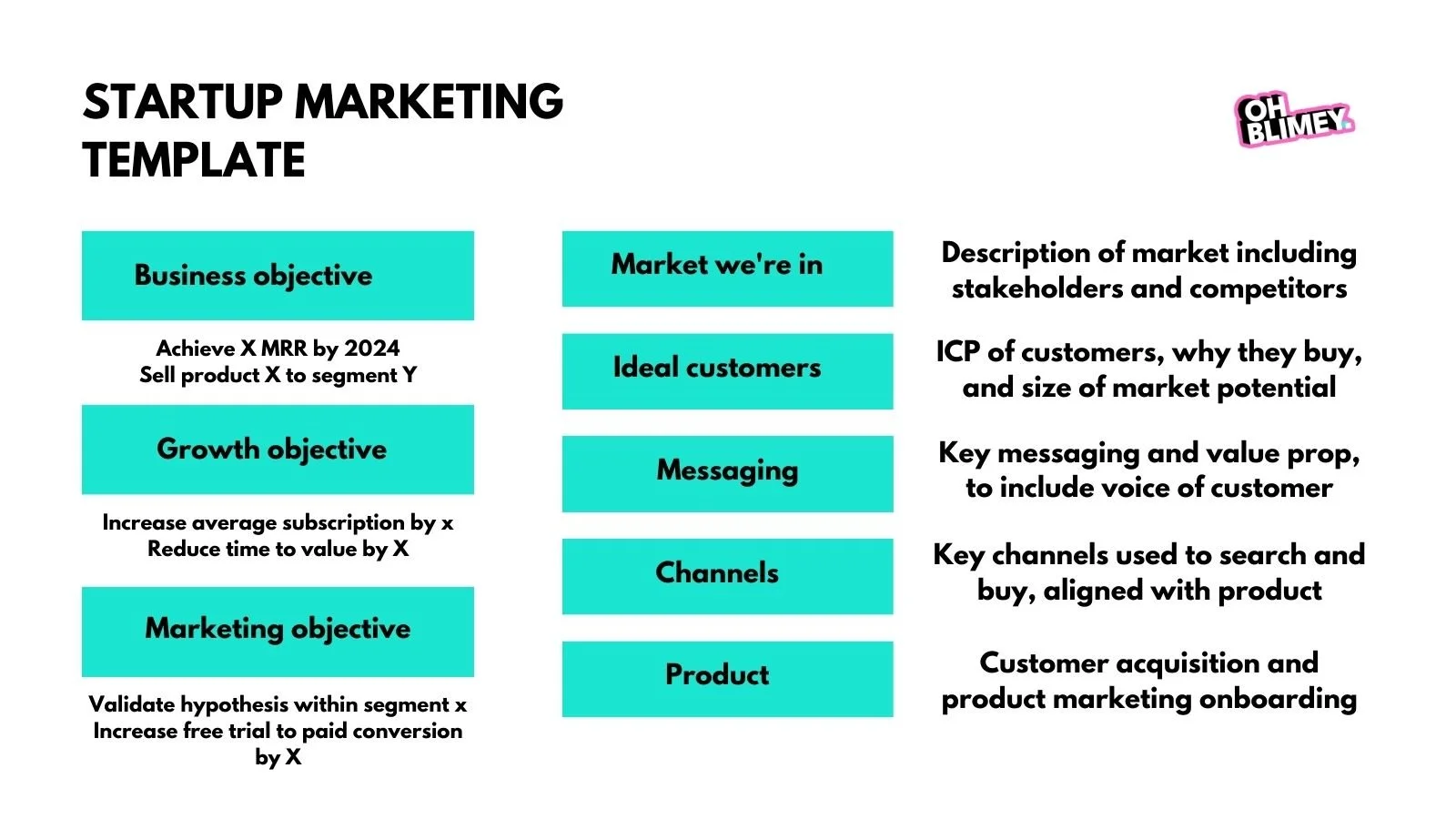
This essay is all about how to show you, one-person marketing team, the template you need to focus your marketing activity and help you feel confident you’re supporting the startup’s growth the best you can.
A short example of what to include in your one-two page plan.


About the Author
Lucy Heskins
Growth advisor and fractional CMO who helps early-stage startups scale without the usual tears, tantrums, or burning through piles of investor cash. When she isn't shouting into the void about product validation and go-to-market strategy, she's usually sharing brutal-but-fair startup marketing reality checks on LinkedIn.
