

3 startup growth strategies that’ll get you closer to product-market fit.
Let’s set the scene. You’re part of a founding team, and your startup is gaining momentum. Things are starting to point in the right direction, customers are coming in.
If the above sounds familiar it’s likely you’re in the messy traction phase. You know, it’s the part where you’ve got a good feeling about things but at the same time, you want to set fire to it all, train as a cat whisperer and maybe live on a beach. Maybe that was just me in my latest startup.
I digress.
So what’s the ‘stuff’ you should be focusing on to ensure you’re sailing the ship in the right direction?
It’s all about traction “done” the right way. Traction refers to a measure of growth or, as Demand Curve describes it: “permission to keep going”.
Here’s the snag, though; developing it in the wrong way only leads to the premature scaling of ineffective customers.
Trust me, there’s nothing worse than scaling your startup based on who you thought was the ideal segment only to realise that actually, it wasn’t the right bet after all. Headless chicken analogies seem appropriate at this point.
Traction in the context of product market fit.
"Product-market fit means being in a good market with a product that can satisfy that market”, says Marc Andreessen.
“Being in a good market” - what does that mean? To me, it means there are enough paying customers/people with a problem they’re willing to pay to solve. If you haven’t you need to go back to the startup validation scoreboard.
“Your product can satisfy it” - what does that mean? Your product doesn’t need a ba-zillion features, it needs a handful to help someone complete a task - on a functional, emotional and social level.
I don’t know about you, when I first came across this, I felt it was a little bit fluffy. I needed something a little more concrete, which led me to this definition:
“Product-market fit describes a product or service that effectively fulfills the underserved needs of the target market in a way that can sustain growth and profitability”. Log Rocket.
Nice. I liked this definition as it spelt things out a little more. The part I was drawn to was the “sustain growth and profitability” part. Because it gives you a kind of compass for your business.
If your market becomes too small, you need to be able to move into another segment OR you need to add to your value proposition so you can sell more to the same people.
And that’s what’s underpinning traction.
The priority growth and marketing strategies to get to product market fit.
Now we know the underlying theory that’s driving this, here are the main marketing and growth activities of startups that support the move towards product market fit.
These at a high level are:
Focus on retention, not acquisition
Use a few channels, not loads
Run general growth experiments, not specifics
These are not new ideas and I certainly didn’t come up with them (I wish!) but the following article shows you how I used them in a startup or two and how we unpacked what each meant.
Focus on retention, not acquisition
When you’re pre-product market fit, your company’s focus needs to be retention. Not new leads, not getting fixated on features, and not becoming stupid obsessed with the latest “hack”.
Let’s face it, it’s easier said than done. Especially if you’re like one founder I worked with who got all Gollum-PRECIOUS when a new lead would come in.
I’ll say it again: premature scaling of ineffective customers is unbelievably wasteful. If you haven’t sorted your retention challenge, bringing in a ton of leads is just going to rinse your bank account and inflate your CPA.
Before we dive into specifics, I want to quickly talk about the product-market fit question by Sean Ellis. You know, the one that asks: How would you feel if this service/product was no longer available? If 40% or more say “very disappointed” you’ve “got” product-market fit.
Now, I’m a marketer and we do love a vanity metric… but I have had an issue with the above. Because it doesn’t reflect commitment. You can’t do anything with this. Just like you should always look for commitment in the validation phase to signal intent… this question is open to interpretation. It doesn’t reflect commitment or the context in which you are asking the question.
What’s a good retention rate for this stage of your SaaS startup in this phase?
Well, it depends. Let’s look at monthly rates:
Userpilot says for b2b SaaS, it’s around the 35% and upwards mark.
Reforge says it’s 40% and upwards.
Profitwell suggests early-stage startups can be as high as 24%.
Nathan Latka suggests it’s 83.2%.
But let’s also not forget that these rates will differ based on you being b2b and b2c, marketplace, etc etc. These stats and benchmarks will also be different based on your revenue, your stage etc.
Measuring cohort retention - a chart below from Segment which is really useful.
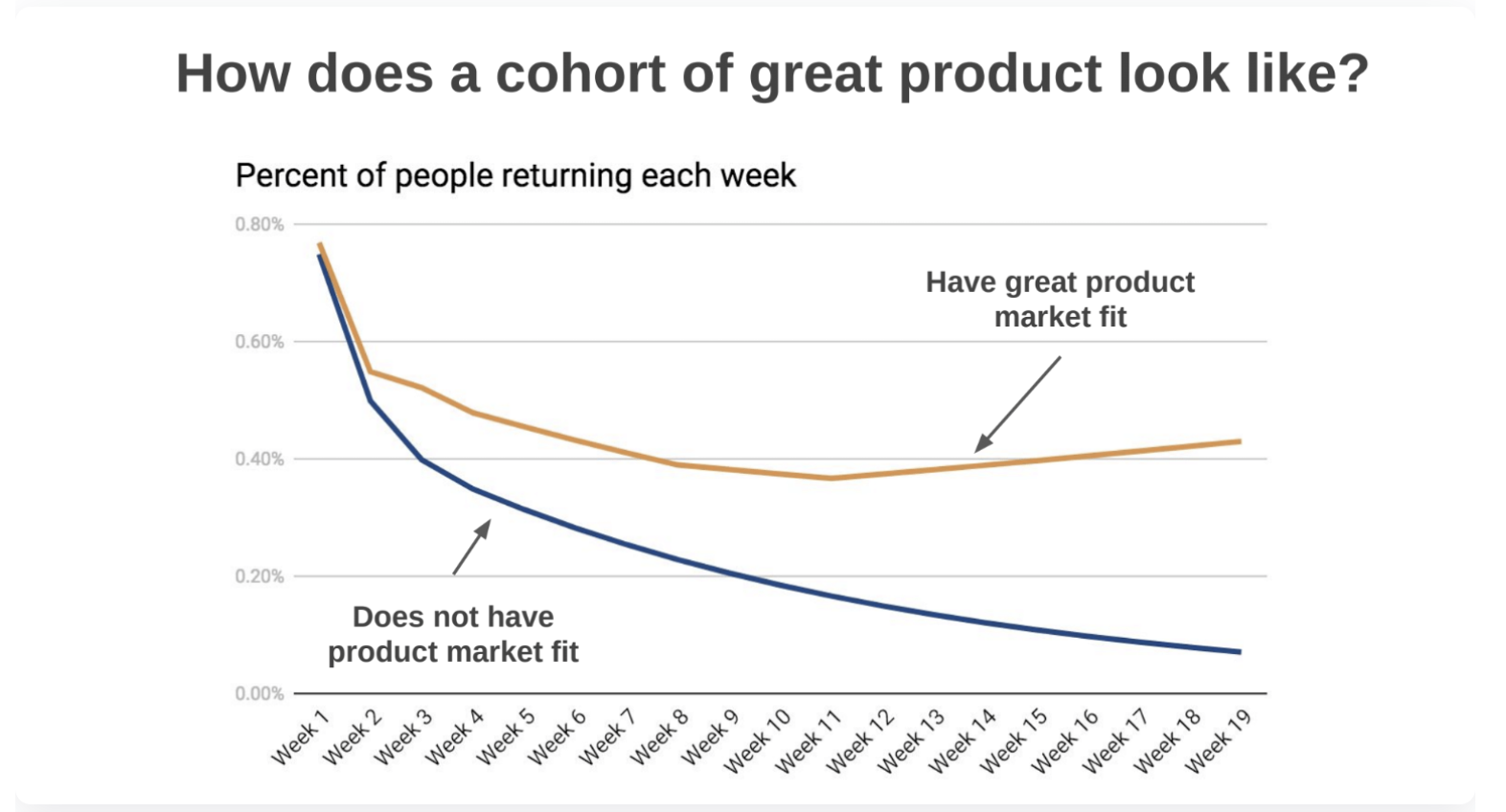
I'll talk with startup founders who look at retention as just one general number, which is a good start. But there are some activities we can do to understand which segments are pushing this up and pulling it back.
Break down retention data by cohort to understand the separate retention rates. You can start with a simple analysis of things like business size and then get a little more sophisticated by digging into further demographics, psychographics and what their Jobs to be Done is. Here’s an example of applying JTBD to your marketing.
Applying this theory: an example
We tried the above approach as a startup I was working in. This opened up a ton of info, most relevant was that we clearly had a number of opportunities to improve the retention of our ideal users - from the campaigns we sent out, to the onboarding and then to their usage.
Once we had this, we implemented a few changes from a marketing perspective. This included the campaigns we created right through to the onboarding process and what part of the platform to show them.
We didn’t collect the info we needed at sign up, so we started to ask this in onboarding. This detail allowed us to dig into our free trial paid conversion rates with a little more certainty.
We learned *why* people where signing up, and therefore, designed pathways and playlists to help them realise the value of us much sooner.
Interested in digging a little deeper? I’ve written about the true cost of neglecting your startup’s onboarding process.
2. Use a few channels, not loads
It’s all about a traction lane that leads you to scalable growth. This traction lane is made up of a few channels that when used in the right way are repeatable.
How many channels should you be using when searching for product-market fit? Chances are, you’ve got a few you’re using. They’re bringing in traffic and leads but you don’t really know what’s working and why.
I worked in a sales-led services startup years ago that took pride in the fact we used seven channels. How bonkers is that? When you lifted the hood we realised that two of those channels made up 75% of our results.
The move from pre-product market fit to product market fit in this particular company was tough. Our marketing channels comprised a ton of unscalable channels - organic social, outbound campaigns, blogging, newsletters…
The problem with this was:
Unscalable channels are time-consuming.
The cost to acquire leads fluctuated.
We felt a few channels didn’t “work” but that’s because we didn’t “explore/do/execute on them properly”.
The thing is, from a marketing perspective, this is the stage where you need to get ya shit together and consolidate your marketing channels.
To understand which channels worked for us, we tried a couple of things. We:
created a customer experience map of the entire journey using a customer-led growth approach
overlapped the data of our ideal customer (from step 1)
and then could see which channels formed part of their buying process.
Don’t get me wrong, this was tough. There was a concern/frustration to let go of a channel if it wasn’t performing - aka part of the above. I found myself worried about letting it go because of the pressure from the top to focus on leads.
But we stuck through and were able to make our reduced set of channels work. I’ve written about what traction looked like in our early-stage startup if you fancy a case study packed with tons of specifics.
3. Run general growth experiments, not specifics
The testing we did wasn’t ground-breaking and by that I mean super specific. That’s because we didn’t have the volume to get super nerdy. For us, growth was all around big moves like:
Changing messaging on the home page and landing pages
Testing pricing tiers and free trials
Introducing content marketing for those larger clients, supported by a CRM
Re-ordering onboarding stages or omitting them completely
Testing different value props within sub-segments of our client base
Messaging - e.g. using “technology” or “software”. Subtle, I know.
Creating content around customers’ objections or trade-offs and creating a drip content plan around them
Testing and optimising learnings from a recruitment platform company
When I was leading marketing at a recruitment platform, we were on the cusp of product market fit. (I only knew that because we achieved product market fit).
I learned pretty quickly it was all about big wins. I’d talk to some people who’d turn their nose up against our big-win approach… but in hindsight, they did so because their business was at an advanced stage than ours.
The type of growth activities we were conducting included:
Agreeing what constituted a micro test and a macro test, and commit to macro changes at this point only.
Micro for us was changing the colour of the button
Macro for us was changing the onboarding process
Changing the imagery from graphics and illustrations to stock people
Trialling in our outbound campaigns different call to actions:
A video from a sales rep with an audit of a landing page
A whitepaper - a buyer’s guide
An article around a struggling moment.
It wasn’t always easy and we certainly didn’t “win” from each - but it was an effective way for the entire team to contribute and not just be siloed into marketing and sales.
Summary
What “good looks like” will depend on a huge variety of factors and what industry you’re in. But ultimately, to reach that milestone of product market fit, these examples should serve as a point of reference.
Traction is never meant to feel comfortable. As you grow, you find new things to worry about, to obsess over. I promise you! :)
If you want a better idea of what “good” looks like or a clearer path to growth, feel free to check out my fractional marketing lead services. I’ve worked in B2B SaaS, marketplaces and apps.
