How to be strategic when creating marketing content for your SaaS startup.
This article is written for founders who may not be in the position to hire a marketer at the moment, but perhaps wants to bring in an intern. These tips and this line of thinking - I hope - will give them direction.
...but it’s also for the marketer who’s getting tired of being told to ‘be more strategic.’ Here’s a few strategic content marketing ideas for your SaaS business to give you direction.
An intro to creating marketing content for your SaaS startup
Any of the following sound familiar?
You write a blog, pop it up on Twitter, get a few likes (thanks, Mum) and think you’re work is done.
You write an article on Medium, hit publish, and then, because the sales aren’t rolling in, your boss tells you it isn’t working so you stop it.
You create content without talking to your customers to understand what info they need to make a decision about your product.
Yeah, you’re ~that person~.You send a newsletter out, someone clicks on it and you think ‘OH MY GOODNESS! THEY MUST BE INTERESTED’ - then you pass to your sales person who gets overexcited, follows it up and bugs the customer. There’s no sale, if anything it’s ruined the relationship. Then sales tell you marketing leads are rubbish.
Sorry, the last obviously struck a chord.
The problem with content marketing.
A lot of content that’s created doesn’t allow for where your customer may be in the buying process. It doesn’t consider what’s motivating them to solve their problem.
As a result, the results you get are skewed. Things take much longer than they should. Your customers get confused about what it is your business actually is/does. Everyone starts to lose respect for marketing.
But the good news is there’s a few good places to start when looking at creating strategic content marketing for your SaaS business. These frameworks have helped me time and time again to give my work direction.
Before we start: here’s a few assumptions I’m making about you:
- You kinda have a good idea of who your customers are. You’ve conducted your customer interviews and you’re getting a feel for what they look like, what motivates them.
- You’re open to exploring new ideas. I’ve worked with a lot of startups who aren’t open to trying new things. This stubbornness gets in the way of learning.
- You get that it’s not a short term quick project. It’s all about creating the right content for your audience, not just writing a blog for the hell of it.
4 steps to follow when creating strategic content marketing for your SaaS business
Audit the marketing content you’ve already got
Work out where your customers are hanging out
Arrange content ideas by buying process
Arrange content and tools by customer lifecycle stage
1. Audit the marketing content you’ve already got.
Chances are, you’ve joined a startup where the founder has already put a lot of the groundwork in. She may have grown a loyal readership on Medium, launched her own podcast or amassed a following on YouTube. Dig into this. This is your starting point.
What I want you to do is identify what content gaps there are, based on the type of business you are in and what type of sale happens.
A good way to kick this off is to use a content marketing framework, like this handy one from Smart Insights.
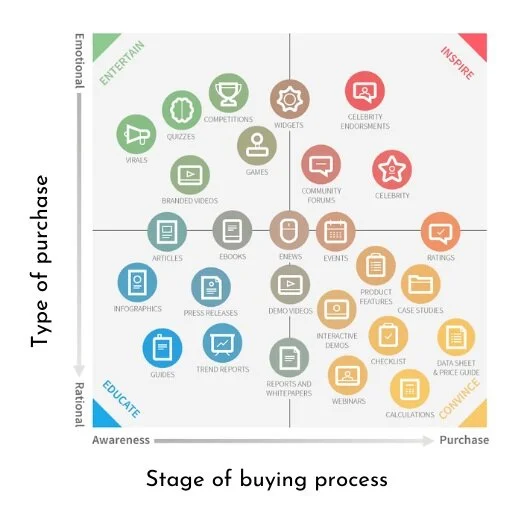
Content Marketing Matrix, Smart Insights
Along the horizontal axis is the buying stage your customer will go through (from just ‘aving a look on a website to “here’s my cheque book”). Marketers amongst you will know this is also referred to as the awareness - purchase process.
The vertical axis shows the type of purchase someone may engage in, from emotional to rational. For example, if someone is buying flowers or a picture from Etsy of their Gran, this could be seen as more of an emotional buy.
If you’re looking to buy, say, virus software for your laptop, this is more likely to be a rational buy. In other words, it’s a must-have. You’re not going to well-up buying it.
(Well, you might. I’m not judging, we’re all friends here).
The content formats are then grouped into different quadrants, based on these two categories.
How to audit your own stuff using the content marketing framework.
Firstly understand what type of business your startup is (b2b, b2c, rational/emotional product).
Then make a list of all the content you have at the moment.
This activity will then show you some gaps.
Let’s go back to the picture. Applying it to Careercake when I first started…

I could see the team had done a great job at putting the ground work in. There were a number of content types, including:
Branded videos - learning videos, hosted on YouTube
Guides - a downloadable guide on writing cover letters
Case studies - early stage supporters happy to share their story
eBooks - this was in the planning stage but was a way to talk to the b2b market
Celebrity endorsements - a glowing testimonial from a certain Dragons’ Den star to build credibility…
You try it.
This is a good exercise to do with the founder as they’ll remember bits and pieces that you may not immediately be able to see by searching their name on Google.
2. Work out where your customers are hanging out
The first step here is to consider: are you a b2c or b2b brand?
I’m going to use b2b as an example here.
If i was joining a b2b startup, I would start by creating a short survey for the range of people I market to:
paying customers
prospects who’ve expressed an interest
customers who’ve cancelled
prospects who didn’t even sign up for a trial
Within these segments I would then start to look at what sources they use to learn more about the problem my SaaS business helps them to achieve.
Learn where they hang out using surveys.
Every time I would have a customer interview*, afterwards I would fire over a short survey asking them:
Q. Where are the five places you get information about? [your job]
Q. Who are the three people who influence your ability to do
[this project]?
I wouldn't make the survey long, nor would I give them options. After a while I could see a trend in the sites they were visiting.
From here, I would then visit the sites / networks to see what kind of content my competitor are creating.
Are they educational pieces or more tangible case studies? What are people saying in the comments? All good stuff to inform what you’re going to create.
Getting started is simple. I even wrote a blog about it: marketers, stop making excuses and talk to your customers.
*Good practice is conducting a minimum of 15 customer research interviews a month btw*
Try Typeform for easy-peasy survey creation.
SparkToro to see where they hang out online.
Google Trends to look for seasonality considerations.
You don’t have to listen to everyone.
Look at the answers that come in, and prioritise your customers on who to listen to. If there’s a vocal person with loads of opinions who probably won’t actually subscribe and pay for your product - then they ain’t really the person you want to be listening to.
3. Arrange content ideas by buying process
Ever heard a marketer spout TOFU, MOFU and BOFU acronyms at you?
They’re not space gun noises. Pew! Pew!
An important strategic step to take when looking how to arrange your content is to understand where it sits within the buying process.
This is where these acronyms come in.
TOFU: top of the funnel.
This is what we call the awareness stage. It’s the part where you’re probably online and are aware you’ve got a challenge so you’re browsing through different sites, reading educational blogs to learn a bit more about the subject.
What this may look like on an SaaS site: people reading your blogs, maybe subscribing to your newsletter.
MOFU: middle of the funnel.
This is the interest/decision stage. This is where you may have had a look at a demo, enquired about pricing because your boss has asked you to get some quotes for consideration.
What this may look like on a SaaS site:: A brochure download, signing up for a webinar co-hosted with one of your customers.
BOFU: bottom of the funnel.
Here’s the bit where you’re pretty sure you’re going to sign up, but you’re looking for signs of credibility. You may also sign up for a trial.
What this may look like on an SaaS site: People attending an event you’re running.
Applying it to your startup

Write down the sign up process for your business, using the stages detailed above.
What gaps do you have?
What opportunities could you pursue?
98% of people who visit your site will not buy from you, nor will they click contact sales. So you need to serve them relevant content that helps guide them around your platform, answering any questions they may have.
More reading: Here’s the 19 channels you can use to get traction
4. Arrange content and tools by customer lifecycle stage
Lastly, we are going to look at the customer lifecycle - because your work isn’t finished when someone pays.

b2b customer lifecycle marketing touch points - Smart Insights
The traditional purchasing process goes out of the window when you’re in SaaS.
Every month someone continues to subscribe and use you, you need to keep reminding them why you’re adding value and how you can help them to achieve their milestones.
Above is another awesome example by Smart Insights showing the lifecycle marketing model. You will see they use a different set of buying stages: reach, act, convert, engage.
This is really important to understand which tools/channels are right for that moment.
Applying this to your SaaS startup:
With your team, map out every stage the customer will go through.
Get every department involved. Admin, sales, customer service: each department has a different relationship with the customer, and they may be asked questions you've never considered.Don’t try and solve everything at one time. Break it down into stages: reach, act, convert and engage.
Let’s say I am a SaaS platform, and I want to look into the Reach Stage. Channels/tools available to me are PPC, SEO and… content marketing. What could I realistically do with the resources I have available to me? What opportunities are there to explore new ones?
These are just a few ways to think strategically when creating marketing content for your SaaS startup. This can also form part of your growth strategies if you’re looking to reach product-market fit.
Think about the bigger picture and the context to guide your work. You won’t feel as overwhelmed, nor will you question why you’re doing something. Trust me!
If you want to talk more about creating strategic content marketing for your SaaS business, please do get in touch.
I work with founders and startup marketers, helping to navigate the messy journey of creating and marketing a startup.
Extra homework.
Check out this article, How to Build an Effective Content Marketing Funnel.