Hey, marketer, thinking of joining a startup? Maybe read this first.
<This article is now available as a web comic! Check out The Adventures of Startup Marketing Club (tears include burnout and tears).
When I first heard I was joining my first startup, I was excited.
The typical 9-5 office job didn’t really appeal; I’d often found myself feeling frustrated when we couldn’t look at new ways to do things after being told, ‘it’s what we’ve always done’.
You can imagine my excitement then when I was offered a role in a startup that was focused on being a disruptor, creating a new market and with it, new ways of working.
What. A. Learning. Curve.
I naively thought my progression and experience would be linear.
In actual fact it was like this:
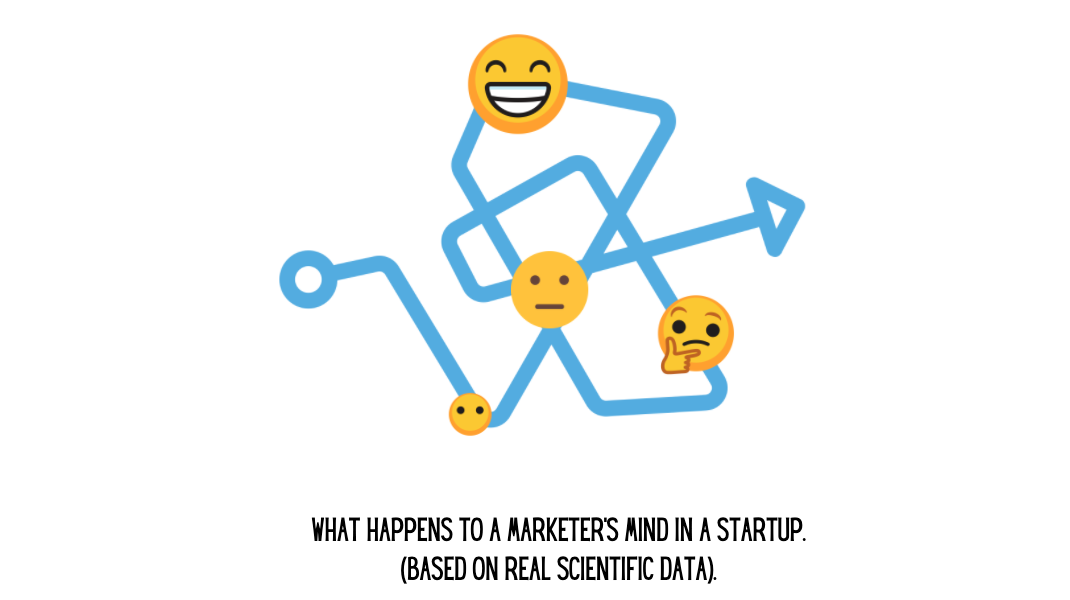
Here I am, nearly ten years later, with several startup marketer roles under my belt. What I am finding at the moment is through mentoring junior marketers and talking with founders, the same stuff keeps popping up.
Some people aren’t aware of just how different a startup is to an established business. It requires - IMO - someone who’s open to learning, happy to forget the marketing they’re used to for a bit.
Oh, and you need to wear a lot of hats.
So I thought I’d share my two-pence worth on what you need to know if you’re thinking of entering the startup world.
You have to forget a lot of stuff from your previous roles.
You have to start again.
You can’t just replicate what worked in your last business - that was a unique marketing strategy with channels unique to that business, that market and those customers.
If you really want to get an understanding of what you’re going to do, you need to know the stage the startup you wish to join is at to determine the marketing you’re likely to do.
Gah, that was a mouthful.
Blank & Dorf in The Startup Manual, suggests that there are four stages a startup goes from an idea in the founders’ head to a fully realised business.
These are:
Customer discovery - taking the founders’ vision and turning it into a series of tests to get facts
Customer validation - run the tests and see if there’s a repeatable process to build the business
Customer creation - start to build end user demand, set up sales channels
Company building - making the move from from scrappy startup to a business that is validated
The stage you join will determine what your marketing role will look like and the value you can bring.
I remember joining a startup that was in customer discovery phase (i.e. getting those ideas out of your boss’ head and turning them into guesses) but coming from a company that was in the customer creation phase (i.e. I had a lovely budget, team and the channels had been set).
That transition was tough.
I’d gone in thinking that you can just use the channels you know work.
Instead, my role, for nearly 8 months, was solely customer research focused.
I wasn’t building SEO strategies and demand generation campaigns, I was going RIGHT BACK. Customer interviews with people who thought the business idea was great, others not so.
Marketing at this early stage goes by a very different guise: customer development.
The results of which were instrumental in helping to rebrand, change business model and ultimately, lead the path to start testing to see if people would pay for the service (spoiler alert, it did!)
If you’re inquisitive, love learning about customers, and can’t leave things alone until you’ve proven your assumptions, I think you’re going to like being a marketer in an early stage startup. Check out more info on startup marketing basics to whet your appetite.
2. Is the startup environment right for you?
“The demands of customer discovery require people who are comfortable with change, chaos, learning from failure and are at ease working in a risky, unstable with no roadmap”
(Blank & Dorf, in The Startup Owner’s Manual)
This is 100% reflective of my experience with startups.
There was a period whereby I would regularly think I was crap at my job because we weren't working towards the achievements or milestones I knew signalled success previously. At the time, I didn’t get that startups completely different and have different milestones to a developed business.
The way I got around this was to work every hour I could. I thought I needed to work more to compensate for the results we were not achieving.
Of course, this impacted my mental health.
(Side note, there’s also a lot written on the impact on your mental health working in a startup can have, although it’s mainly for founders).
(Another side note, I was lucky enough to work out when I needed to take a step back to help the above).
The chaos of joining a startup where you’re pivoting, changing positioning, and feeling like it’s two steps backwards one step forward can play havoc on your the self worth.
That’s why it is so important to know what you’re expected to do before you sign up.
3. If you don’t have a CEO or board that ‘gets’ marketing, you’re going to have to educate them.
Chances are, at some point in your career, you’ve had to defend your craft by those who don’t quite get it. Whether that’s to a relative, a line manager, someone in the pub - everyone’s got an opinion on what marketing is.
When joining a startup, chances are you’re going to be the only marketer. You don’t have allies yet. But if you’ve got a founder who gets marketing, that’s a good thing. (As long as they actually get it).
A few months ago, I attended a networking event run by a pretty successful brand close to home. I was excited; it was a brand I really liked and the attendees got to hear from one of the co-founders. You can imagine my surprise when he boasted, after being asked what marketing they were doing, that he hasn’t spent a single £ on marketing.
I was confused. The exchange with the audience went like this:
Q: ‘So if you don’t do marketing, where do you sell your online merchandise?’
A: ‘Through the website, and Instagram”Q: “Do you do events?”
A: “Yes, four or five a year, one of the big ones in London, one in the US and the rest, around the UK. We very rarely break even from sales on the day there”Q: “And what about your design, pricing and packaging? And who talks to your customers?”
A: “Oh, that’s (Alice) she does that - comes up with the guidelines, helps translate the brand into something people just want to pick up”.Right.
It’s not the first time I’ve heard a founder boast they’ve spent nothing on marketing, not realising that there’s so much more to it.
Too many people fail to realise that marketing is the process of understanding your customers, building appropriate channels to reach them and ultimately meeting their needs (profitability).
Yes, you can have a newsletter, you can have a Twitter account but these are merely tools that form a wider strategy.
Another mistake I see in startups is when there’s pressure to get direct sales from marketing. And when it doesn’t work, marketing is blamed or its budget is cut.
Of course, there are founders and boards that get it.
But when considering your next startup test the waters to see to what extent marketing is understood - to gauge how much time you’re going to spend educating too.