How to map out your SaaS sign-up process when starting from scratch.
A shortcut way to visualise your SaaS startup’s customer flow
As a marketer in an early stage startup - or indeed, any startup - your focus has to be on the customer.
You’re their voice, their champion. You’re the person who tries to uncover their motivations, why they’ll want to buy from you. All with the aim of creating a value proposition that works.
(These insights are also SUPER useful to use when you find yourself needing to push back on the boss when they come running in with a bonkers idea).
The insights you collect during customer discovery and customer validation stages will influence the decisions the startup makes about pricing, the business model, positioning - you name it.
So, obviously a key part of this is using your insights to influence the customer’s journey when interacting with your SaaS product.
You want to optimise the customer’s journey in such a way it:
they derive the most value from your product and can achieve (X)
you hit sales targets / objectives set by you and the Board.
You want to create such a relationship that they keep coming back because as everyone knows:
(Cue really obvious advice you should know, ‘cos you know, you’re a marketer)
It’s cheaper to keep a customer then acquire a new one.
Get started with SaaS sign-ups by visualising the common paths visitors will follow
Let’s start by considering the steps you’d expect someone to follow when making a purchase from you.
Think about the process you go through when visiting a coffee shop.
You’ll go through a series of steps that have been carefully thought out by the business to try and convert you to becoming a paying, and hopefully, repeat customer.
There’ll be various ways they attempt to up-sell you:
“Would you like to try our new house blend?”
Not to mention, get you to come back:
“did you know we’re running an open mic night, we serve beer?”.
And, if they are really, *really* good they’ll build a relationship with you to the point where you only buy coffee only from that brand.
So, who do you apply this to your SaaS business?
You want to plan for all eventualities (within reason).
From the point whereby they sign up, to when they become a paying customer. You want to create a sign up process that is geared about finding ways to keep your users engaged for longer and/or increasing the frequency of spend with you.
Luckily, as humans we’ve got access to a series of mental models that will inform what we expect to see in a sign up process. So you’re not *literally*starting from scratch.
Before we go any further, though, here’s some of the the stuff you need to know beforehand when looking at signup processes.
This is article is a general overview; it doesn’t allow for differences for b2b, b2c or b2b2c user flows (yep, they’re different)
It doesn’t allow for different entry points - aka how someone has come to find your website - aka ‘lead source’
The SaaS customer flow: a visualisation
I’ve used the awesome visualisation of the SaaS customer journey, based on Croll & Yoskovitz, to demonstrate the process someone may follow.
Here it is:
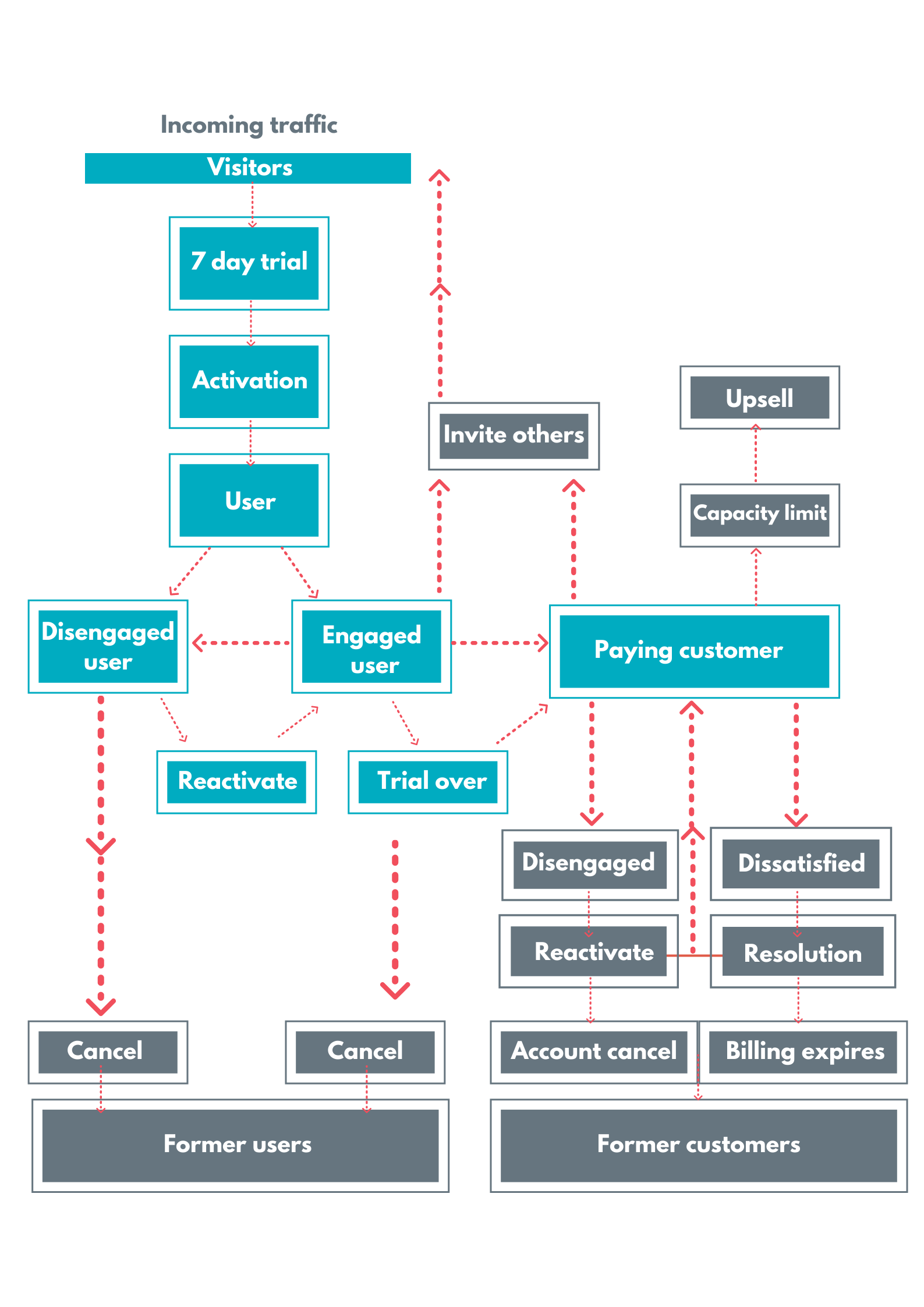
SaaS customer journey visualisation, Lean Analytics (Croll, Yoskovitz)
How to you apply it to your startup:
Example situation: B2B SaaS sign up
Business: Wayhey! CRM
User journey: I’m a Sales Director that needs a CRM to help manage my team’s efforts. I’m new to the site, but familiar with how CRMs work.
Offer: 7 day trial to the CRM, whereby I want them to upload contacts, send a few emails and create a custom report.
Stages:
Remember this when looking at each stage:
What is it you want the user to do, and at each step what info are you trying to collect to inform their relationship with you?
They visit your website
Sign up for a free trial (7 days)
They activate their account, and start using the platform.
There are a few elements within this approach.
> How much effort is it to create an account? How long is the process?
> What questions do you need to ask now, and which can wait for another time?
> What can you do to reduce signup friction?
Within this, they could get email comms to influence and drive certain behaviours:
a welcome email, highlighting 3 tasks to undertake to drive engagement
a personalised message from the CEO (human connection)
reminder to say they need to add their card details in to keep accessing all the features
The 7 day trial ends, and at this point the user either:
decides to hand over their card details and pay to use the service
may not have seen value and ends the trial
If they are a paying customer, it is up to you to work hard and retain them each month.
This is the most basic flow to follow, and as such a great way to start.
The highlighted sections in the image (teal colour in the image) show the stages that virtually every business focuses on.
But as you can see, there are plenty of other stages that you can focus on to either maximise the potential sales OR reduce the chance of them churning.
Consider the following:
What stage of the buying process are they in?
What are the main tasks/things you want your user to do? Watch a particular set of videos, log-in a few times, upload code onto their website? Which combination of tasks are more likely to convert a user to become a paying customer?
What are the objections they have that may stop them moving forward (converting)?
What copy do you have from your customer interviews you can use in the landing pages or emails to help show them?
Do you want to rely on emails or push notifications to nudge people the right way?
If they cancel, ask them why they’ve cancelled. There could be some objections you’ve missed out on.
Could you use an onboarding tool, such as the one offered in Intercom?
Once you’ve brainstormed this, move onto the next sections to optimise for such as how to reduce churn or look at ways to up-sell.
More resources to help:
12 B2B SaaS Signup forms (with screenshots)
When designing a website, do our brains a favour and keep it familiar
Friction can actually be a good thing for sign-up flows
Why your Request a Demo button is hurting your startup’s sales process.