Your onboarding is hurting the growth of your tech startup.
I talk with founders in the early stages of product development who are really confused when - despite spending £X on a fancy new platform - a few months after its launch, the levels of growth they’d anticipated (slash told their investors) are nowhere what they thought they’d be.
There’s way too much pressure on driving traffic and getting new leads. There’s never enough focus on driving the right traffic and optimising the onboarding process to ensure leads don’t fall out the other end.
Retention is just a footnote at the bottom of the board update.
“Onboarding?! You think I’ve got time to play around with the signup process and onboard every new signup?” I hear some people say.
Honestly. Yes. If you’re an early-stage startup, your focus needs to be on retention, especially if you’re focused on growth and reaching product-market fit. It just has to.
As the founder or first marketer, you need to understand what people are expecting when they sign up to your product and what things need to happen to ensure that customer gets value.
(This is often called reaching the aha! moment in product usage terms. It’s when someone reaches the value realisation stage - the part where they just get your product; it’s how they make sense of it and can see it in their everyday life.)

No, not that a-ha.
Do you have an unhealthy relationship with your product’s onboarding process?
If any of the following sound familiar or you’ve experienced, you may have an issue:
You think that because you offer a free version, you’ll get loads of sign ups.
You think your product is so easy to use, it doesn’t need any form of onboarding.
People tell you they love your idea, go and download the app. They experience a pretty rubbish experience, and never come back. (And avoid eye contact with you at the next networking event).
A few people sign up, they do pay but then - because your intro price is dead cheap - they forget they even pay for it. Six months later, they ask to be refunded because ‘I didn’t actually use it’.
You copy the onboarding process of Salesforce because you really like it and it seems smart. (But you’re not selling CRM software nor are you Salesforce).
Luckily, I’ve made enough mistakes and learned heaps along the way to hopefully steer you in the right direction and get you rethinking about your SaaS startup’s onboarding process.

Turbo Tax’s onboarding process. It’s pretty, huh?
What is SaaS or product onboarding?
“Customer onboarding is the process of helping new users get started and stay engaged. It’s a series of steps and resources that help make incorporating a SaaS product into the user’s routine as easy as possible” ChartMogul.
Wait a minute… I think there are a few bits missing in this definition.
Firstly, it forgets that important role marketing plays in the stage before activation - acquisition.
As Ramli John in Product-Led Onboarding suggests, ‘to be successful, you need to plant the seed of future value at the first value touchpoint’.
What he means here is this. Every social media post you put out, every reference you make to your product in a podcast... whatever you do - it ultimately impacts the onboarding process. It’s all about positioning.
Secondly, it neglects the concept of habit changing. Let’s say you’re introducing a new idea or a new way of doing something. Changing habits and routines can be really, really hard. The time to start educating was yesterday.
Okay, so onboarding then is a combination of perception, habit-forming, engagement, motivation, and value realisation… right? Yep.
And it’s also not just about the sign-up process? Yep. It’s about ensuring the customers’ journey of coming into your product sets them up in the right way that they achieve the value they’ve been promised from your external messaging.
Hint! Next time you speak with your agency who’s building your product… ask ‘em about this stuff. They should be advising you on this.
The cost of neglecting your SaaS startup’s onboarding process.
80% of people have deleted an app because they didn’t know how to use it (Wyzowl).
74% of people are likely to switch brands if they find the purchasing process too difficult. (Salesforce)
Looking at your startup’s onboarding process is a great growth source. It offers the opportunity to optimise for your best paying customers and reduce the amount of money you spend on getting them in.
So why are you not putting the extra effort in to ensure your startup’s onboarding experience doesn’t end in the same way?
Can you really afford to be one of these statistics?
Getting started with designing your SaaS startup’s onboarding process
(Side note, if you want to learn how to map out your SaaS sign-up process specifically check this out.)
Which SaaS onboarding tools are available?
There’s a range of tools available, with the market catering to those for enterprise software and individual users as well as a hybrid between the two.
Personally, I have used Intercom and the plug-ins that come with email marketing platforms. I’ve also heard really good things about Userlist, Appcues and explored tools such as Pendo.
When asking for a demo, think about how many users you need to support and how many no-code features there are to reduce the amount of time you may need for a developer.
How do you visualise it?
Next you need to write down your customer journey, from their struggle right through to when they evaluate a product like yours and then what they do to become a recurring customer. The idea is to understand how to optimise their experience to get them to the aha moment!

Again, not that aha.
What does your onboarding need to do to show your new customer that your platform is the one for them?
What is the one action or combination of actions that your customer needs to do to increase the likelihood of them renewing past their free trial and continuing their subscription?
When you map out this stage, consider what they are thinking, feeling and doing. All of which can influence their decisions to use you.
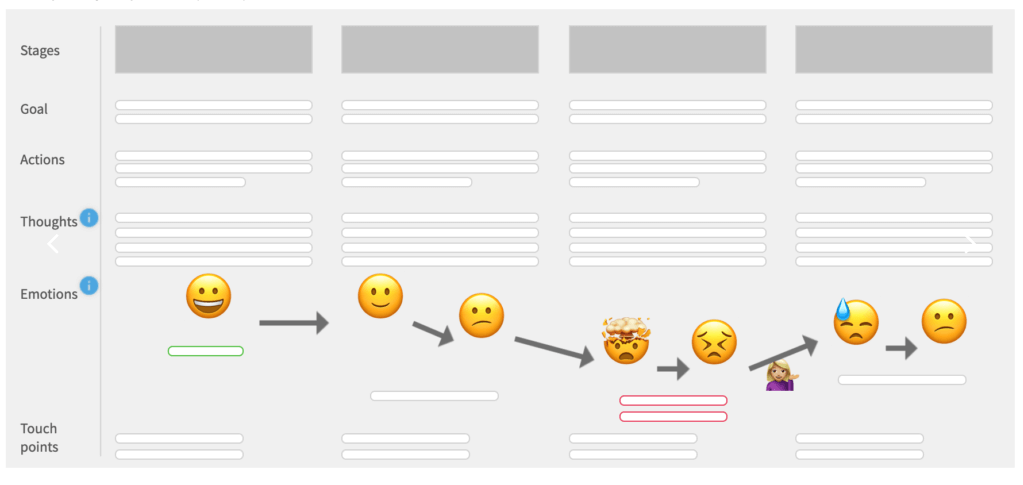
Example of a customer journey template - User Interviews.
There are tools out there to help you visualise the steps a customer will need to go through, and how they’ll feel when navigating around the platform. Check out this handy guide.
Where can you get this info? What worked for me - before we went onto automate parts of the journey when I was at Careercake - was to ask to speak with every new sign up over a month’s period. I wanted to delve into what they were expecting, what they needed to get sight of, and what frustrated them about the platform.
If someone has gone to the bother of signing up and trying your platform, you have no reason not to follow up.
Side note: You could also apply customer-led growth startup strategy to get these insights.
What are good metrics to work towards?
Don’t you dare say ‘daily users’… *shakes fist*
I’ve spoken about it before, you know, that time I was in a meeting reporting on our startup’s metrics which we based on Netflix’s.
Le cringe.
We were talking daily active users and monthly active users, without any really understanding of the context that someone was using our online learning platform. They were purely vanity metrics. They didn’t indicate if someone felt comfortable signing up and using the service.
Whilst there are many metrics you can use, I urge you to consider the context you’re in and what is a good indicator of someone ‘getting’ your product?
The stats that worked for us were based around the following:
Did they do everything in the onboarding checklist?
(For us, it was sign in three times and create a playlist).Did they renew and… keep using the service?
The latter is the most important part because…
RETENTION, RETENTION, RETENTION.
Optimise for your customers’ value and not the pre-made templates provided by the kit you just signed up to.
Yep, templates are nice but have you ever had a conversation with a customer and learned what really delights them?
Yeah, that is what you need to optimise around. It’ll help you with your KPIs too.
Hopefully, this latest rant has shown you that your onboarding process isn’t something to be left behind. Especially when you’re a startup - every new customer needs to be treated so carefully, each offers a new opportunity to learn but also to work towards product-market fit.
If you’ve any questions about this process, I offer startup marketing help for tech founders - feel free to get in touch - no question is daft or too simple. If I can help, I’ll help.