

An intro to startup branding for the skeptical founder.
No, PLEASE tell me more about the time you bought from one cold outreach message.
Why is it that some startups don’t really do brand marketing or rather, the founders fail to see the value?
I say ‘fail to see the value’, because I’ve been in one too many board meetings where the focus is on leads, leads, leads and a (heated) discussion about why they are not converting.
All the while, you’re sitting there trying to build a case for branding and how it could actually help you to convert some of those leads. But you don’t feel confident voicing this, ‘cos they’re all more experienced than you, right?
Having worked somewhere where the 100% focus was on lead generation I can tell you this is no way to market your business. It’s not sustainable. Revenue decreases year on year, the CEO gets frustrated with marketing, and from a brand perspective, you just look a bit tacky.
This edition I am going to try and continue to build the case for investing in branding marketing for your early-stage startup.
I’m not going to tell you to hire a brand strategist from Pepsi and sponsor the entire week at London Tech Week for your early-stage startup. No investor or CEO is going to sign that off, silly.
Truth be told, you don’t need that.
Just like you will iterate your product as you validate it with customers, you’ll iterate your brand too.
Why you should be looking at your startup’s branding.
Simply put, there are two reasons why you should be looking at your startup’s branding:
You’ll convert more of those leads you’re generating from your cold outreach activity
In a few years’ time, your revenue is going to be a lot higher than if you hadn’t bothered.
In his interview with Everyone Hates Marketers, Mark Ritson says that there’s not a lot of brand strategy you can do in the first few years BUT he does say that if you do invest in some activity, you’re likely to see better returns at the end of year four.
Some startups are waaaaaaaaay too focused on leads
I get it, money is tight, you’ve got only three months’ cash in the bank. Then, when your marketer comes in and starts talking about fluffy brand awareness newsletters you think, deep down, “is it too early for my first drink?” [Reader, it is].
But I think this is where marketers drop the ball. We can fail to communicate the benefits of brand marketing for their startup. We’re reporting on it all wrong, we need to be doing more to be taken seriously by founders.
Most of the buying process is done subconsciously
That’s why your brand needs to show a potential customer what you do, who you are, and why you’re right for them.
It’s the reason why you buy certain products and align yourself to certain products. Even if you operate in b2b, you’re still competing for an emotional pull. They’re human beings after all.
It takes 5-7 impressions for people to remember your brand.
That’s according to Failory.
It’s the reason why your cold outreach isn’t working and why your cost per acquisition is crazy high. You can’t just expect to send an email to someone’s LinkedIn mailbox and expect an instant response/sale. Where have you seen this work?
The 5 things you can do today to make your startup’s brand look bigger than it already is
1.Create a marketing boilerplate
This is a step I introduce to every startup I work with. Put simply, it is a selection of ways to describe your startup based on word count. (E.g. your 100 word description, your 500 word description). You’ll use this if you get featured in PR, events or if you’re doing joint marketing. It gives you a way to control your story.
Here’s how to write a company boilerplate from Composely as a guide.
2. Create your startup’s story
People remember stories. And, if you create your startup’s story around this framework you’ll make it memorable too.
Check out how to nail your startup’s pitch using Pixar’s approach.
3. Start writing down your positioning statement
April Dunford has a range of resources for companies working on their positioning. Complete the exercises here to give confidence to your team in articulating why your startup is different.
4. Set standards.
Create standards and stick to your standards. Standards make you look bigger.
Check out my previous post on why your marketer isn’t being a pain in the ass by asking you to use the right font to learn how standards build credibility.
5. Spend 60% of your marketing on brand and 40% on performance marketing
I’ve always followed a fairly similar rule and this stat is literally from Mark Ritson. Use it to guide your marketing activity. Use it to assess your spend on marketing on a quarterly basis.
Startup branding in action.
Case study: creating a brand for early-stage startup, Careercake.
I’ve written about my experience as part of the founding team of Careercake, an online learning platform that helps learners rise to, take on and beat the firsts in their professional career.
Today, Careercake’s content is available on LinkedIn Learning and reaches learners in over thirty countries. Careercake’s success didn’t happen overnight, it started off as the idea and YouTube channel.
A few years in, we saw a real opportunity to sell into HR and learning teams within the private sector. There was a gap in the traditional careers market for authentic, down-to-earth advice. But, as a YouTube channel that had a reputation for advice around writing CVs, we had our work cut out entering this new segment.
We were entering a market with some big players with some really great brands.
Our approach was simple:
A new identity that reflected the punchy personality designed for our customers (not investors).
A continued commitment to brand activity (e.g. speaking) but with a renewed focus on talking at events where the gatekeepers were and/or brands we wanted to align ourselves with.
Control over the guidelines. This was important. We had a font, colour scheme, and boilerplate full of our messaging. This gave us control of ensuring a consistent message.
Careercake’s branding in action:
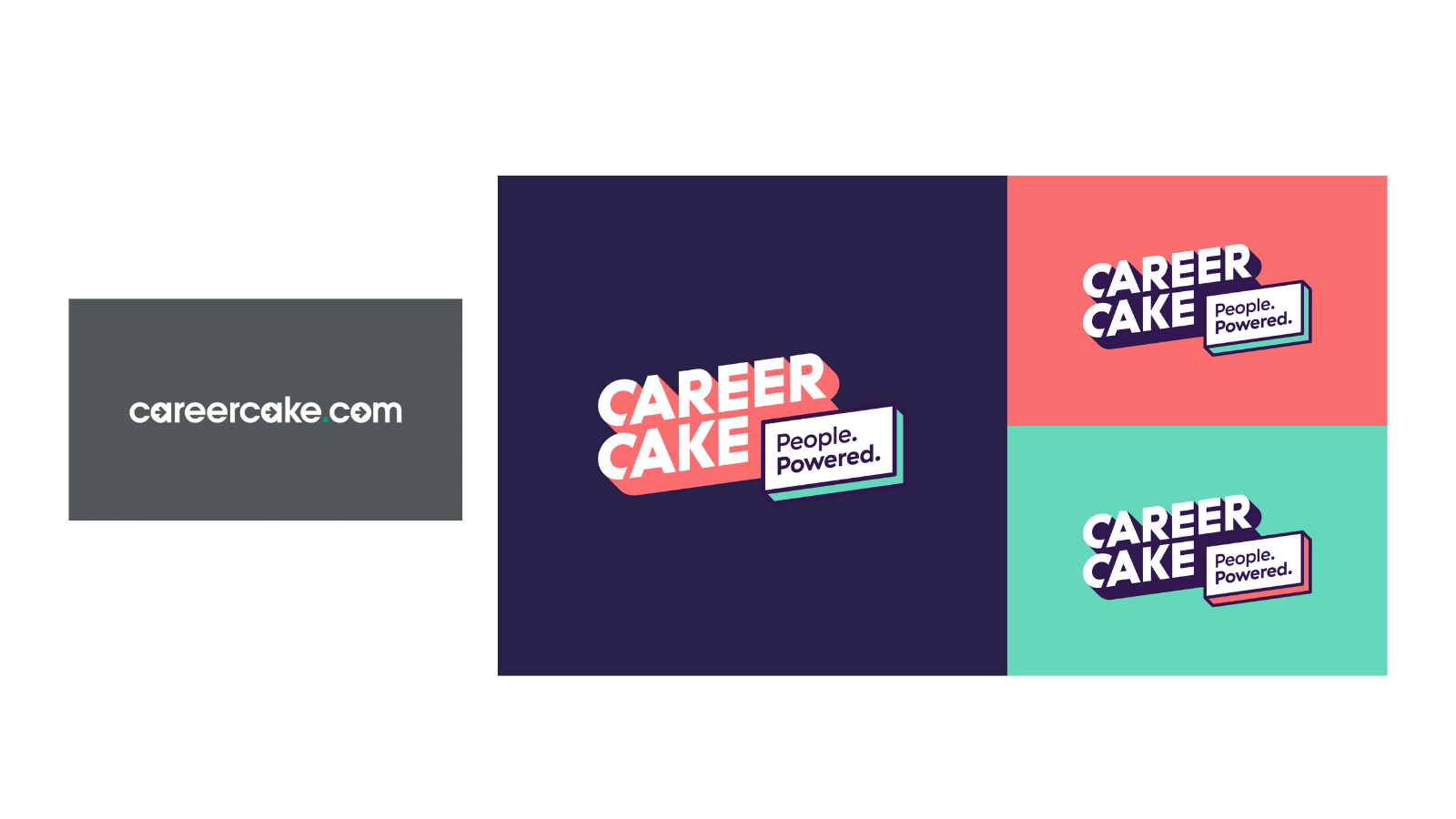
On the left, Careercake’s old identity. On the right, a much more punchier identity suited to the audience. Design by Bluegg..

Careercake’s style guidelines. Save them and send to partners to ensure they use your standards.

This is me (on the left) and Careercake founder, Aimee. With a well-designed logo, we purchased branded t-shirts and ‘looked the part’ whenever partners wanted to use the brand image in their collateral.
(Yep, we painted the wall the right shade of blue too).
The end result.
Of course success didn’t happen overnight, however, by using a proper designer, allocating 60% of marketing towards the brand in the right places, and being a pedant about how the logo should be used help us open up new opportunities.
These were all super simple activities that, by getting involved, helped us look like we had a team the size of our competitors. It all helped build credibility.
- We moved from selling primarily to the education market to the financial services industry
- The standards that were set meant we could work with brands like LinkedIn without having to tweak our brand assets
- We created a brand we were and are proud of. I still wear my Careercake t-shirt!
Summary
I’ve purposely not gone into loads of theory in this article on startup branding. The reason being is that I don’t think it articulates why a startup founder should invest in branding. It makes out like it’s a big project, something that’s really difficult to measure.
Early-stage startups are still validating their product, they’re still trying to fit product market fit. There’s still a whole lot of messiness going on. You don’t need a full on brand strategy, but you do need to set standards to build credibility within the segments you’re trying to enter.
Learn more about marketing help for startups based on actual founding team insight with my other articles.
