

Sorry, startups: your tech product is not the perfect solution.
Your product isn’t the sandwich, your product is the mustard.
Yep, you heard me correctly.
Too many startups think their product is the be all and end all; the thing that’s going to radically change their customers’ lives. But the problem is, that’s rarely the case.
Hear me out.
The other day I was listening to Circuit Breaker, the latest podcast from Bob Moesta and Greg Engle. In this one particular episode, Bob tells the listener “your product is not the sandwich; your product is the mustard. Your product can help a customer to make progress, but it’s not THE solution to their problem”.
It is most likely one of a handful of products that helps the customer to make progress.
I love this because it’s all too easy to get wrapped up in your product. It’s also a great way to unlock the age-old marketing advice: when it comes to effective marketing, you just need to be there at the right time(!)
You just need to be there at the right time: what that actually means and how to apply to your marketing.
Let’s say, for example, your product is an applicant tracking system (ATS) used by recruiters. Consider the other tools it needs to work with to help the recruiter to achieve progress (in this case, it may be to hire a great candidate).
An ATS needs to also operate with the following:
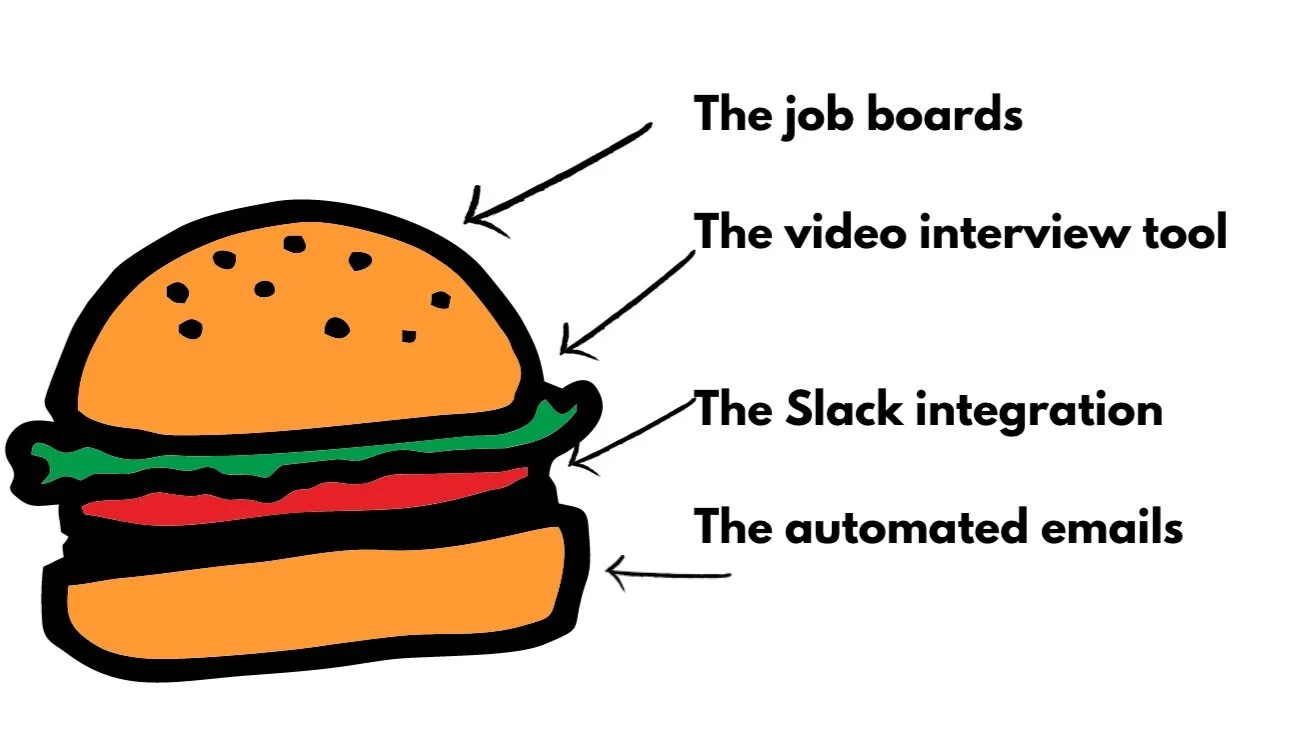
The job boards and job feeds to advertise the vacancy and attract incoming CVs
The video interview tool needed to interview remote workers
The Slack integration to collect internal feedback
The automated emails you send to candidates who’ve got the job
The part where you issue a formal contract.
Already, you’ve got five moving parts that your product needs to operate seamlessly with.
Next, factor in the type of business that would buy your product.
Perhaps they operate in financial services so they may be a little stringent when it comes to security.
Maybe they refuse to let employees download particular apps or software.
Or, let’s say, they aren’t allowed to use Zoom because their parent company has a deal with Microsoft Teams.
I could go on.
Look at the interview tool, the ATS, and the Slack integration - they’re all the mustard. Or, the tomato or burger… Each plays its own part to create the ultimate experience.
If, at any part of the process, one of these tools or factors gets in the way of progress, they immediately cause the customer to stall.
So, consider all of this and tell me, do you still think your product is the only product a customer needs?
Your product isn’t used in isolation.
Your product isn’t going to solve all your customers’ needs.
The customer has to make a series of tradeoffs to sign your contract off, whether you like it or not. Moesta and Engle in Demand-Side Sales, talk about the reality that all customers have to make trade-offs. And that’s why the perfect solution doesn’t exist.
It’s not all bad news. Your product isn’t the only one that your customer will make these tradeoffs. Nor are these tradeoffs reserved just in a business setting. We all compromise.
But the good news is, that by realising this and talking to customers and learning exactly which other tools you’re working with… you can start to open up potential marketing opportunities.
You can start to learn where our customers are, partner with the right people, and…. drum roll please, be there at the right time.
I’m going to talk you through how.
Break down your customers’ workflow by solution/tool
I’ll use another example based on the time I signed up to Hubspot.
Context: I was a marketing manager supporting a sales team of around 15 people. As a marketing team our target was to generate leads (of course). A lot of leads. We had good distribution channels in place, getting the leads in wasn’t really the issue. What was the challenge was we had no system to collect these incoming sign ups, no lead scoring. Everything was kept in a spreadsheet.
Spreadsheets, ammirite? *shakes fist*
Whilst I was looking to generate qualified leads for the sales team to close, deep down I was trying to build a case to reduce the number of leads and focus more on increasing conversion rates.
Here’s the tools I was using before signing up for Hubspot:

Example of my workflow when trying to achieve my goal of attracting leads for a marketing campaign.
Applying this to your own startup’s marketing:
Already you can see that I was using five tools before (the designer, Spreadsheet, Wordpress, Mailchimp and Salesforce). Hubspot would eventually come in to replace the spreadsheet and Wordpress for us.
Each tool - be it Mailchimp, Salesforce or Wordpress - each had to complement the other to ensure my process was seamless. They weren’t the entire solution (aka, the sandwich), they made up one part of a very complex jigsaw.
In Hubspot’s case, they can see how to position themselves. They were reducing the friction of using spreadsheets. They integrated with Salesforce. It offered ‘better’ more intuitive tools for me to create landing pages and optimise them without having to annoy the designer every five minutes.
As a marketer for Hubspot, for example, I can see a number of opportunities available to me from this exercise.
The most obvious is partnership opportunities. I could approach Canva, Mailchimp or Salesforce to explore potential marketing partnership opportunities.
Okay, okay, I can hear you saying - “well, how do I do that? I’m just a small startup”.
Here’s how I would approach it.
Think about Canva, Mailchimp and Salesforce as the tier one brands. They’re not the only brands out there. Each has its own competitors, which support marketing managers with similar challenges. Approach these for join partnership opportunities.
Try searching for “Canva + Salesforce” or “Competitor + Competitor” keywords and see what types of content comes up. This may give you some inspiration for content to create for your marketing materials, positioning, or features.
Look at their audience: are they problem aware or solution aware? This insight will give you an idea as to how to position your language.
How this can influence the channels you use too
There are many channels available to us startup marketers, many of which can be grouped by sentiment - or, rather the sentiment of the search. In fact, I’ve spoken about how to drive startup growth by choosing the right marketing traction channel before.
I reference Hockenmaier and Rachitsky who talk about the three lanes that make up the majority of new customer acquisition. These lanes are: performance marketing (Facebook, Google Ads, LinkedIn), content marketing (YouTube, SEO), and viral marketing (referrals).
I’m not saying copy your competitors, however, what I would recommend is looking at these complementary tools a customer is using in conjunction with (potentially) your product to unearth ideas for channel usage.
For example, let’s say Salesforce is a tool that is used as part of the total solution (aka the sandwich). Here are three ways you can use this intel for your marketing ideas:
Middle of the funnel: if you have an API or feed that integrates your product with Salesforce, ensure this is listed on your product pages.
Middle of the funnel: ask a customer to talk about their experience of integrating your tool with Salesforce to get over any objections.
Top of the funnel: look at Salesforce and identify the lead magnets they are using. Are they relying on whitepapers or webinars? If so, it is likely that the content marketing traction route may be a good bet to look into.
Summary
It’s all too easy to become consumed with your startup’s product. To think that your customer comes into work and dreams up all different ways they’re going to use your product, how they are going to fight for it to get it over the line.
We know that’s not the case. There’s a reason why your product is not the perfect solution for your customer. We make trade-offs every day. The key for startup success is knowing this, understanding the eco-system you’re operating in, and how to position your product against the anxieties your customer may have.
