

What type of marketing does your early-stage startup need?
Hiring your first marketer for your startup isn’t just a big decision, it’s a strategic decision.
I’ll talk with startup founders who confidently tell me they’ve got a part time intern to help them “manage the socials”… thinking that’s marketing.
They’ll ask this poor marketer to post on every platform, they’ll balk at the idea of going on TikTok, and then they’ll get annoyed when ‘nothing comes through’ or a message isn’t written the way they would have done so.
This isn’t me starting a beef with interns, honest. Rather, I am trying to make the point that marketing exists in many guises. And the marketing strategy you operate and the channels you use to reach customers can and will depend on a whole host of factors.
Don’t worry, I am going to talk you through what this looks like using the startup I worked at.
The question isn’t when should you hire a marketer… the question is, based on the stage your startup is at, what type of marketing should you consider?
The evolution of what type of marketing our startup needed
- a case study with examples.

I’ve attempted to visualise the marketing activity I was involved in as we built Careercake, from the ideation stage to the customer creation phase. The idea is to show you that different types of marketing kick in as you learn more about your customers and your market.
A few notes to focus on before we dive in:
The phases are aligned to those created by Steve Blank in The Startup Owner’s Manual.
I’ve also shown where the product development came in to highlight that marketing has to happen at the same time as you build.
The types of marketing didn’t just finish completely and move to the next phase, rather, this image is to show you how our emphasis changed.
Initially, our business model was around optimising for users over revenue.
This worked for us but I appreciate there are many models out there.
I’ve got a startup marketing template if you want to jump straight there.
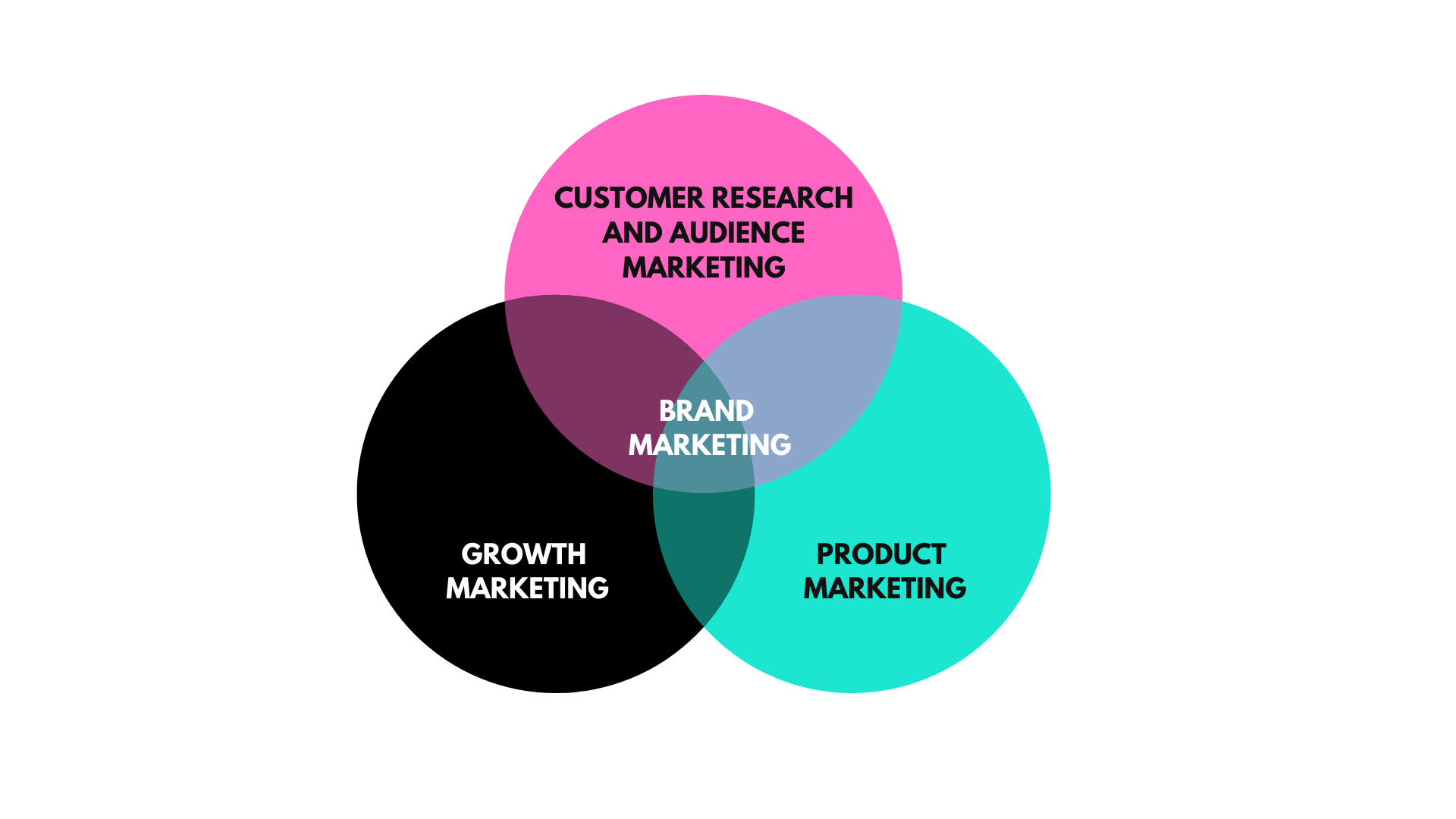
Behold, the venn diagram of marketing awesomeness.
A super quick way to show you it’s all connected. Each type of marketing impacts the other.
The four marketing activities that helped grow our early-stage startup.
Customer research and audience marketing
Product marketing
Brand marketing
Growth marketing
Customer research and audience marketing
Aim: to find customer segments to identify if there’s a problem that actually needs to be solved.
When you need to use it: when you’re pre-revenue, have no customers, and lack the real data behind why someone would buy from you.
Marketing doesn’t really exist at the problem validation stage. And so, my emphasis was around conducting customer interviews to identify whether there was a need for Careercake and validate the founder’s assumptions.
We’d conduct 10-15 interviews every fortnight with people we felt where representative of our ideal customer groups, with the aim of understanding if there was an appetite for our offering and what the problem was with current solutions. To build the list, we’d use a combination of research on LinkedIn and Twitter as well as asking for introductions within our networks.
Lucky for us, people were genuinely happy to help and get involved.
We learned some great lessons. Firstly, ignore the hype. We needed unbiased - or, at least, as close to unbiased - views as possible. We also opened up some great conversations, such as the problems people felt existed with the learning industry and how to best position our brand as a result.
We also learned that our TAM wasn’t as large as we thought it would be which would then go on to have implications on things like our customer acquisition model.
With the findings, we then created a series of tools to help the founding team and investors share with potential customers. These included:
Pitch decks for different segments
The story of our startup, including messaging boilerplates (which would later go on to form our positioning)
A website landing page with a few pages aligned to the level of awareness the market had
Lead magnets to capture the initial interest.
Whilst this was happening, I was also involved in audience marketing to better understand how your potential customer may buy.
Competitor research is a good starting point to learn about the channels people use (e.g. do they Google search your product type or do they click ads on Instagram?) It’s also a good way to start mapping out how customers buy your product and how they use it.
It wasn’t available then, but I’d totally recommend using SparkToro for this today.
2. Product marketing
Aim: retain users coming in; get a feel for what they are hiring your product to do.
When to use it: when you’ve soft launched your product, and you’ve got beta testers and a few paying customers.
After the launch of Careercake’s platform, which came complete with a free 7-day trial and the addition of another 50 new videos to the platform, my focus changed to retention. This focus meant I naturally started to focus on product marketing.
Why product marketing made sense at this point:
We wanted to focus on retaining users before we turned the advertising tap on.
We wanted to work out the kinks in the product. We were a 2 person team, after all.
We needed to work out whether our choice of customer acquisition mechanism would work (e.g. free trial vs, freemium).
We wanted a level of certainty around our go-to-market strategy.
The aim of this stage was to see if we could influence how people signed up, watched our content and shared it. It was all about understanding adoption.
This was strategic from our perspective. We knew that operating in a market that sells to HR/L&D is really tough. Not only are you trying to get the managers on-board but we also need to find ways to increase adoption by the employees.
Day to day, product marketers typically are involved in both strategic and tactical activities. Here’s what I got involved in:
Messaging and positioning (message market fit over product market fit).
More customer interviews and audience research. Here we dipped our toe into Jobs to be Done.
Sales tool creation - e.g. landing pages, brochures, playlists.
Customer acquisition - free trial testing and onboarding.
Pricing.
Creating content - website pages, lead magnets, ghost writing, articles for partners.
Reporting on customer segment use. E.g. Does this segment convert better than the other? What’s our free trial conversion rate? That kinda thing.
Here’s a job spec from UserPilot I would recommend checking out to see if this is the marketer you need.
3. Brand marketing
Aim: to build the brand to give it the right level of credibility, to help enter new markets, and to show you’re a proper business.
When you need it: early on. You’ll need this up and running before you start with performance marketing.
Hopefully you will notice that in the diagram above, brand marketing kicks in pretty quickly. I’ve done that intentionally. I’ve also written previously about the importance of looking at your startup’s branding before.
There are two reasons why you should be looking at your startup’s branding:
You’ll convert more of those leads you’re generating from your cold outreach activity
In a few years’ time, your revenue is going to be a lot higher than if you hadn’t bothered.
I’m not saying you have to invest a ton of money in branding because as you learn more about your customer, your brand will also change.
Investing in our brand early on opened the doors to new markets.
Whilst other startups in our sector were worrying about the cost of using a “proper designer”, Careercake went in and committed to great design. It was a decision that paid off. Later that year, we were lucky to secure a large financial customer as a client.
It was also important because… no one bloody knew who we were! You’ve got one chance to make a great first impression, and if we wanted to be seen in the same leagues as our established competitors, we needed to seem to be as sharp.
If I was to do this startup thing again, I would find the money to get a decent designer. But using a good designer is half the battle. You need that person to be the custodian of the brand, to pick people up when they don’t use it correctly. A consistent brand tells customers the left hand is talking to the right hand.
The type of activity I would be involved in was largely around:
Working with a designer to create the brand and assets. This was important because once they had provided me with the right formats in the right files, I could simply drop them into Canva and create my campaigns effortlessly.
Top of the funnel activity - e.g. talking on podcasts. Careercake would get a LOT of requests to talk on webinars and podcasts. We needed to be strategic about which to appear on and why. I’ve heard people say exposure doesn’t pay the bills. That may be true, but by aligning your brand with another that your customer uses - I believe - helps with conversions.
Partnership marketing. This was a great way to get in front of new audiences and test messaging.
4. Growth marketing
Aim: Identify which scalable and unscalable channels worked for us.
When you need to use it: only when you know who your ideal customers are, what your value proposition is, and you’re prepared to assign budget to start testing.
The thing with working in a startup under the lean model is that you have to work for every single penny. And so exploring potential channels was governed by this premise.
How did we choose the right channels?
We knew we had to find the right balance between scalable and unscalable channels
We knew we were still channel-led before even contemplating moving to a product-led model
We chose our channels by the ‘sentiment of the search’.
Growth marketing requires someone who loves and can execute on testing, optimisation, and data analysis. The marketing that had happened so far helped me to get an insight into how our customers may buy a product like ours.
For us, our channel-led approach involved SEO, YouTube and partnership marketing to drive traffic and conversions. The partnership marketing, whilst it was an unscalable channel - e.g. took a while to get it up and running - helped us to achieve a few quick wins whilst the content created via SEO and YouTube kicked in.
Understanding what channels work and what the payback is takes time. It wasn’t an immediate result for us. There are nearly 20 marketing channels available. If you read my post on how to drive startup growth using the right traction channels, you’ll quickly realise there’s strategy behind picking the right ones.
For the channel work, I had previously launched a content strategy involving SEO and marketing automation, so I was comfortable leading on this. Whilst we were testing and waiting for SEO to kick in, we used an agency to help us with the link building and also testing on Google Ads.
By the customer creation phase, we were using four channels that were largely driven by content marketing. These were SEO and YouTube, partnership marketing with LinkedIn, and organic social media.
We never got to the company building stage of Steve Blank’s model. But that’s because our focus was on validating a sellable startup idea - one that an established company could leverage. That actually came true recently, with news that SocialTalent - the world’s leading e-learning platform - acquiring Careercake.
What our startup’s marketing process ended up looking like

Visualization based on Lean Analytics.
I’ve attempted to show you what the customer journey looked like and how each function comes into play and impacts each other.
The model is a SaaS model, and shows the following:
brand, audience and customer research marketing impacts every stage
our channels - SEO, YouTube, webinars, events and a partnership with LinkedIn Learning were the mix of channels we used to drive users
What did we focus on?
For us, we worked on ensuring the free trial to paid conversion rates were where we needed them before my attention turned properly to growth marketing. That would be my main piece of advice here. Think about their experience whilst in the platform, sort out the bugs, ensuring your messaging is in line with what they are expecting… then turn on the advertising budget.
Resources to help you understand what marketing your early-stage startup needs
What traction looks like in an early stage startup
How to become a T-Shaped Marketer
How to create a marketing plan for your early stage startup (part 1)
Hire marketers: how to hire and fire good ones
Growth strategies to help you reach product market fit
Lean Analytics - Croll and Yoskovitz.
The cheat code: How to make it really work when choosing the marketer(s) for your business:
Think about what stage your startup is at. This will determine the output required by marketing.
Consider the type of marketer you need. There’s no need hiring a CMO-level candidate if you’re not going to give them a budget or a team.
You, as the founder, have to support and commit to marketing as well. That means listening to your marketer and adhering to standards.
Understand that you need to give them a budget.
Put all your misconceptions about marketing to one side. It’s different in a startup, baby!
