

Go to market strategy vs marketing strategy - which do I need?
Updated on 26/06/24
I remember the moment I realised I needed go to market strategy rather than a marketing strategy.
I’d just joined a startup, having previously served as a marketing director in an established business. (This distinction is important, reader).
I rocked up on my first day with these big plans for driving revenue and establishing this startup’s brand. Yet, when I went to implement a lot of the work, much of it didn’t land in the way I wanted it. I was able to drive traffic and sign-ups, however, when it came to those users staying around… it was clear there was a big disconnect.
My focus was on leads, leads, leads. Which now, seems a bit bonkers, because to have a focus purely on lead gen assumes that you have everything else in order. It assumes that the product experience is set up in a way to nurture sign ups, and you’ve got the right comms going out to position your product in a way that customers realise they were right to subscribe.
I was trying to fit a marketing strategy into what really should have been go to market. There were no repeatable processes for me to use because… quite simply, they hadn’t been set up yet.
There’s a saying when it comes to marketing - you can’t polish a turd. This assumes that you can throw as much money and effort at your marketing, but if the baseline strategy isn’t in place or the product is a bit naff, you’re wasting everyone’s time.
If you’ve not considered how to enter a new market/launch a new product - you’re driving new enquiries to a disconnected offering - maybe it’s time to learn the difference between marketing strategy and go to market strategy.
Go-to-market strategy vs marketing strategy: what’s the difference?
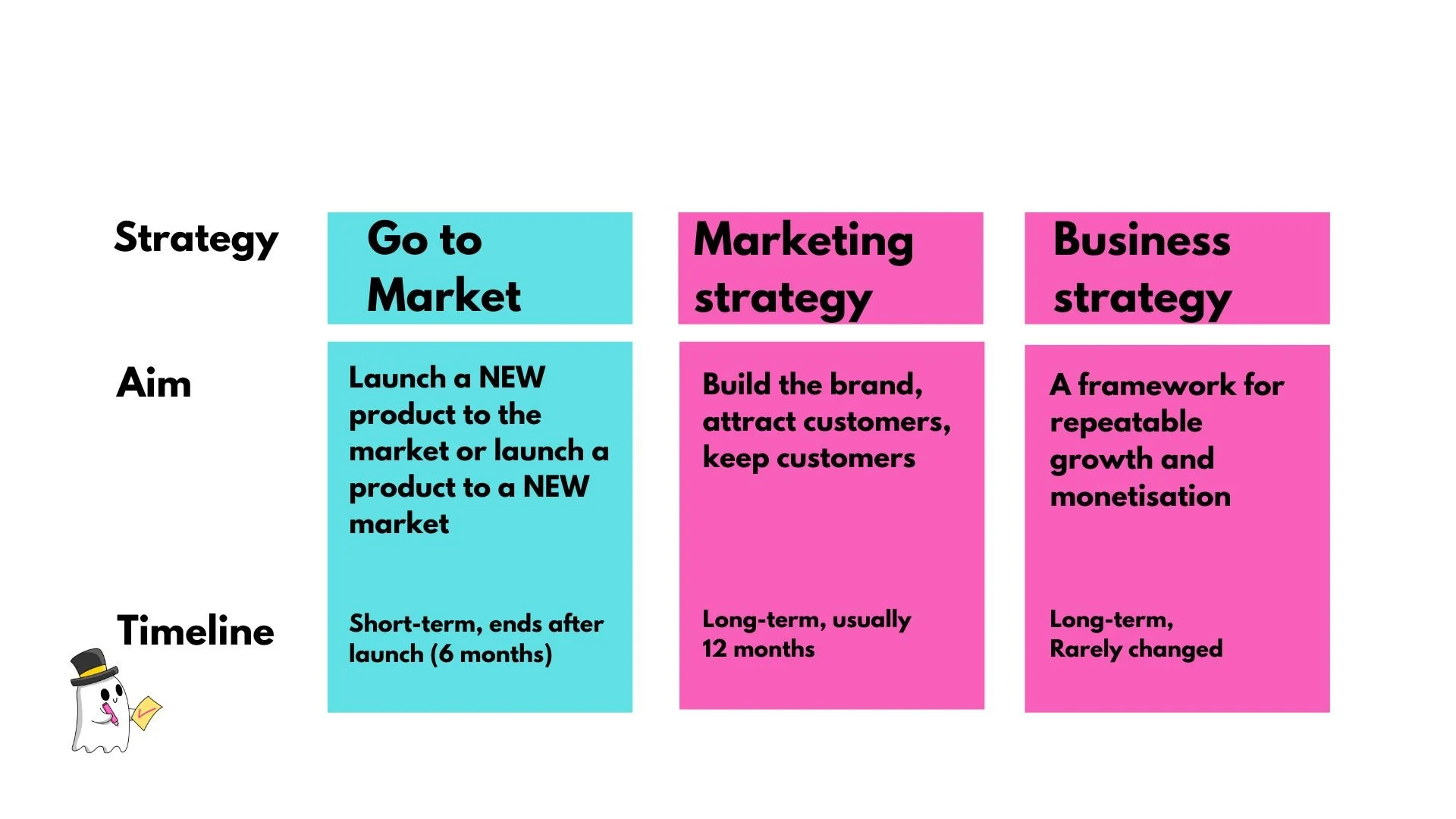
In the blue corner we have the go-to-market strategy.
Go to Market strategy is all about the new.
Put simply, it’s about launching a new product/service into an existing market OR launching an existing product/service into a new market.
It involves:
- identifying and finding the right customers
- building channels to reach and sell, repeatedly
- implementing the right processes to build sustainable growth.
Unlike marketing, go to market is about the strategy that connects your product, channel, customers, market, and brand. It typically lasts 6-9 months, and involves a lot of validation work with the aim of absorbing parts into your repeatable marketing processes.
Validating the need for a new product is all about understanding whether there’s a problem that needs solving, and whether people are currently spending their cash to solve said problem. (And there’s a business model that can support it, of course).
And in the red corner we have the marketing strategy.
Marketing strategy is all about brand, customer attraction and retention.
It’s a longer-term play - around, on average, 12 months - and it assumes that you’ve already launched and you’re focused on building demand for the product. Whilst a lot of its focus is on developing repeatable growth by developing campaigns, key messaging, and content, it doesn’t always get involved in the validation piece nor looking at the product as much.
But here’s the clincher, if you’re an early-stage startup, chances are the version you have - or need - is a combination of both.
👋 Love the blog but need actual human help?
Don't you worry. Beyond the free advice, I work directly with early-stage founders to sort out their growth. You can bring me in as a fractional CMO to build and grow your foundations, lean on me for a methodical approach to see if there's a market for your product with my startup validation services before you spend a fortune building the wrong thing, or design a custom go to market strategy to launch aligned to the stage you're at.
What’s included in a go to market strategy?
These are the main areas of your strategy.
Market definition
Customer segmentation
Value proposition
Competitive analysis
Distribution channels
Pricing strategy
Sales and marketing
Revenue and sales goals
People and processes
Metrics and KPIs
What’s included in a marketing strategy?
Situational analysis
Objectives
Segmentation
Tactics
Actions
Control
Where does go to market strategy fit in the business growth stages?

These are the stages a business will go through as it develops, according to Brian Balfour and his thoughts on startup lifecycles.
You’ve got the traction phase - also known as searching for problem market fit.
You’ve got the transition phase - the chaos known as searching for product market fit.
And you’ve got the growth phase - think of this when you’ve scaled and you’re diversifying and adding new products.
The thing is, go to market exists at every stage because of the principle of introducing “new”.
Unsurprisingly, however, the guise it takes at each stage is very different. The metrics, deliverables and actions are different.

About the Author
Lucy Heskins
Growth advisor and fractional CMO who helps early-stage startups scale without the usual tears, tantrums, or burning through piles of investor cash. When she isn't shouting into the void about product validation and go-to-market strategy, she's usually sharing brutal-but-fair startup marketing reality checks on LinkedIn.
