

Before you say “no” to a marketing channel for your startup, consider this.
Before excluding a marketing channel, consider whether you have a low-touch or high-touch marketing funnel. Only then can you have an opinion about what’s fluffy and what ain’t.
“I want marketing, I just don’t want any of that fluffy marketing”, said a head of product to me the other day.
“What’s fluffy marketing?”, I ask.
“You know. Newsletters”, he says.
“Ah, newsletters, eh?” I start thinking to myself: Not newsletters, surely? The part that nurtures those prospects not ready to buy. Prospects - I’ll add - that you spent a good proportion of money on, building a list and running your sales outreach to. The audience that you’ll likely ask to “jump on a quick call” when you realise you’ve no idea what to put on your home page or campaign.
The head of product continues. “Well, not newsletters, but things like branding. I listened to a podcast and was told branding is expensive, oh, and you can’t report on it.”
“Brand stuff, eh?”
I think further, stroking my chin: Surely you don’t mean the part that tells your market the right hand is talking to the left hand, that you’re not some cowboy company, you’re professional. And he can’t mean the part needed when your ideal customer realises you actually offer the same features as your competitor.
I continue. “Got ya. Out of interest, what does good marketing look like to you?”
“Sales. Demo requests. Conversations with people who are ready to buy. My focus is on the product, I need you to get me demo requests and sales-ready leads…”
Bingo. I think we may have got to the potential route of the problem.
Reasons why some startups say “no” to a marketing channel or tactic.
I find the above tends to be a common problem from non-marketing founders. It’s not their fault; look around.
There’s a lack of understanding that those first founder-led customer sales will be the combined effort of sales AND marketing. Actually, that’ll be the case for a long time.
We’ve also got non-marketers calling the shots in marketing-focused conversations. They’re the ones who will say, “oh we’ve tried that, it doesn’t work”.
And the big one… a misunderstanding of whether your SaaS model is high touch or low touch. This will help determine if that newsletter is coming out…
There’s also a misalignment with the stage a startup is and the marketing they need. Let’s say you’re raising seed investment. The marketing your startup needs at this point is going to be hugely different to that when you were pre-revenue. Steve Blank, in the Startup Owner’s Manual, tells us that at the very early stages of customer discovery, marketing doesn’t even exist.
I respectfully challenge the language with this; it doesn’t exist in the guise we’re used to. It’s not all Barbie's $80million budgets, ya see. But, as marketers you can’t take offense to a comment like this, either.
Take a step back and look at what’s blurring the lines and making growing a startup harder than ever.
We’re told we need marketing, but we’re not told why we need it.
We’re told we need sales in, and anything that doesn’t ‘look’ like sales is a distraction.
We’re told we need to talk to customers, but we aren’t told what to do with the information.
Oh-KEN, then.. What do we need to do?
If you’re engaging with a marketer for your startup for the first time, it’s likely that you’re going to be in the problem-solution fit <> product market fit phase.
To determine what type of marketing you need for your startup, we need to use a little theory. A great way to think about it is to understand if your startup’s product is high cost or low cost. This ultimately will determine the channels you use and what level of ‘human’ is needed.
Low cost versus high cost - which is your SaaS?
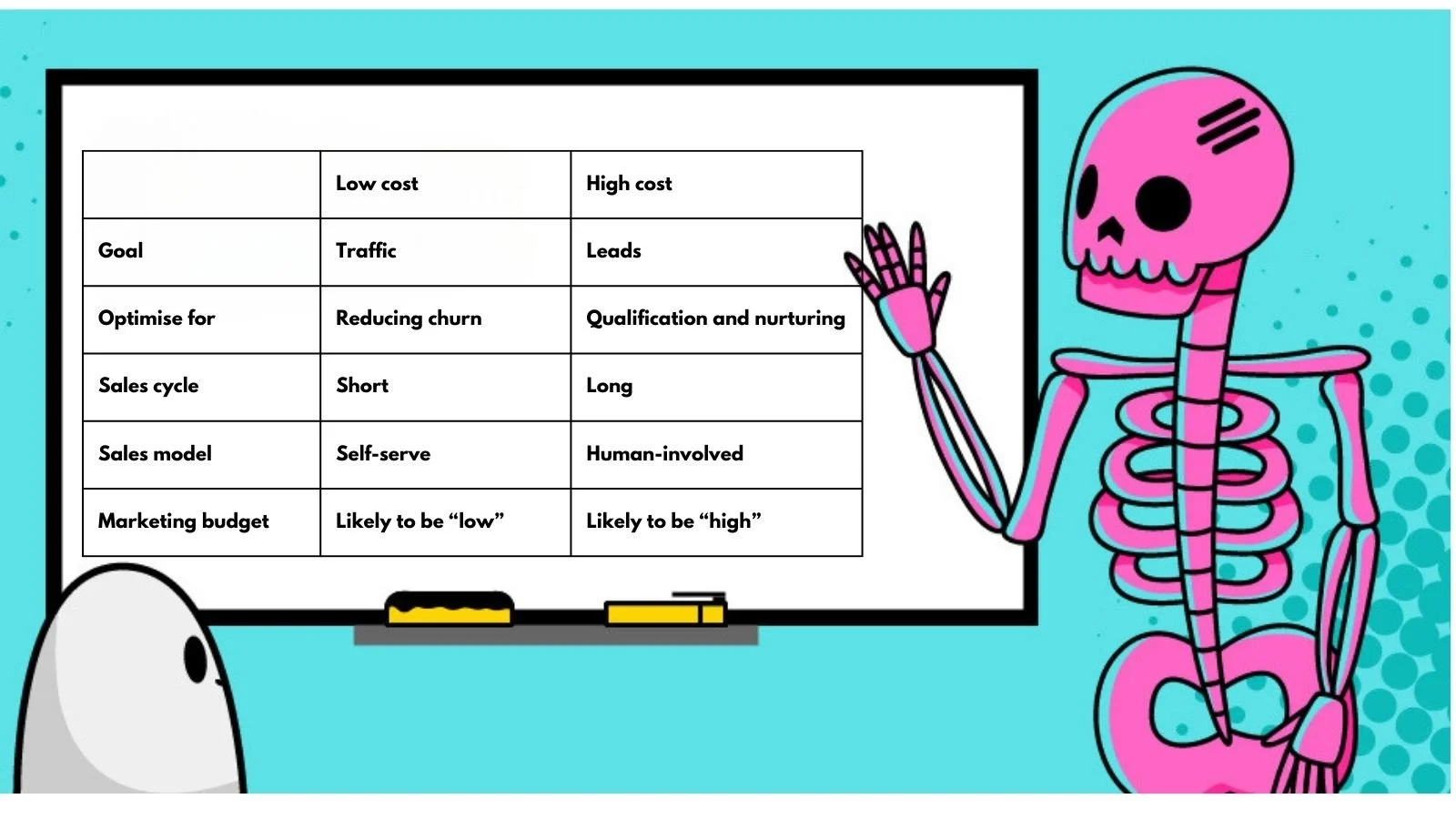
What about the newsletter, where does that come in?
Well, it’s all to do with what happens to the traffic when they hit your site and how a sale is closed. In a low-cost, low touch model, a newsletter is likely to be a crucial part of the puzzle. It’s a way to automate comms for many people.
What a low-touch SaaS model looks like
Let’s say you’re a spelling app. To sign up and use the product, you don’t need to interact with a human. The product is offered on a self-serve model.
By its nature, users in this setting are very likely to churn. It’s very unlikely you’d rely on a human to contact people at risk of churning for a £10 product.
You know what you would do? Consider tools that will remind those who have signed up to a campaign or register their interest of the value you deliver. One of which could be a newsletter tool. Check out these SaaS email campaigns for inspiration.

What a high-touch model looks like
What about if you offer an expensive, enterprise- level solution? Well, you have a slightly different funnel to think about. High touch means generating leads, via outbound and inbound channels, qualifying who is the right fit, presenting a demo and then bringing them on board as a customer.
At any point during this process, a prospect can fall out of the funnel - they may change their mind, put the process on hold, choose tact. Again, consider this and then actually which tools do make sense as part of your startup marketing template and plan.

Summary
Okay, so a lot to think about. My aim for this article was to challenge you if you’ve recently thrown an idea to one side without considering its strategic value.
The example I provided at the beginning has actually happened to me on four occasions. It’s usually a result of a misunderstanding from the business leader’s perspective. But it’s also sometimes the marketer/growth person, recommending a tactic with no justification.
Here are a few articles I would recommend checking out if you’re that startup about to start working with a consultant or agency:
The Rules of Play(book) when working with an agency to grow your startup
How to be strategic when creating marketing content for your business
