

Marketing not working at the rate you want it to? Sounds like you’ve got a Dan problem.
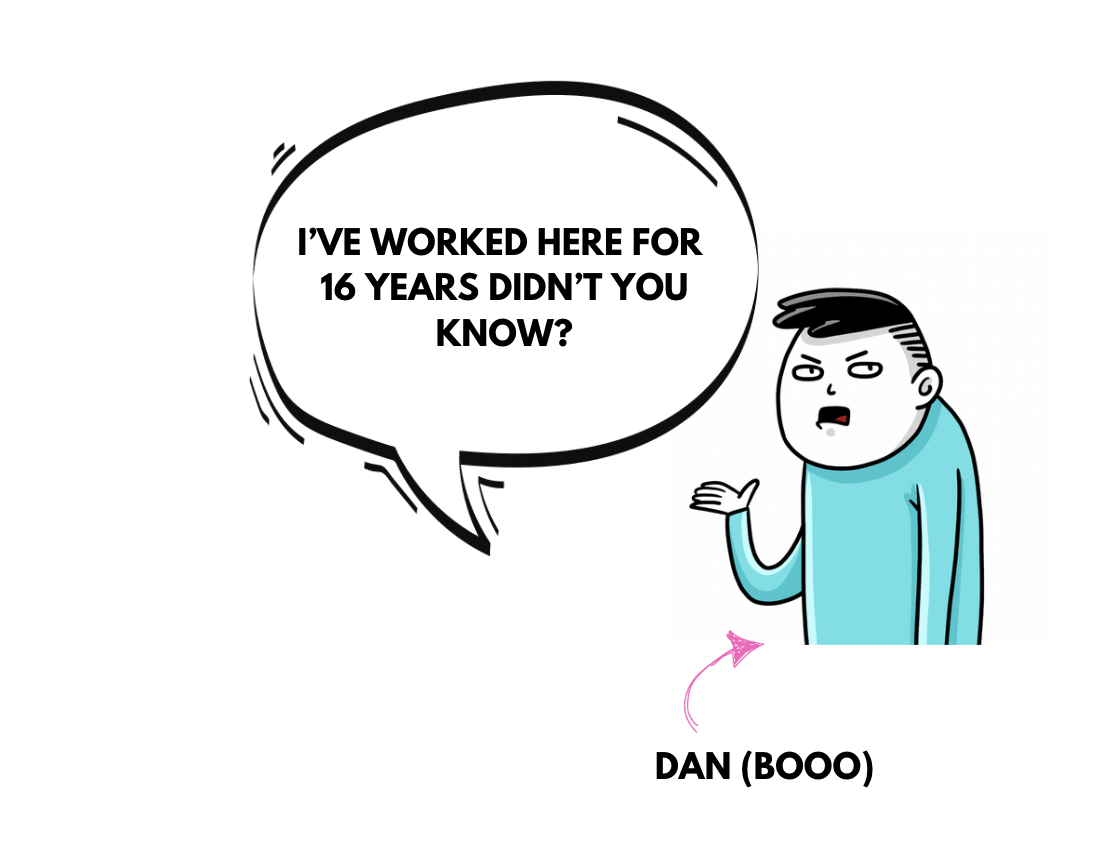
Meet Dan. Dan’s a big headache for marketers like you and me.
He’s been working at a company for sixteen bazillion years, and because of this - and, 'cos he has the ear of the MD - he gets to influence what features are built and whether marketing is working or not.
It’s likely you may have presented an idea for a growth sprint or a different way to look at engagement data. But he’s flat out said no because “we’ve already tried that and it didn’t work”.
Unfortunately, we’re not always fans of Dan.
Dans are the reason we, as marketers, spend 70% of our time explaining what we do and only 30% actually implementing.
No wonder we’re exhausted. Thanks, Dan.
A while back, I was speaking with an organisation that had big, grand plans to hit £1 million in revenue within six months. For context, that would have been a 4,900% increase.
They’d been around for a year or two, dabbled in marketing, and tried to AI prompt their way to a marketing strategy… but nothing seemed to land and they did what many do, retreat back to perfecting their product.
They told me marketing just wasn’t sorted.
They’d tried paid advertising, but it didn’t work.
They said they’d spoken to customers, but that didn’t work either.
They’d also tried a webinar campaign but Dan said it didn’t work. So they didn’t try it again.
Every attempt at developing a B2B marketing strategy had been derailed because the results they were expecting didn’t materialise within their desired timeframe.
Marketing was seen as just a series of failed attempts at cold outreach and advertising. (Which, as we both know, isn’t marketing.) No mention of client definition, no awareness of who they were actually competing against.
At this point, you’d think: red flag alert, right?
Marketing was already on the back foot, competing against:
A team who thought ChatGPT could just create stuff
The belief that you can switch on a magical lead tap without learning from past experiences
The opinion that marketing is fluffy; it’s less tangible than an opportunity appearing in Salesforce or a new feature being added.
Sound familiar?
We know that marketing isn’t fluffy.
It only becomes fluffy when you can’t articulate how it fits within the sales process.
It becomes fluffy when you can’t explain why a customer would switch from what they’re using to your product.
It becomes fluffy when you recommend the wrong tactics - ones suited to a different business stage.
And you know what fluffy means? Ineffective.
So, how did I navigate this conversation (and how could you?)…
How I’d approach their b2b marketing strategy conundrum:
Let’s say I’d decided to work with this organisation. Here’s what I’d be looking at (keeping in mind the stage they’re at):
Optimise what’s working before even thinking about lead generation.
Combine marketing, product and sales efforts. (Gasp! Sorry, Dan)
Re-think the data you’re collecting so marketing can “do stuff with it” (With examples).
1) Optimise what’s working before you even think about lead generation.
Want to save money and get better conversions? Of course you do. Silly.
If you’re uncertain about what works and why, and you don’t have the data to back up which customers are actually paying you and returning… you need to build an understanding of what good looks like.
Start with the basics. And yep, you’re going to have to ask Dan for some reports.
What’s your retention rate by cohort?
If you offer a free trial, which cohort isn’t converting as well as it should?
How much is each customer worth to you - and how “easy” is it to convert them?
Are you posting on social media just for the sake of it? (And are your sales people cringing at what’s been posted on a weekly basis?)
Are you sending welcome emails and then doing nothing with the replies?
Are you cold-emailing, adding the leads to a spreadsheet, and then forgetting about them?
This stage can be pretty data-heavy and can expose some big gaps.
How you might apply this:
Look at each stage of the customer journey—from problem awareness to evaluation, trial, and repeat spend. Where does marketing fit into nurturing behaviours?
Assess the metrics you have and what’s missing. Build a Looker dashboard (or similar) to start tracking activity from impressions to repeat sales.
Gather insights on your ideal customers and ask product/dev to run reports on how different cohorts interact with sales, marketing, and product.
2) Marketing, product, and sales need to work together
Last night, I heard this ever-so-clever chap called Seth Godin* describe a brand as the promise you’ll deliver the value proposition you said you would.
Call it growth if that makes you more comfortable, but marketing needs to have influence and control across the entire customer journey. Especially in B2B sales, marketing, or services. Which means it needs to work with product/service and sales. And you know what this means? Getting some united KPIs my friend.
It’s the only way to build some strong foundations to increase that retention marketing you read about. Here’s a starter on metrics you may want to think about.
If you exclude marketing and let Dan run things, then you can’t complain that existing business is down or upgrades are lacking if marketing has no say in the onboarding process or retention.
Nor can you can’t get frustrated that your customer data is rubbish when you wouldn’t let marketing collect the right data at sign-up.
I’m not saying marketing should dictate everything. But if their main objective is delivering the value you promise - whether through sales, market expansion, or something else - they need a seat at the table and they need your backing, not Dan’s.

*Haha, of course, you know one of the most famous marketers out there. Fun fact: Seth Godin actually started out in product. So you have to listen to him, right?
3) Re-think the data you’re collecting on prospects
“We can’t add that field to the sign-up process.”
“We have data on email addresses and login dates…”
We’ve all been there. You try to optimise, ask the dev team for data, and they export a spreadsheet that looks like this:

They think it looks fine. You’re crying inside.
When I say the right data, I get that it can be subjective. But here’s what I’d be looking for—beyond your usual campaign-level marketing metrics.
What are they switching from? (Hint use Jobs to be Done here).
This insight can inform sales and product.
If your sign-up process is short, use this data in onboarding to direct them to relevant workflows.
If your sales process is long, use it for email nurturing to reinforce your value proposition.
Where are they in the buying process?
If someone downloads a whitepaper and ticks “yes” to marketing emails, they don’t actually want to hear from you.
If they’re further along, say in the evaluation phase, they’ll want proof of how you deliver on your value proposition for their use case.
Sketch out a timeline, using the Jobs to be Done timeline, to map out what content is missing from your B2B marketing strategy.
What’s their fit/lead score?
Not every lead is right for your product, and sometimes you take a punt outside your ICP. So, how are you assessing fit internally?
A strong approach is segmenting by what they actually want from your product.
And then overlaying with demographic and behavioural data.
How many achieve the activation metric?
An activation metric captures when users experience your core value proposition. It’s not a vanity metric like "logged in on day three."
It’s a signal that someone has achieved their desired outcome— e.g. hosted an online meeting, had someone watch their Loom, or booked a retreat stay.
If this number is low, focus your marketing efforts here. Otherwise, you’ll turn the lead tap on, and no one will stick around.
Summary
Many dismiss marketing as fluffy - just ads, outreach, and LinkedIn posts that don’t drive real results. But often, the real problem isn’t marketing itself; it’s a "Dan" calling the shots. Dan has influence, resists change, and expects instant results without understanding what makes marketing work.
I’ve tried to show you why so many B2B marketing strategies fail in this article. It’ not because marketing doesn’t work, but because companies focus on lead generation before fixing the basics. You can read more about the basics of startup marketing.
It covered how to:
Identify and optimise what’s already working before chasing new leads
Align marketing, product, and sales to drive real growth
Collect the right data to make informed decisions (and avoid vanity metrics)
Use activation metrics to ensure new customers actually stick around
If your marketing efforts keep falling flat, it might not be marketing that’s the issue - it might just be Dan. *Shakes fist* Want to chat about plugging the gaps in your b2b marketing strategy? Let’s chat.
