

How that bl@@dy owl got us hooked (and how your edtech or learning app can use product-led growth)
It’s 11pm and you're in bed playing on your phone… despite telling yourself you were going to get an ‘early’ night.
You can’t sleep yet; you’ve realised you need to open up Duolingo to maintain your 427-day streak, despite having zero intention of visiting North Macedonia.
No offence, North Macedonia - I’m sure you’re great.
How does that cheeky little green bird ensure we are hooked? And how can you emulate what it does best to attract and keep users engaging with your product?
It’s likely you’ve heard the terms product-led growth, gamification, notifications, and freemium thrown around. The thing is, in reality, not every business can use them.
Many startups think they can launch their platform or app and let it do the selling, right? But it doesn’t work that way, unfortunately. Market, business model and product maturity will all impact how and if they can be used. (Trust me, I worked for an edtech that tried to launch with product-led growth from the beginning and that caused extra work…)
What I’m going to do in this article is explain the core concepts of what Duolingo uses to attract and keep users, and let you consider if they are right for the stage your product/business is at. These are all routed in the basics of marketing for edtech companies.
Here’s how Duolingo uses each of these, and how you may be able to use them for your latest product release.
Product-led growth: a strategy that keeps users using and using
Product-led growth (PLG) is a strategy that relies on the product to attract, acquire and keep users in your product.
In a nutshell, it’s when a company has built and optimised its product in such a way, it does all the heavy lifting when it comes to supporting a user… instead of relying on sales teams to follow up on that lead magnet you requested.
It’s a go-to-market growth strategy worth considering if your product:
supports a self-serve model (i.e. you can buy and use your product with no/little involvement from a human)
isn’t overly complex (i.e. you don’t need a human to configure anything)
you’re happy to open up your sales funnel and have more users flowing in and out (and have the infrastructure to support it)
has an effective onboarding strategy that’s not prone to leaks.
Duolingo show users the value from the get go
When you get to Duolingo’s site, there is no need to create an account or throw your card details in.
Unlike other learning platforms, like LinkedIn Learning or Coursera, it’s all about showing off what value Duolingo can deliver you. They don’t make it hard for you to realise what’s on offer.
Rather, they’ve worked out a sequence that’ll show you how you can be learning a new language within minutes.
The decision to get you involved in a few lessons from the get go is clever: they’re presenting the value they can deliver without providing any details up-front. Yes, they ask for your email address and info at a later stage but this decision to ask for this info later on is a clever way of opening up the sales funnel.
In the product world, we call this closing the gap on time to value.
Here’s Wes Bush on the concept:
”When user onboarding is bloated with too many unnecessary steps, new users will abandon an app and leave it for good. You’re in a race against time. Users have little to no patience to read long directions and no time for steep learning curves. The default is to find the easiest and quickest path. That’s why it’s important to reduce your time-to-value as much as possible.
The goal is to shorten the time-to-value (TTV), the amount of time it takes a new customer to realize the value of a product. A short TTV means customers receive a faster return on their investment of time—and that means they are more likely to stick around!“
How to apply this to your product:
What’s the “thing” someone needs to do with your edtech or learning platform to realise the true value?
For instance, when I worked for a learning platform, we deduced it was when someone watched a course and added it to a playlist. For Duolingo it could be the completion of that first game and the dopemine shot.
When you’ve decided what the value is, look at your onboarding and weed out those unnecessary steps getting in the way of people realising just how great your offering is. Shorten the time it takes for them to see what it is about your app that delivers value.
Another thing to consider here is Duolingo’s use of the freemium model.
Freemium is a type of customer acquisition strategy that enables users to explore the core product without paying. Here’s more on my thoughts on whether you should use freemium for your product/market.
Duolingo asks lots of questions during onboarding for commercial decisions later on
One of the biggest bug bears I hear from marketers or organisations looking to invest in marketing is a lack of data collection on who their users are.
I wrote about this very experience of when b2b marketing doesn’t work. You know, when marketing asks the developers for cohort data, and when it’s returned there’s a sharp realisation that they haven’t been collecting the info needed to attract more paying customers.
Duolingo asks a fair few questions, all of which you could use in your own sign up process.
For example, let’s take the process of me signing up to learn to speak German. These are the questions I was asked, and commentary regarding ways they can use this.
What language do you want to learn?
An instructional, simple way to signpost from the beginning.
How did you hear about Duolingo?
This gives you an idea of which marketing source/ channels were used to nudge someone to sign up.
Why are you learning German?
They can use this to influence the phrases and conversations to learn in the early onboarding stages, ensuring it’s relevant. For example, if I say I am going on holiday, a lesson on how to order a beer would make sense.
How much German do you know?
Used to pitch what level to present the tasks and questions
What’s your daily goal?
Use this to inform the engagement nudges and emails to entice me back to the platform to use.
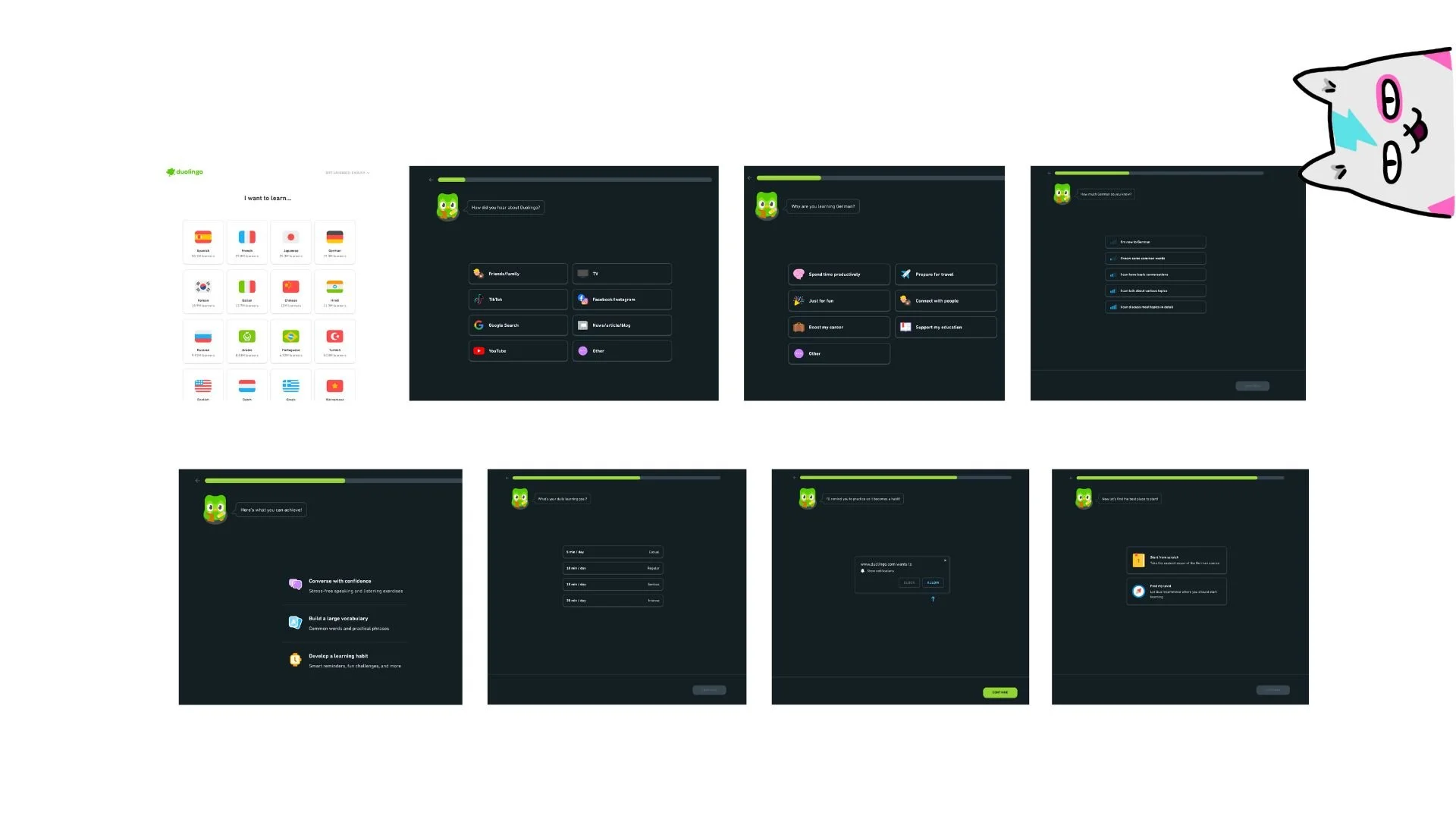
Onboarding screens for Duolingo as a new user, learning German
How to apply this to your product:
I’m not suggesting you recreate this for your own product. Duolingo is notorious for testing to see what works and what doesn’t. This selection of questions may not be relevant for you, or too long.
But look at the questions you’re asking and identify what benefit they have from a product, sales or marketing perspective. Trust me, you’re not bugging them by asking these questions.
Duolingo makes learning fun with the use of gamification
Gamification is the use of game design elements and mechanics in non-game contexts to enhance the users’ engagement, motivation, and learning. And apps like Duolingo use gamification to transform what could be routine educational activities into engaging, rewarding experiences.
Personally, I think the term gamification is thrown around a lot.
In essence, it’s the use or integration of gaming elements, such as badges, XP, leaderboards etc into a learning platform all with the aim of keeping people using, engaged, and learning. Simple, right?
People like to say they use gamification because in reality it makes boring or hard things a little more approachable. As software businesses look to keep those users they’ve worked really hard to acquire, gamification allows you a way to encourage users to build a routine around your product.
As Nir Eyal said in his book, Hooked, “fostering consumer habits has proven to be an effective way to increase the value of a company by driving higher customer lifetime value”.
There you have it. Gamification techniques are a way we can lower the thinking time people dwell when trying to use a new product, and we reward people for taking seemingly mundane tasks.
How to apply this to your product:
How can you introduce a reward system into your product to create that gamification feel?
Points, XP, hearts… even words of encouragement are simple ways to start adding this in.
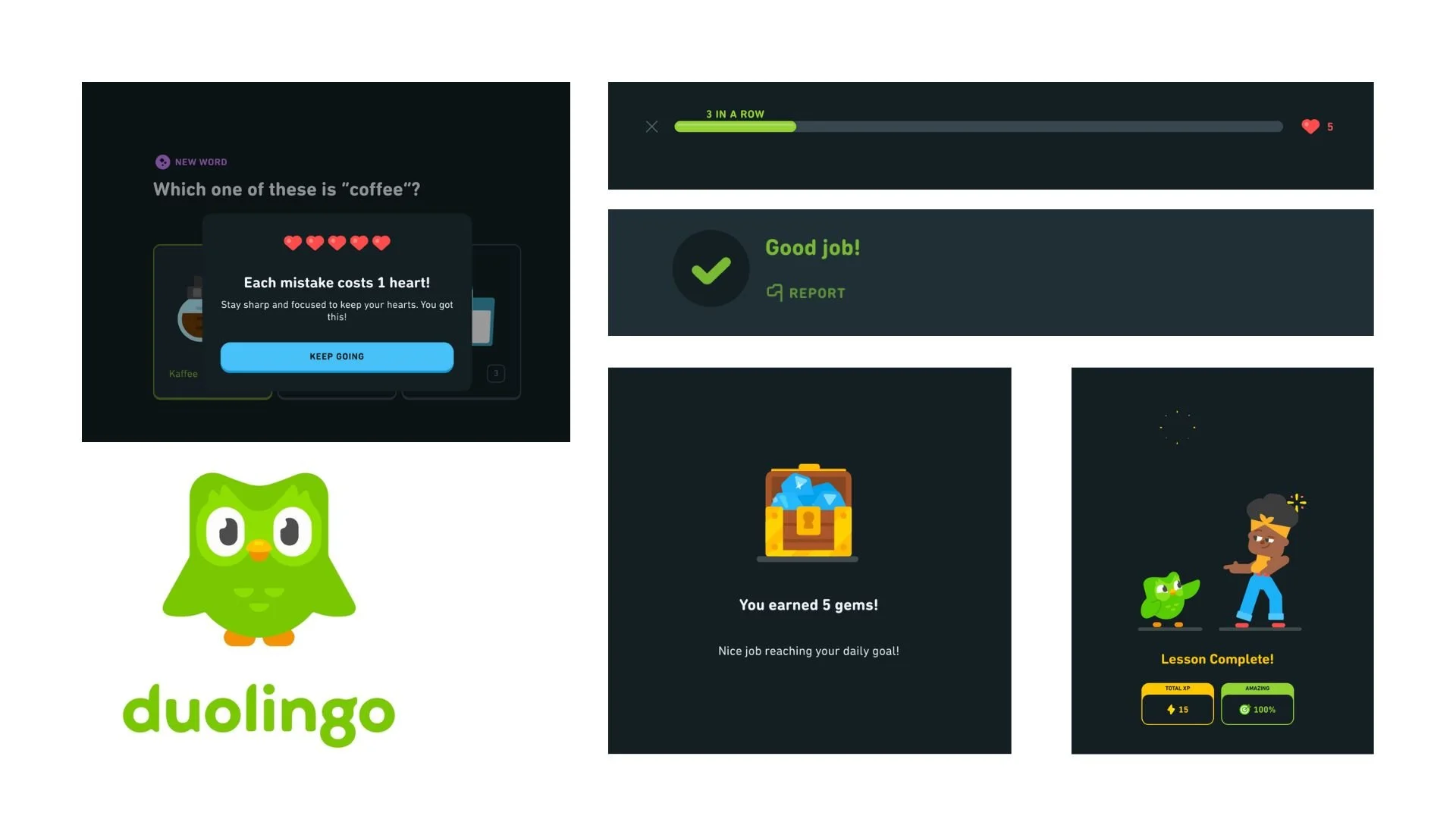
A few examples of the reward mechanisms used
Duolingo’s use of notifications:
It’s not what you do, it’s the way you do it
Duolingo uses a number of ways to notify users, in essence pulling them back into the product. I signed up and within two days received a notification as well as two emails.
On day one, I was filling in the blanks, guessing the meaning of words that’ll help me to order in a cafe.
By day two, I’d enabled notifications and was shouting BROT! at my computer.
Duolingo uses well-timed notifications and reminders that re-engage me without overwhelming me to the point I want to cancel. This carefully crafted sequence ensures users quickly understand both how to use the product and why it's valuable to them personally.
But let’s face it, Duolingo is really known for its passive-aggressive tone. But it turns out they’re super clever when it comes to using psychology to get people to learn.
The aim of these notifications is to encourage us to come back and use the platform right. But would Duolingo have the same impact if the bird was super cheeky or polite? Nah, of course not. The disappointed tone used makes us feel like we’re letting the app down if we don’t engage. And it’s precisely this tone that contributes to the success of reeling us back in.
Don’t judge me on my unopened emails…
But it’s not just emails.
They get you to explore other ways to remember them.
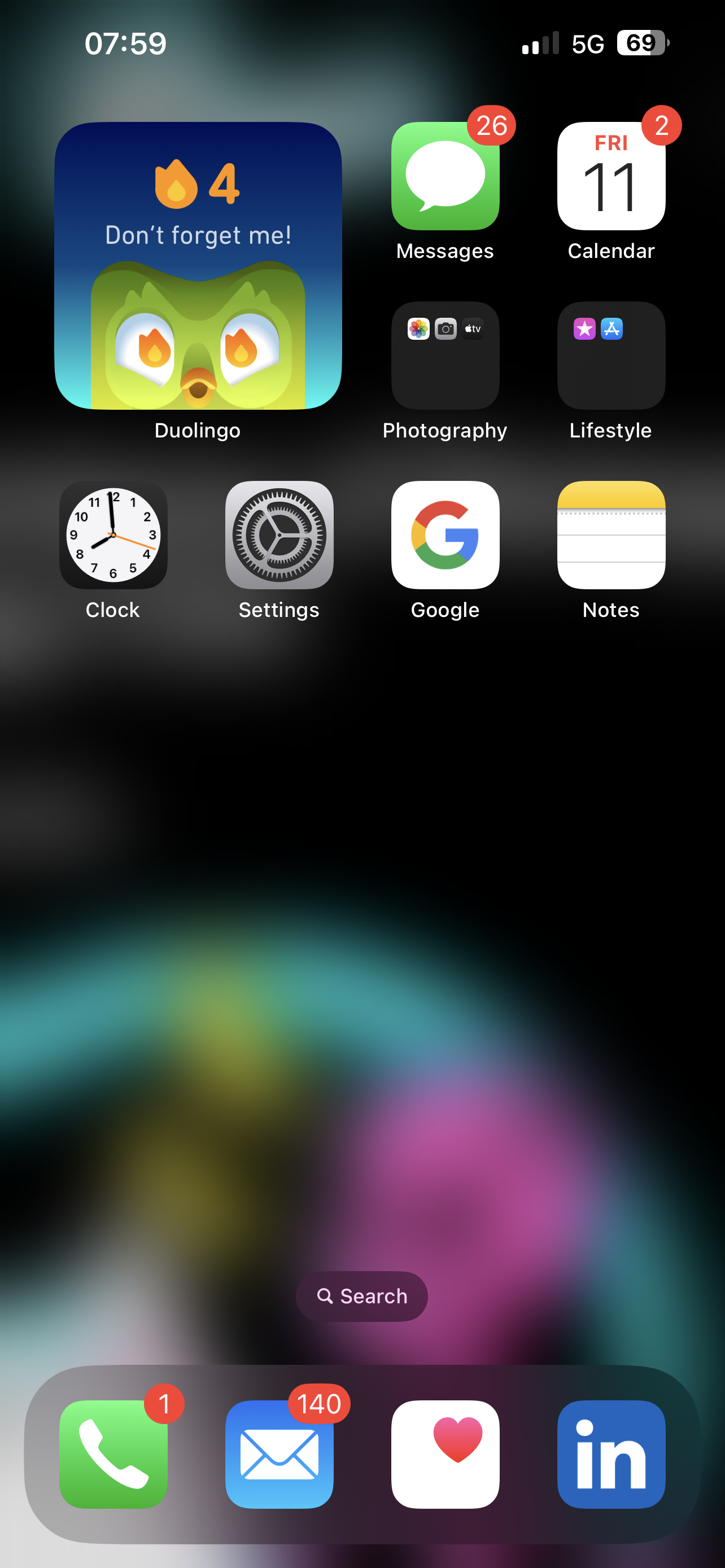
Take this screenshot of my phone. I’ve been coaxed into adding Duolingo to my home screen via a widget. Do I wake up every morning and see this face, prompting me to engage in an early lesson?
You betcha.
How to apply this to your product:
Before you even contemplate getting your user to subscribe to your in-app notifications or email digests, think about what your product’s first strike is.
A first strike is defined as when “a user has experienced a tangible benefit or solved a problem they couldn't solve before using the product.”
This could be recalling a phrase in German in the case of Duolingo, for example.
Then, orientate your email comms or in-app notifications based around this core action. Don’t just send an email for the hell of it. It’s a wasted opportunity.
So, is product-led growth right for your edtech or learning platform?
Product-led growth is a type of go-to-market strategy that’s best used for businesses with an established product and who have achieved product-market fit.
If you don’t have product-market fit, I would suggest avoiding launching with it immediately. That’s because to use it effectively, you need to have proven traction and already have a marketing engine that’s up and running and delivering consistent leads.
Let’s say you’re early-stage and have just a handful of users engaging with your product.
Try these suggestions to provide yourself first:
Identify the 3-5 different types of user likely to engage with your product.
Look at the retention rate of each.
Of these, focus on the one who you are really confident knows what to “do” with your product
Look at their journey, what can you optimise? Where are there potential gaps or breakages?
Then… and only then, trial a self serve model, which allows these users to test drive the platform with minimal if not zero involvement from you. You’ll need to find a way to signpost these users, by team size, feature request etc. Still keep your “talk to sales or request a demo” for the more complex user that you’ve not sorted the journey.
When you’re “happy” with the performance of this user journey, work your way back up the marketing funnel. And switch the campaign button ON.
Test which marketing campaigns, messaging and formats are most likely to encourage the self-serve user.
Rinse and repeat throughout your other cohorts.
Summary
I could write all day about Duolingo and the parts of the product I’d love to use, but that’s not really going to help anyone. The lesson or thought I’d leave you with is, you can’t just recreate a business - it doesn’t work. Your market, customers, channels, people are all different. But if you are going to borrow ideas, borrow the ideas that are aligned to the stage your business or product is at. Otherwise you’re setting yourself up for a very steep learning curve.
If you’re working in edtech or learning, and want to have a chat about some of these techniques I’ve implemented personally, give me a shout.
