

4 Sales Demo Best Practices (Why Your Startup’s Demo Process Sucks)
Updated on 16/05/24
“Get ‘em on the phone, it’ll increase conversion rates.”
(Like all of a sudden we could charm any prospect).
“Don’t put the price on the website, it’ll only scare them away.”
(Hint: we’ve not worked it out yet or we’re worried we’re leaving money on the table).
“Avoid leads from Google ads, they don’t close!”
(I haven’t quite worked out that this prospect is expecting what was included in the landing page offer).
These are just a handful of things I’ve heard sales and founding teams say when it comes to pitching to a lead.
In one particular business, the Head of Sales bought into the idea that we were a “sales-led company” which meant we could convert any lead… as long as the SDR was able to get them on the phone.
He believed it was sales’ mission to educate prospects coming in. But, this was a mission that wasn’t shared with the rest of the team. If they couldn’t progress the buyer to the next stage of the pipeline, then the marketing team was to blame for sending over duff leads.
And when a lead did progress… well, enter the sausage factory!
Every prospect that came in was funnelled into the same experience.
They all had to watch the same tired sales demo and listen to the same old script; irrespective of whether or not they’d bought our type of product previously or were even ready to buy.

Prospects weren’t allowed access to the solution to learn at their own pace.
We had to control the narrative; everything was on our terms.
Of course the majority of “demos” didn’t always close. We’d be ghosted because of the pressure we’d put on them. And, if someone did sign up, they’d rarely hang around for long afterwards.
We operated in a competitive environment where copycats would appear every few weeks. It was so easy to replicate the business model, when higher intent prospects came in, they knew that they could negotiate or discount.
They knew that we were competing on features alone, and could use that to their advantage.
The secret to closing more sales? Meet prospects where they are.
The easiest thing for your prospect to do is nothing. That’s right, nothing at all. No sale. Na-da.
I learned this when watching April Dunford talk about how to craft a product story at her most recent appearance at Business of Software.
She shared the following stat from Challenger:
40-60% of B2B sales purchases end in no decision. The easiest thing (for a potential customer) is to do nothing.
It took me back to those leads we couldn’t activate. Not just in the scenario above, but in a previous startup I had worked in.
We’d get people who showed some interest in the platform, however, more often than not, they’d agree to a sales demo and then …. nothing. (Learn how painful it was with: Why won’t my leads activate my trial?)
The reason (now) seems really obvious.
They were not ready to buy because they’d only just realised they had a problem. Face palm.
We were treating all of our leads in the same way. Those who were just beginning their search and were conducting a little desktop research were given the bells and whistles reserved for those who were about to sign off on a 2 year contract. No wonder they ran for the hills every time we’d try and check-in.
That’s the problem with some sales-led startups or, rather sales-led businesses that don’t give a crap about their buyers. They pepper their website with nothing but a request a demo button and don’t realise the harm they are doing to their startup’s sales process.
They’re concerned that they have only one shot at talking to a prospect that they over-sell or promise too many features. Or they discount when they don't need to.
We don’t take the time to work out where someone is in the buying process. And that’s what was wrong with our demos and why we weren’t closing.
Think you may be in a similar situation? Ask yourself these questions:
Does your startup’s sales demo account for people at different stages of the buying process?
Do you have collateral for each stage of the sales cycle?
Do you know what your prospect needs from you at each stage of the buying process?
The four elements every sales demo needs…before you start selling.
I’m going to share with you the four frameworks that can help you to answer those questions above. Before you start reading this process, you have to understand - and be at peace with - the fact that all your incoming leads are not “hot” and you’re not going to sell to all of them.
The four sales demo best practices to unlock your startup sales potential:
Uncover your customers’ Jobs to Be Done
Map out your prospects’ timeline and assign them to a track
Your customers’ workflow and product eco-system
Re-engineer your sales deck to put yourself in your prospects’ shoes.
Uncover your customers’ Jobs to Be Done
Jobs To Be Done (JTBD) is a framework that helps you understand why and how people buy products. It was co-created by The Re-Wired Group’s CEO, Bob Moesta, and is used by a range of companies, including Autobooks and Intercom.
Sales demo best practices include understanding your customers’ JTBD. This dramatically increases the likelihood of connecting your product with the right buyer at the right time.
The idea is simple: we don’t buy things at random, there are a series of forces that come into play that push or pull us towards making a purchase. And, as a startup founder, you need to work with your team to understand what these are in relation to your ideal customer.
You may have read excellent books geared towards customer research and asking the right questions, such as the Mom Test. The JTBD theory goes one step further and forces you into the WHY behind a purchase. Only then can you really create the right go-to-market strategy for your startup.
Applying it to your sales demo: If you know what your customer’s JTBD is you’re halfway there to creating products and promoting them at the right time. Once you know this, you’ve got the fuel for the next set of steps that will help you create an effective sales deck. If you don’t know your customers’ JTBD, I would start talking to your marketing team and founder… quick!
That’s a lotta theory, I know. Here’s a case study on how I applied JTBD to the marketing of one of my clients.
2. Map out your prospects’ timeline and assign them to a track
Keeping within the tools available when using JTBD, here’s the buying timeline. When you conduct customer research projects or work with a consultant offering product marketing for your startup, you’ll unearth a ton of information about what they were doing, why they were searching, and what was ‘moving’ your customer closer towards your product.
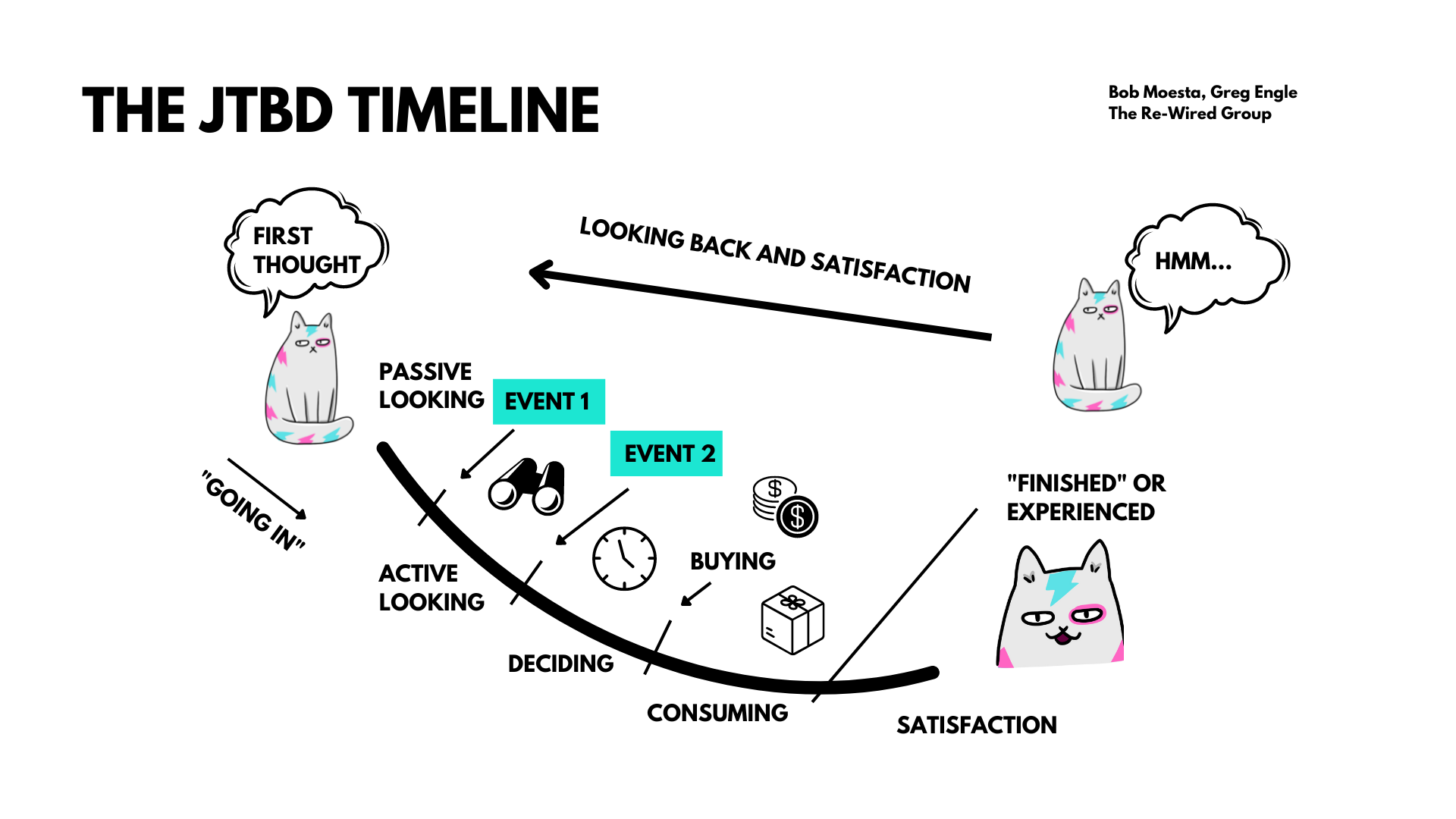
When you work with a consultant offering product marketing for your startup, you’ll find out what they were doing, why they were searching, and what was ‘moving’ your customer closer towards your product.
Here’s the great part: we all follow the same timeline, this isn’t unique to a particular type of customer. But we don’t all approach it within the same timeframes; there are catalysts or trigger events that speed this process up or slow it down.
Let’s look back at the example I shared at the beginning of this article. We were treating all leads that came into us as “solution aware” but you’ll note that by doing so skips a ton of steps. Hell, we don’t even know if they are comparing us to our competitors.
We would arrange a call and, when there was a risk of us losing the prospects’ interest, we’d bamboozle them by offering new features and selling something that was too good to be true. By doing so, we opened the door for these prospects to join the 40-60% of non-buyers.
What I found really effective when applying this to a startup’s audience was creating two tracks: discovery and action.
Discovery track - these are people who are problem aware. The chances of them buying there and then are zero.
Action track - these are people who’ve put you within their long list of solutions. The intent to buy is there, but they’re currently comparing you to a few other options that you’re totally unaware of.
Action: ask your prospect the right qualifying questions to understand what track to put them on. For instance, someone on the discovery track is more likely to respond best to stories and brand associations. You want to do what you can to create a position in their mind of where you “sit” in their buying experience.
Someone who is on the action track is further down the process. They may be comparing you to direct competitors, they may be comparing you to their own DIY bodged solution. They may have already attended a sale demo with another provider. They’ve got more insight and are now looking for more rational features to combat their anxieties and answer their questions.
3. Learn what other tools are used in your customers’ workflow and product ecosystem
Another example of sales demo best practices is working out what solutions/products your prospect uses to fulfill their JTBD. Years back, when I was involved in marketing for a recruitment technology company, I hired Hubspot to help me manage incoming leads and nurture them for the sales team.
For me to get buy-in for Hubspot, it also had to talk to other solutions in my marketing tech stack. It had to integrate with Salesforce, with Xero, with Wordpress and with existing Google sheet databases.
If it didn’t integrate the way I needed it to, I may have gone elsewhere.
Action: collect this information from your prospects. You could ask them this in a high value landing page or when sales talks to them. Make sure they’re present in your sales decks. By doing so shows you really know what’s going on in your market but, more importantly, by creating strategic partnerships with these suppliers will reduce some anxiety from the customers’ perspective. (Of course, ensure you can integrate with them - you don’t want to make any bad promises.)
4. Re-engineer your sales deck to put yourself in your prospects’ shoes.
You’ve probably guessed what I am going to suggest next. Yep, we’re going to rip up your current process.
Only joking. But I hope you can see that by getting this far you’ve exposed a number of gaps in your current demo process. I’ll sometimes get push back from people who will think they don’t have time to create three, four or even five versions of a sales deck.
The problem with this is that they are looking at it from the perspective of a series of decks. But that’s not how people buy. It’s not how people learn.
Think of it as one large sales deck or, a documentary of someone buying your product. Based on who you are talking to, you present certain parts of the story. You’re always going to have a few stock elements, however, if you’re clear about who your customer segments are and why they buy from you - this process should be easier than you think.
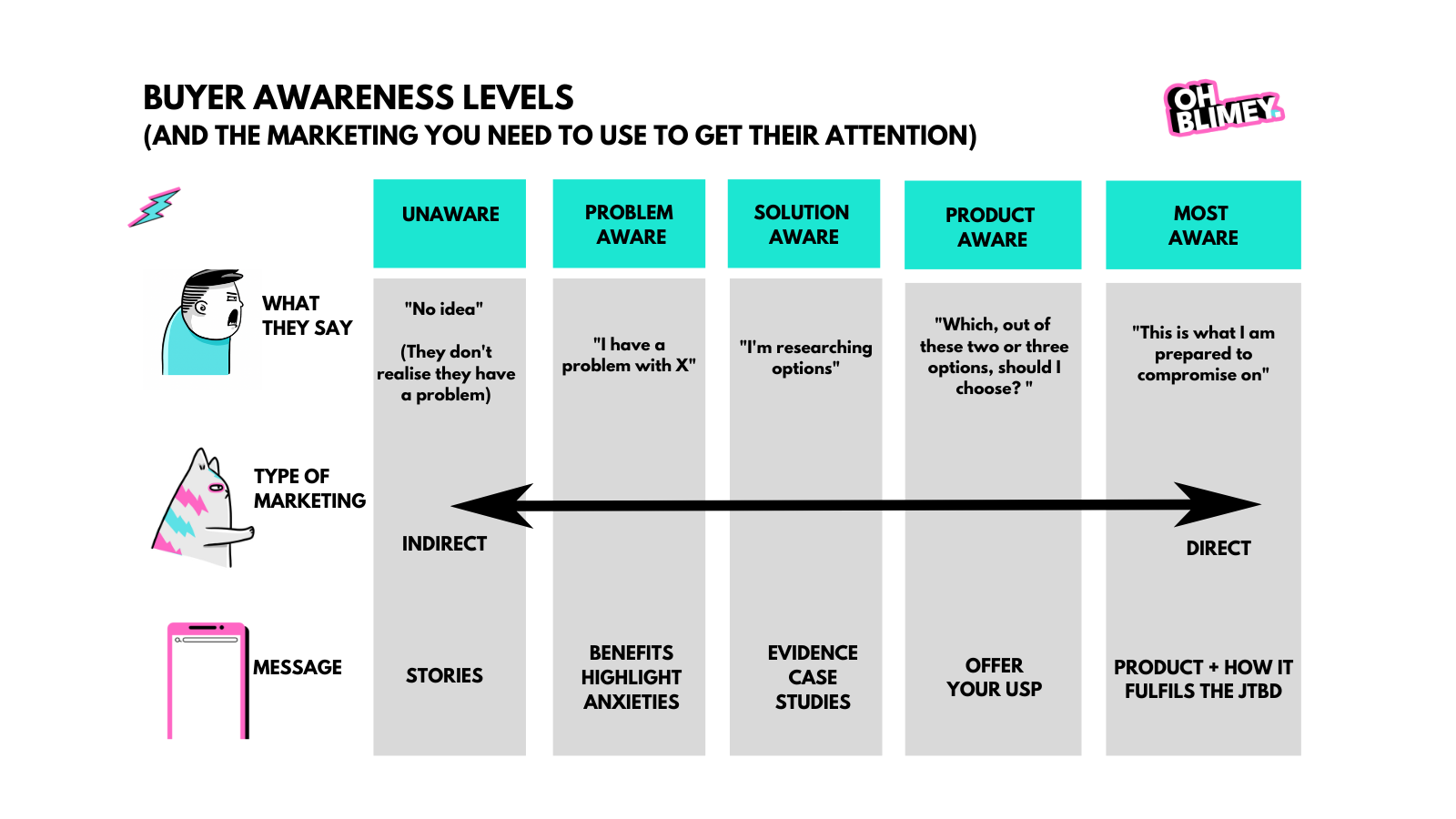
Buyer awareness levels and marketing needed to get their attention - Oh Blimey.
Summary: re-engineer your sales demo for your startup
Hopefully I’ve presented to you the case for creating new additions to your sales demo process and not bucketing prospects all together. I’ve seen this process work many times. From a marketing perspective, this is so impactful because you’re able to show what you’re all about - making revenue. From a sales perspective, it helps you avoid reeling a list of features that no-one’s really interested in listening to.
This article summarised:
Present clear jobs to be done - this will stop you from presenting features that are not relevant to your target customer and will reduce feature overload
Have clear paths - there should be content for those in the “discovery track” and those in the “action track”
Know who else is in your customers’ ecosystem and don’t be afraid to present them
Meet your customers where they are at, and not where your inflexible systems are
Know that 40-60% of people are not going to buy from you so try and leave the best version of your company (and yourself!) to them.
There we have it! We hope this post helped you understand more about sales demo best practices and how they can help your startup’s demo process.
Are you a B2B business eager to launch your product or service? Let's see if we can turn your vision into reality!
Get in touch for a friendly chat about how we can help your business or check out our services to find more about what we do.
