

Identifying the secret saboteur in subscription software products
Which user is secretly killing your engagement rates?
“They’ve signed up for an annual contract”, the founder told me.
The startup was an edtech platform that offered online video learning to higher education. We sold to department heads who’d purchased a subscription on behalf of their students. Students would receive their subscription via a code or email sent out from the head of department.
We were pre-product market fit and in the validation stage. (Despite us thinking otherwise). They were one of the super early customers or early adopters if you will. It was promising to see someone buy into what we were looking to create… and then hand over their money, willingly.
At this point, I was the product/marketing/customer success person. Note, these roles are all interchangeable when there’s only two of you in a startup.
I’d spent ages designing user flows and onboarding campaigns to keep the users signed up, engaged and happy.
So, we pressed live on our platform and sat back. With the caveat that we were in MVP stage - hoping that would excuse us for any niggles, we made a note to check back after 30 days.
One month later: we’re scratching our heads. The engagement rates were lower than we’d expected. Much lower.
We couldn’t work out why.
The client loved it. The few end users who had signed up loved it even more.
So, why were adoption rates so low? It made no sense.
Improving subscription rates in your edtech product: get out of the building
Steve Blank in his book the Startup Owner’s Manual says that in order to really validate your customer segment, you need to leave the building. You need to experience the context that someone is likely to use your product.
Whilst much work was put into this at the beginning when the purchase decision was being made, there was a ton of work that needed to be done in the engagement of it.
I know that sounds like effort, especially if you’re in the business of improving software subscription products, but here’s why.
We arranged a meeting to discuss the early performance of the contract, particularly why people weren’t signing up in their droves to use the product.
I was sat in the careers office where I observed the following:
A student would come in for a meeting with their careers advisor.
They’d have their face to face, most probably discussing career options, CV styling etc etc.
After 20 mins or so, the student would leave.
And the printed card with our subscription code on would be in the same place, on the desk.
It wasn’t until we noticed this a few times that I made a mental note to ask why the cards intended for the students weren’t being issued.
“If I issue a card with your offer on, the student will be able to access this advice online at home”.
“Yes… and?”
“If they do that, it negates the need to come into the careers office”.
“Yes… and?”
“My KPIs are around face-to-face appointments with students”, the advisor said. “If I issue the code allowing them to access your online courses, they may not come in… and it’ll look like I’m not hitting my internal objectives”.
Source of low engagement: identified.
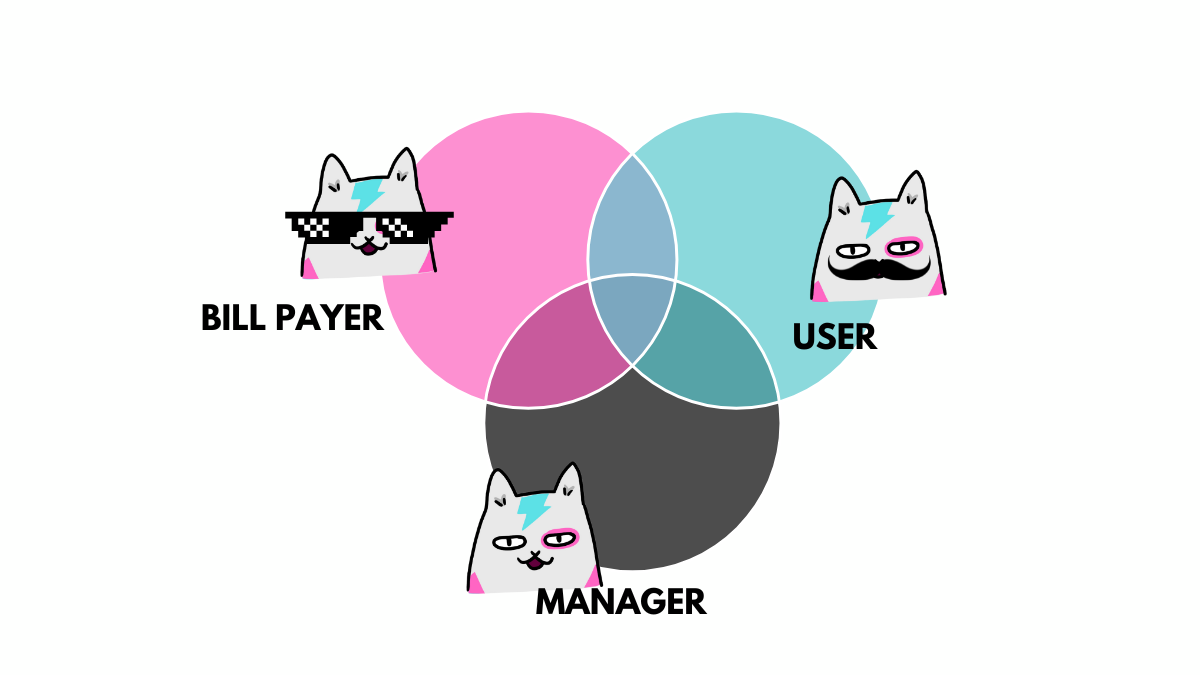
Bill payer, manager and user: the three audiences of B2B software
In B2B SaaS there’s a concept known as bill payer, manager, user. Generally speaking, if you purchase something on behalf of your employees, there are multiple levels you need to sell your offering into.
A bill payer who will sign off the contract;
A manager. This is the person who has likely researched the offering, you’ve courted for months, and if all goes to plan, they’ll be the one who then distributes access to their teams.
A user. Also known as the end user. This could be a member of staff or in this case, a student.
Let’s say you offer HR software that lets your staff pick their benefits package…
Or you’re an edtech platform that requires you to complete X amount of hours learning…
You’ve got multiple players - each with their own agenda and idea of what success looks like. And sometimes one person can occupy a number of roles. For example, your ideal client could be both bill payer and manager.
Companies who miss out on understanding not only the different users but who neglect to understand what each needs to hit to meet their KPIs are missing a trick. It’s why many B2B SaaS offerings struggle with engagement rates. You may have spent months selling into the manager but actually, it’s the end user you need to keep engaged.
In the case of our edtech product, the client had a meeting internally and realised it was time to rethink old KPIs and how students wanted to learn. Our offering complemented the work of the careers advisors and the contract went on to be renewed for a few years.
If we had not gone into the client’s office to see how they were using our product, we may have lost that contract or automated the “wrong” part of the product.
Three ways to improve the subscription rate in your edtech software
Time for the learning bit.

Especially if you’ve noticed a decline in engagement, it’s likely there’s someone who you’ve missed out.
Map out a visualisation of a user signing up and using your product.
You may have a journey for a user, for a manager - even a manager with enhanced or restricted rights.When selling your proposition into a company, if you learn there are multiple audiences, make sure to interview them beforehand.
This will help you to understand what the desired outcome is for each - and whether your offering is right.Understand that when selling B2B SaaS for sectors such as HR, recruitment, learning and development - start with the end user in mind.
Interview them to understand what they need to get value. Pay this part particular attention, as these are the audience that don’t really care about your offering (yet).Engagement rates will always be something you need to focus on. Ensure you’ve put basic product-led growth mechanisms in place that help you to focus on retention. For example onboarding, upselling or communicating with dormant users.
Looking to launch your subscription platform? Keen to build the right foundations for your edtech platform? Learn more about my product-led growth offering to help you start off in the best possible way.
