

Don’t press launch yet: 4 marketing resources your MVP needs now.
Think back to the last minimal viable product (MVP) site you visited. My guess is, you had a look around, signed up to an ‘exclusive waiting list’ promising you you’d be the first one to learn when the product was accepting beta testers. Maybe the founder reached out to you, told you if you recommended their product they’d ping you over a branded t-shirt.
It’s10 months later and an email lands in your inbox asking you to take part in the soft launch. You’re sitting there, scratching your head.
You’ve no idea who the brand is. You probably don’t need their product now. Your circumstances may have changed. You got a new job or you worked out a fix around the problem. Either way, you’ve moved on.
Now, put yourself in the founder’s shoes. When you’re in ‘founder selling phase’, you need assets to help cover your customer research foundations, and you need to be strategic with the ones you create. ‘Cos there’s only one or two of you in the team #ammarite
The whole point of launching your MVP is to minimise the resources needed when testing your startup’s hypothesis, to learn about your market’s reaction and to get a feel for what your go-to-market will eventually look like, right?
But what does the marketing set-up required for this actually look like?
Is it actually just adding a waiting list, even though, deep down, you know you’re likely to get like five leads signed up? One of which includes your Mum. (Hi, Mum).
Is it prioritising developing the next shiny new thing!™ because this is what is on your agency’s roadmap… not yours?
The 4 marketing resources your MVP should have before you launch
When it comes to launching your MVP, you’re looking to find interest in the product and a potential market which will eventually lead you onto that holy grail of product-market fit, right?
But you’re also looking for message-market fit. If this is all new to you, that’s cool - check out the startup founder’s guide to validating an idea for the basics to this and more.
Message-market fit, according to Mark Lewis is ‘like falling in love, you just know when it’s happened. And if you’re not sure, then you probably haven’t found it’.
My take on this is it’s the moment when you know your startup’s story and proposition just lands. It’s the difference between a lead actually activating a trial and ghosting you. It’s not positioning - that’s a long-term play - but it is all about messaging, and understanding the language of your prospect.
Here are the steps you need when you launch your MVP to help you get closer to this new holy grail
Prioritise creating bottom of the funnel content
Create a lead magnet that’s tied to a problem (and not an opportunity to sell)
Create a waiting list campaign to start collecting voice of customer wording
Send trial sign-ups these super quick questions to get a feel for your pricing
Side note: this takes time. Learn more building product or building market - which takes longer?
Prioritise creating bottom of the funnel content
Bottom of the funnel content is marketing jargon for website pages/sales collateral that’s aimed at helping potential customers purchase. Note, the emphasis is on the purchase part. Depending on whether you are a b2b SaaS product, a consumer app or a marketplace, these examples of content will differ depending on your ideal customer’s journey and what they are hiring your product to do.
But, for simplicity’s sake, think case studies, alternative pages, and pricing pages. It’s pretty much anything that will nudge a potential customer the right way by acknowledging their trigger points and anxieties.
If your resources are sparse, which, let’s face it, they probably are, when considering what additional pages to include in your website landing page, I’d always suggest the bottom of the funnel first.
If someone has come across your website, you’ve got one chance to see if the value proposition resonates. You’re trying to squeeze your elevator pitch in, you want to show them how they could use it and what benefits it can deliver. Deciding what content to create and why is also known as aligning your content to your sales process.
If you’re interested in learning more, check out how to be strategic when creating content for your SaaS. Or, if you want a more holistic approach, try why your request a demo is hurting your startup’s sales process.
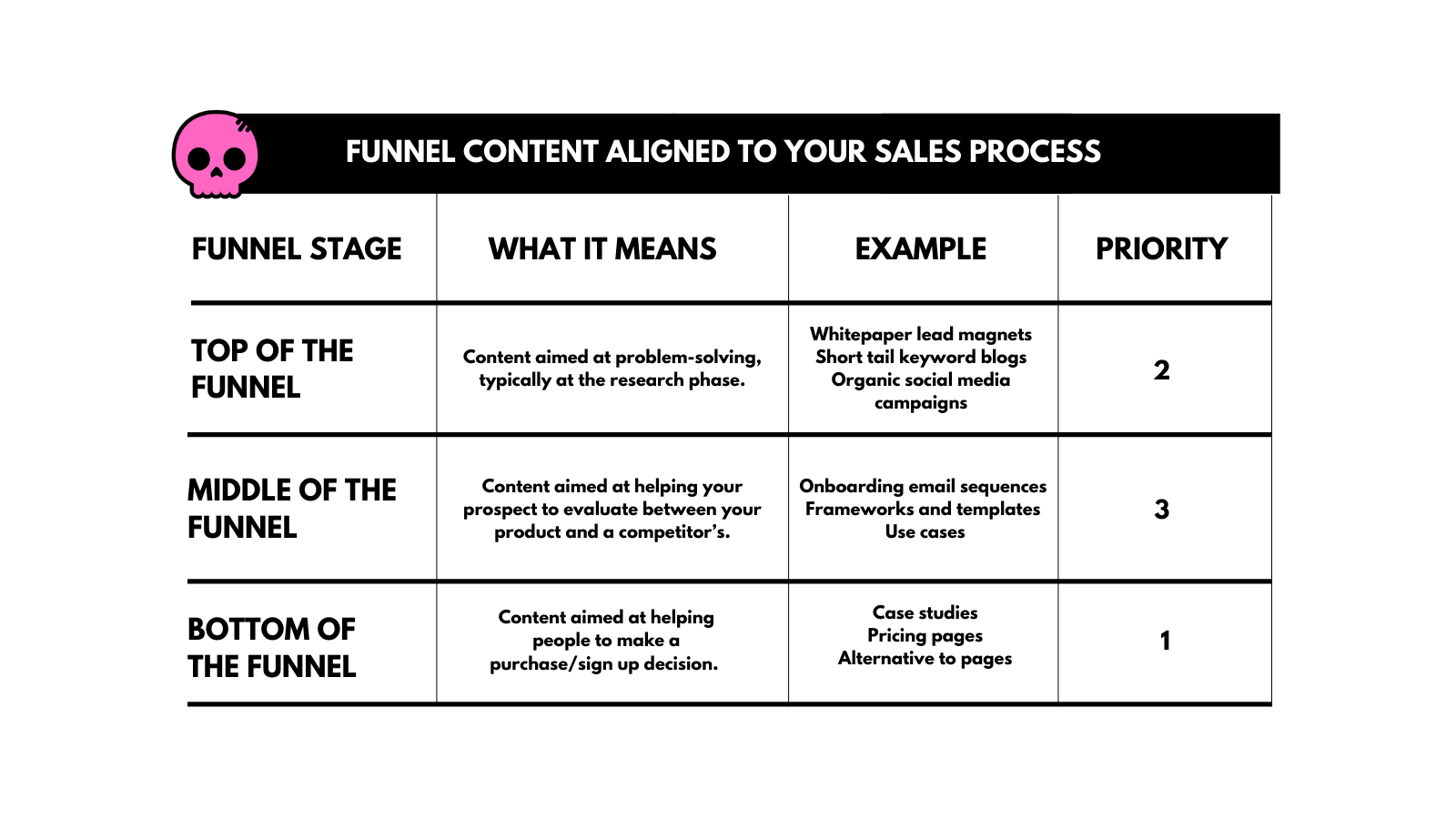
Funnel content aligned to your sales process. Image shows examples of funnel stages, what I actually mean by this, and examples.
Create a lead magnet that’s tied to a problem
(but don’t use it as an opportunity to sell)
This step is aimed for those of you who operate within the b2b space.
Lead magnets are a great way to test the severity of a problem, to understand early-on what channels people use to seek out answers to this problem, and what channels they use to educate themselves.
Think about the books offered by Intercom or the webinars you probably attended throughout the pandemic. These are effective ways to create an association with a brand and a particular problem/space/line of thinking, and build an audience because you would have asked for an email address.
How you could apply it to your startup’s MVP.
Think about the elevator pitches you’ve been giving people. Think back to that problem you’re looking to solve - that’s the topic for your lead magnet. Lead magnets are for people who aren’t ready to buy from you; they’re there to help you start building an audience.
Here’s another way to think about it. Not everyone who hits your website is ready to buy. Hell, it’s likely 95% of visitors will never buy from you.
People arrive at your website in all stages of the buying process, from researching to considering whether or not to sign up to your product. Down the line, you’ll be able to change this depending on the marketing you put out there.
But until then, it’s likely whilst you are still working out what you do and who you serve, you’ll get a mixed bag of visitors. Start showing off your credibility and expertise in your specialist area by giving them a lead magnet for free. You’re likely to get more downloads of this than, say, a fancy brochure. Trust me.
Want to see an example in action? Download my lead magnet How to Talk to People and Land Your First Customer. Even if it’s just to see how I have created the page, follow up email, and lead booklet itself.
Pre-launch: Create a waiting list campaign to start collecting voice of customer wording
Startups, stop adding a wait list and doing nothing with it.

How many of you have a landing page with a waiting list that’s just gathering dust? And, how many have you experienced that real pain when you finally send an email campaign, only to realise that half of the emails are junk because people have left the business etc?
When someone signs up, create an automated email thanking them, and asking them to take part in a 15 minute Zoom research call. Ensure your calendar link is in there too.
Not everyone is going to want to take part, and that’s okay, but building this into your routine has a number of benefits.
What you’re looking for is to understand what they think the problem is and how they describe it. You want to collect their words, because it’s these words that’ll make your sales messaging really stand out. You also want to dig into what triggered them or what was happening at that precise moment that led them to search for an answer to their problem and/or land on your website.
Whether you’re selling to b2b or b2c, you want to create emotional and rational messages. And these interviews can be a gold mine for messaging, and understanding how to pitch your message to different segments.
Send trial sign-ups these super quick questions to get a feel for your pricing
Throughout the hell that is validating your MVP stage, pricing is going to come up. Price it too low and people will think you’re a cheap startup. Price it out of context and without considering what other tools people use… you’re opening yourself up to all sorts.
Let me share with you this really cool way to look at pricing with The Van Westerndorp Pricing Model. It’s a model that’s used with survey responses to get an indication of willingness to pay for a product.
Create an automation for people who have used your product and experienced what you believe is the true value exchange or aha moment, and send them this super quick set of questions. Bonus points go to those who also introduce a question that allows you to segment the type of audience.
At what price would it be so low that you start to question this product’s quality?
At what price do you think this product is starting to be a bargain?
At what price does this product begin to seem expensive?
At what price is this product too expensive?
Summary
There is of course much more you can do when launching your startup’s MVP, but, from a customer research perspective and an early marketing standpoint, this should get you started. The real pain behind this is thinking about what you’re actually going to do with the info you collect.
To summarise, these are the steps I would recommend taking when launching your MVP:
Prioritise creating bottom of the funnel content
Create a lead magnet that’s tied to a problem (and not an opportunity to sell)
Create a waiting list campaign to start collecting voice of customer wording
Send trial sign-ups these super quick questions to get a feel for your pricing.
Still scratching your head? I get there’s a ton of info here to absorb. If you’re interested in learning about pulling this all together to create a sweet lil go-to-market strategy for your pre-launch startup, I think I can help :)
