You can’t polish a turd: a lesson in startup positioning to take to your boss.
This is genuinely one of the best pieces of advice I’ve ever heard.
It’s a quote from April Dunford, one of the few voices worth listening to when it comes to talking positioning. Apologies for the fan-girling, but it’s going to continue.
I’ll give it a bit more context.
“Marketing can polish a turd.
Positioning can turn a turd into fertiliser” (April Dunford).
I first heard April speak at Learn Inbound and then a year later, at SaaStock. Before listening to her talk, I’m embarrassed to admit that I thought ‘this should be a good refresher. I’m a marketer, positioning is what I do!’
How wrong was I?
Positioning was something I thought *we*, as marketers, have sorted. I mean, it’s what you learn at your CIM workshop. It wasn’t until I listened to April I realised some of the mistakes businesses make, but also how to really take advantage of the one we were sitting on.
Positioning is something that every business needs to have nailed. Without it, your sales and marketing will fail. Your customer success team will be frustrated and your retention levels? Meh! You’ll have to work even harder to get leads in. Your CPA will increase.
Here’s a little story to demonstrate how you can work out if you’ve got a positioning problem:
A few years back I was a junior marketer in a startup. Little did I know at the time, many of the frictions that had occurred between various business units were because of a positioning problem that hadn’t been addressed.
Sales teams found it difficult to sell: they’d go off on their own tangent, all the while, marketing was told to keep generating those leads. My lead target tripled because we couldn’t close the leads, all the while important projects were being put on the back burner.
“Just keep throwing stuff at the wall and see what sticks!”
(This was an actual sentence I was told. Note, I still adore this particular manager even today, but it wasn’t that helpful when starting out).
“Leads from marketing are rubbish. You’re the reason I’m not going to hit my sales target”
(Again, another thing I was told by a sales person. Nice).
Marketing strategy and the work that’s required to craft your positioning, your value proposition and the ingredients you need to make your business successful were dismissed. Marketing was considered an activity where you fire out a newsletter and update your Twitter feed.
This naivety around the importance of getting the positioning right cost the business a lot: sales, customers going to competitors, and people.
Good talent wasn’t sticking around because the situation was chaotic.
So, what is positioning?
It’s ‘deliberately defining how you are the best at something that a defined market cares a lot about’
(taken from Obviously Awesome . Seriously, buy April’s book).
Seems simple and straightforward enough...
…yet, why are we only spending a small percentage of time on it?
Here’s why. (IMO).
It’s either not knowing what it truly means - there are things you don’t know you don’t know - OR it’s because you run full steam ahead, based on the words from the first person who tells you it’s a great idea; you treat their words as gospel.
For example, you’ve got this product and you think it’s really straight forward. Your Mum tells you it’s great. But, after a while, what you find is people aren’t describing it the way you want them too. They’re saying you’re similar to X, when in your head, you’re like, “erm it’s more like Y”.
What the wrong positioning looks like if you’re in SaaS:
the wrong type of subscriber is coming in and causing all types of havoc on your churn rates.
they’ve come in expecting one thing, and getting a very different experience.
they’re complaining because you’re missing feature 1, 2 and 3
“that one person at the start said it was great, so I need to find more of those people!”
It doesn’t occur that at any point you need to look at the positioning itself.
And here, lies the point of this article.
You can’t polish a turd.
If your product or business idea’s foundations are incorrect, or have been based on bias or a false positive, you can dress your business up and put a lovely logo on it but I doubt it’ll be as effective as you’d hoped.
If you haven’t spoken to your target audience in depth, if you haven’t dug deep enough to understand the real problem they have and how you’ll solve it… you can throw all the marketing campaigns at it, but it’ll still be a dud.
That’s because somewhere along that customers’ journey there is going to be a misalignment, and that customer is going to be pretty pissed.
Sorry, I’m aware this all sounds a bit negative. It’s not all bad - promise.
Here’s an example of what happened with us.
BTW: we’re still a startup and I’m not professing to say we have the answers, but here’s an insight into what happened for us.
The penny dropped for us when we realised that changing the context and category would help:
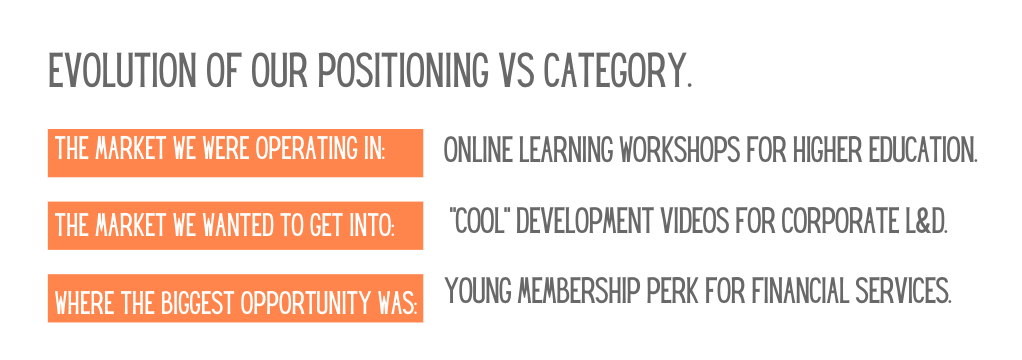
Evolution of our startup’s positioning.
In theory - and reality - our offering works in all three contexts, to varying levels of engagement, however, it was with the latter that we really felt found our feet as we are genuinely solving a problem.
We’ve got some great customers in each context - like, really great - but the context that solves the biggest challenge for the customer at this time, and therefore poses the most suitable solution based on what our strengths are, is number three.
Our brand helps them to speak to a specific audience in a way they cannot.
The market competition, at present, is relatively low.
Our decision to go niche and support a user for a core set of years in their career is aligned to a particular type of customer.
Creating a new category or developing a niche within an existing market?
Understand what you do best.
When we set out, we thought we wanted to be in the eLearning category as this, we felt, was what our supposed target audience knew, and that point of reference would help us to explain what we did.
Describing ourselves as this led to confusing sales pitches, with potential customers expecting us to offer the same features an eLearning platform would do. For example, they expected assessments, structured content and theoretical approaches.
Hot off the trail of an investment round, we toyed with the idea of introducing these additional features, but when it came to it, luckily, we had the foresight to stick to know what we know is our strong point.
That meant distancing ourselves from the eLearning category and setting out to develop our own super targeted niche.
It meant focusing the roadmap on parts of our offering we know we do best: expert-led content mapped to the pain points a new-to-work learner needs to build up their confidence.
Side note, we were especially happy when one of our agencies described Careercake as: not just a content provider, a CONFIDENCE provider. Little things.
I hope that if you are a startup marketer or founder wondering why your pipeline is taking a bit of a hit - or the traction you’d hoped for is taking much longer - maybe you’ve learned a few bits from this piece.
If positioning is something you’re interested in, avoid the trap of using things like one-stop-shop in your positioning.