

Why your “Request a Demo” button is stalling your startup’s sales
How to identify gaps in your sales offering and create content in a way that won’t turn your ideal customers off.
Visit your website and have a quick skim of your call to actions.
I bet, if you’ve only got a small handful of customers, the majority - if not all - of these buttons say “request a demo”.
And I double bet (‘cos that’s a word) that you’ve littered this all over your website because you REALLY want a demo call with someone because you REALLY think you’ll be able to charm them and sell to them.
The problem with only offering this “salesly” call to action, you’re assuming that everyone who comes to your website is ready to buy.
The thing is, over 98% of people who visit your website don’t buy.
Nearly half of customers who visit a site do so to research. And then, there’s the camp who are there purely to compare your product to another they are considering.
The scary thing is, these are the stats widely used for eCommerce.
What happens if you apply this thinking to a B2B website?
Yep, you guessed it, the figures are stacked against you. Perhaps even more!
Think about the last B2B SaaS website you last visited. This could be for HR software, accounting… whatever.
Did you buy it?
Did you sign up for a sales demo so some creepy sales guy or gal could call you and demo a product that you don’t really get?
I’m going to go with a hunch and guess you didn’t.
Or, think about the next networking event you went to.
Remember when you* were standing awkwardly next to the food table and, out of the corner of your eye, a creepy salesperson walked towards you? And remember when they got your attention only to talk about themselves and try and sell you something?
It’s the same level of ick. It’s the same level of ick as plying “request a demo” fifteen times on your website.
*Clearly me.
The problem with offering just “request a demo” in your startup’s sales process
It’s simple: it only talks to people at one stage of the buying process. And because of this, you’re missing out on building an audience.
I see you roll your eyes, there. I don’t mean “audience” in a fluffy way. Rather, think of it as a group of people who are kinda interested in what you offer or what problem you can solve for them… who you can, through relationship building, call on to ask how to shape your product.
What I’m getting here is, by building this audience you’re not starting from scratch or paying people tons of cash to get in front of people.
Let’s get back to why I’m telling you not to pepper request a demo everywhere on your site.
The best way to think about this is to look at the various stages of awareness we, as consumers, move through, when researching and buying SaaS products.
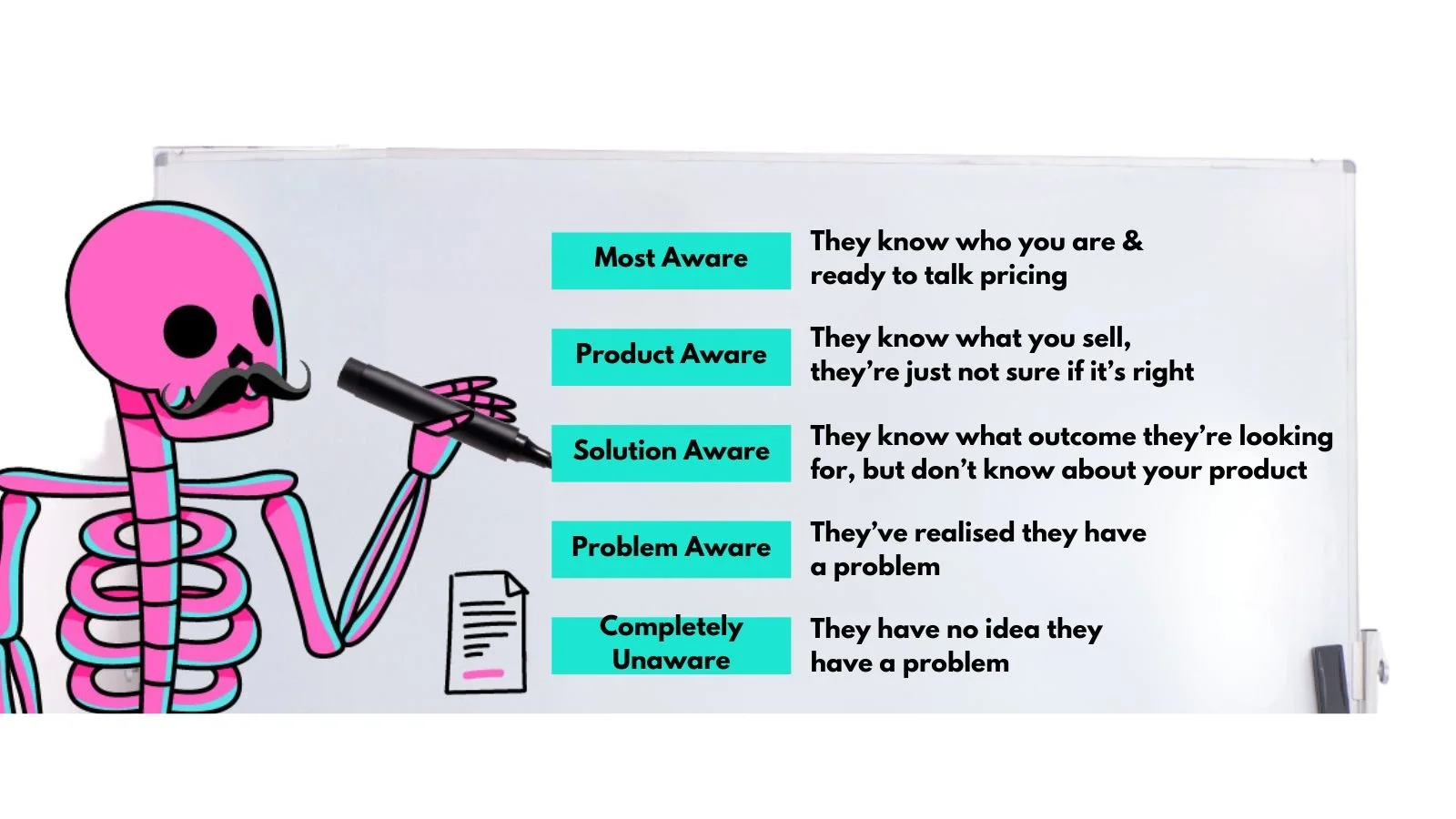
Theory based on Eugene Schwartz
Image, Oh Blimey
Think about it, would you honestly offer a demo to someone south of the solution aware stage?
Of course you wouldn’t.
Successful startups that get this know what they need to create different types of offers (call to actions) to help guide people along this process in the most non-gross salesy way possible.
I’ve written about aligning the awareness a prospect has and how to align to your sales demo process.
“But I only want to talk with sales-ready leads! Why would I want to optimise for people who aren’t ready to buy?”
There are two main reasons this comeback stinks.
Firstly, by creating content or sales collateral for these other stages, you’re actually building a pipeline and an audience.
And secondly, your competitors aren’t likely doing this. Part of building an early-stage startup is brand building and you do this by creating value.
How do you uncover the different people coming to your website (and their levels of awareness)?
And how do you use this to really improve your startup’s sales process?
It’s really quite simple. (I say with the smugness of a marketer who’s audited hundreds of websites).
Create a pop-up survey for your website and ask them.
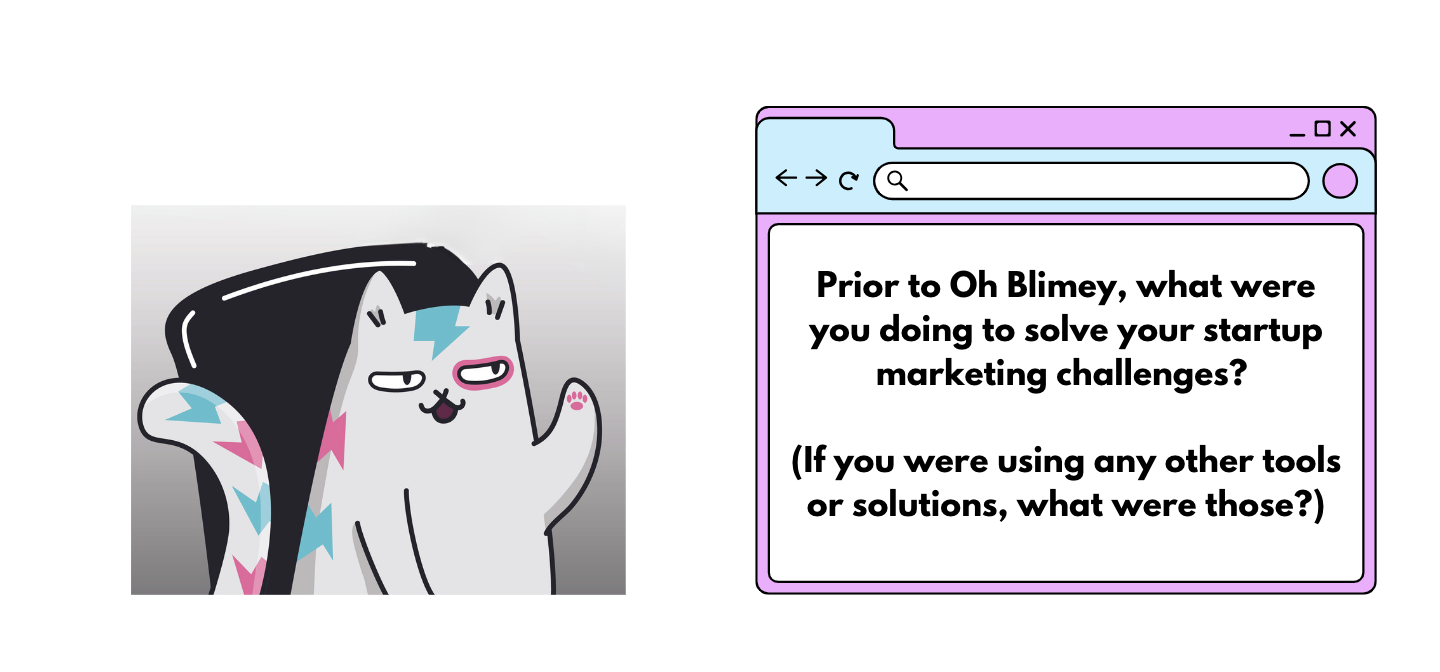
The survey should have a series of questions aligned to help you understand what your visitors are there for.
Examples of questions to ask in your website pop up survey
Where they are in the buying process (e.g. passive searching, active searching, consideration)
What they’re currently using to solve the problem your startup helps to solve
If they had a magic wand, what they would change about their current process
And what’s getting in the way of them signing up for and using your product today.
From this you’ll learn things like:
What percentage of users are coming to you who are “just looking”, who are ready to start some serious research or who are comparing you to someone else
What they believe your product offers and what problem you solve
Which key features to really push when you’re talking about you versus a competitor
And what’s really holding them back from buying.
Will you get tons of people completing this?
Of course not. But in my experience, you will get some and the info you collate from this is key to understanding what content you need in your website and… you’ve guessed it, the call to action to offer to them that just makes sense.
A large part of what I’ve just described here is an example of understanding the progress your prospects wish to make. It’s based on something called Jobs to be Done (JTBD). You can read an example of how I applied JTBD to the marketing of a client who had no process when it came to this.
In essence you want to understand what content will add value to someone based on the stage they are in the buying cycle.
Spoiler alert, I offer this as part of my startup marketing and growth services. (Which are a LOT more affordable than you may think.)
Examples of call to actions to use for your website
Let’s go back to the different stages of awareness when it comes to buying a product.
When trying to come up with content or sales offers, consider what would be of value to that prospect at that time. Don’t say request a demo. I beg you.

Look at the examples above. They are strategically aligned to where that person is in the buying process.
There’s no magic about this all, it’s about understanding where someone is and creating an offer of value.
You wouldn’t offer a demo to someone at the problem-aware stage as they are still getting a feel for things. The language they’ll likely use at each stage of this process, as they begin to navigate their options… will change.
I’d recommend this article on b2b call to actions for further reading.
Summary
Creating your startup’s website, especially if you are an early-stage startup, requires you to be strategic about what to include and what not.
More often than not, websites are created by non-marketing folk who prioritise the product over the marketing. If you’re a b2b SaaS platform with under ten customers, it’s likely that hits home a little.
If you read this article and take a look at your website and remove 50% of the request a demo call to actions - my work here is done.
