

How to Market your Boring Product or Service
Working in b2b, you *could* say I’ve had my fair share of experience marketing some pretty traditional or not-so-sexy products.
(Their words, not mine. Pinky promise.)
I’ve done a stint helping to market telecoms and worked on an AI tool back when it wasn’t the consumerist dream it is now. I've also helped push a weird skills audit tool and helped promote advertising.
But, the thing is… just like beauty, boredom is in the eye of the beholder.
And those examples may have sounded pretty darn cool to you.
I realised the fun of marketing boring products early on in my career.
For me, the switch happened when I realised it's not about spending loads to make things appealing - it's about making it relevant. Understand what's relevant and you'll see your prospects' eyes LIGHT UP.
When I was younger, I had dreams of working on super interesting D2C products. But, there was just something about working with B2B offerings and traditional sectors that appealed.
The thing is, I couldn’t have enjoyed working with these brands any more. Heck, they helped shape my marketing strategy services.
Any role or project I was on where I wasn’t engaged with or the offering was stagnant, when I think deep down why, it’s because we weren’t allowed to talk to customers. It was all one-sided and it was hard work because we were making things up as we went along.
If you think marketing your product/service is proving tricky because you operate in a boring sector, here’s some ideas to get you thinking.
Marketing ideas to make your product “interesting”
Your brand is not your board or investors.
I’ve been that marketer behind a website that is literally vomiting stock imagery with businessmen wearing suits or power posing. Or shaking hands on the driving range (‘cos that’s where the real business happens, right?)
We had no budget and would use a series of cheap photos we thought our board would love.
But in actual fact, the imagery, the copy, the proposition - they were just awful. Luckily, we had the realisation (and falling trial sign-up rates) to make us try something different and represent who we were actually marketing to.
Of course we were able to change it around, but we marketed our brand for at least 10 months with this misrepresentation, turning away hundreds of potential customers along the way.
The thing is branding isn’t “expensive”. When I say branding or re-brand to people (non-marketers), you can literally see them suit up, ready for a duel. If you’re a startup or ready to go-to-market with a new brand, validating that brand is part of the process. There’s no need to throw tons of cash at it until you’ve got some validation.
What makes it expensive is when you don’t know who your target audience is and who your competitor actually is.
👋 Love the blog but need actual human help?
Don't you worry. Beyond the free advice, I work directly with early-stage founders to sort out their growth. You can bring me in as a fractional CMO to build and grow your foundations, lean on me for a methodical approach to see if there's a market for your product with my startup validation services before you spend a fortune building the wrong thing, or design a custom go to market strategy to launch aligned to the stage you're at.
The “Oh No!” moment - realising who you’re actually marketing to
Let’s take a client I was working with who has their sights on changing their membership offering. They’re seeing declining sign-up rates and their competitors have invested in updated branding and “better” marketing.
They took a stab at who they felt they were trying to attract and keep but, when they really dug into it, they were trying to be all things to all people. Market to everyone and you market to no-one. Ammirite?
The fun part of this process isn’t working out who it really is. Nor is it identifying where you should invest your well-earned marketing budget and your one-person marketer’s sanity. No sirree.
It’s taking these segments, and debating whether you have product market fit and actually, how “easy” it is to even acquire them. That’s the fun bit.
All of a sudden, a few Aha! Moments hit you in the face.
Pow!
You realise that you don’t know who your ideal customer is and why they are churning.
You realise that you’re marketing for the sake of it with no real idea what’s working and why.
If you talk to a selection of ideal customers, you can learn a ton about the marketing channels they use to research, compare and ultimately buy a service like yours.
Here’s the thing, if you don’t talk to ideal customer segments regularly, you’re likely to try and fit into your sales processes. And that’s just lazy.
Things like freemium and usage-based trials aren’t just for the likes of “cool” brands.
There are many customer acquisition strategies which, when used correctly, can provide potential users with an idea of what you offer in a way that are aligned to the way they buy.
Here, I am largely talking about free models, such as freemium, X-day trials, usage-based tiers, etc.
Of course, with B2B purchases can sometimes bring with it a level of complexity and customisation - I get it.
But, if you’re losing market share or seeing high churn within a specific customer segment, why can’t you pursue a new way to price your offering, but also allow specific user groups a different experience?
Why can't online opticians offer a freemium delivery service?
Why can’t a data provider offer a Spotify-like subscription sharing insights tailored to your business?
Why can’t dog walkers offer usage-based services - where you’re charged a fixed fee and for every new dog you pay an additional cost?
These are all mechanisms many organisations using product-led growth attract and sign up users sooner. Of course, what market you operate in and the channels you use will determine which you can look into, but the point is - these aren’t off the table as options to consider.
Your growth model can open up some pretty cool insights like where to focus your attention
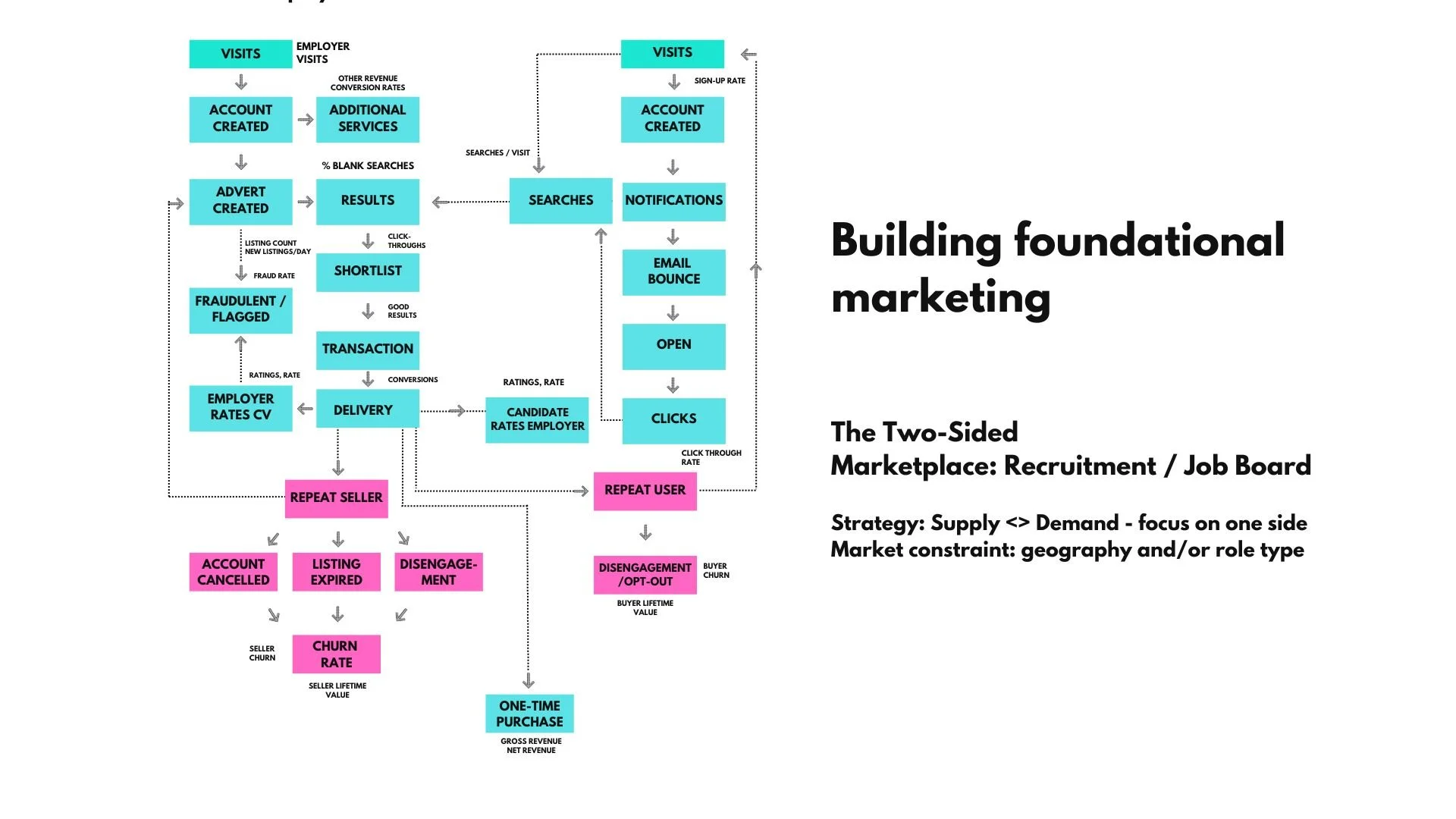
Let’s say you run membership services or perhaps a job board-type offering. Mapping out the process a user needs to follow can help you visualise where there may be gaps, and where you can create differentiation.
I love working with marketplace businesses. I love the challenge of two-sided marketing approaches.
What I don’t love is feeling overwhelmed when it comes to understanding which side I need to focus on, where to focus on, or listening to my boss tell me time and time again “focus on where the money is!” Okay, that last experience was based on my first-ever marketing job.
I digress.
What worked for me in my last startup was to visualise the physical process someone goes through when finding and signing up to our service. Whilst initially, I used this as a means to identify gaps in my knowledge of what users were doing… it actually provided me with ideas for:
Campaigns to attract back dormant accounts
Exit surveys for people who didn’t convert from a free trial
Onboarding email sequences, connecting users to the info they actually needed.
Below is an example, based on Lean Analytics - a great book if you’re super nerdy about stuff like this. Or check out his recent article on this process for a real deep dive.
Think about the stories you can tell with the data you have
Okay, this last point, whilst it made me feel a little sick in my mouth saying it, but it so important.
If you’re sat on a ton of data, think about the stories you can tell in your marketing.
The most obvious example is Spotify’s Unwrapped campaign. “It’s the magic of marrying madness with mathematics,” says a top executive at the Swedish streaming giant.
Think about it; they have access to 12 months’ worth of data, and curate stories based on what’s important to you. Then, they create a big campaign naming and shaming you based on your listening habits - the good, the bad and the ugly. Either way, we talk about it - everyone talks about it, and over 60 million people share it.
“We’ve got some data… is this interesting to anyone?”
Another example could be banking. What stories can you tell about your core customer segments? What they’re buying, what they’re saving up for… when they run outta cash during the month? How can you take this data and turn it into something you’re an expert in?
So, how’d you market a traditional or boring product?
Find the people who truly love it, don’t just keep doing what you’re doing, and maybe ask for a little outside perspective.
I’m working with traditional businesses looking to stimulate growth next year. Want to chat? Get in touch to see how I can help you confidently market your services.

About the Author
Lucy Heskins
Growth advisor and fractional CMO who helps early-stage startups scale without the usual tears, tantrums, or burning through piles of investor cash. When she isn't shouting into the void about product validation and go-to-market strategy, she's usually sharing brutal-but-fair startup marketing reality checks on LinkedIn.
