Stop saying you're the Netflix of this or the Uber of that.
Ways to move forward with solving your early-stage startup positioning.
What this post is about:
- Stop using other brands to describe what your startup does.
- The resources that helped our early-stage startup positioning, and actually helped to land our first few clients.
How do you promote your startup when you’re operating in a super saturated market, up against competitors with 10x as many customers as you?
When asked about what your startup does, have you ever fallen into the trap of saying ‘well, we’re like LinkedIn, but for teachers’. Or, ‘think of us like Deliveroo for dog-walkers’.
Come on, of course you have, we all have.
I get why you do it. Audiences need a frame of reference to make sense of things, especially if the concept that’s being explained is new.
We need something safe or credible to make sense, and process if it’s something that we need/want.
I’ve done it myself.
Whilst working in my last b2b SaaS startup, when asked what we did, I’d proudly use Netflix as an anchor. I would use this as a way to get across the fact that we offered unlimited viewing, and that we’d add new titles on a regular basis.
It worked… in the short term.
Prospects would turn into customers, but they’d be bought into the story of Netflix.
Three months later, they’d ask about new titles and sharing log-ins. Features unique to Netflix but years away for us.
It wasn’t just us, of course. Talk to any new founder/startup and when they’re trying to articulate what they do and get buy-in for their vision, chances are, you’ll hear a similar story.
This approach is a way to keep the interest of your audience, especially when you just haven’t worked out your positioning. (That, or you’re trying to make it seem cool to new audiences.)
But there’s a problem.
By doing so - by claiming you’re an Uber for X industry or Netflix for Y industry - you’re letting your customers down before you’ve even acquired them.
You’re raising their expectations by suggesting you’ve got the same business model, the same proposition. Your audience will make assumptions - even when there’s bad press.
And, you know what this harms? Retention… the metric early-stage startups need to 100% focus on.
(I’ve written in detail about the mistakes we made when looking at the positioning in a startup I worked in. Read lessons in startup positioning).
Okay, we’ve done the theory bit, founder.
Here’s some ways to actually follow this up and work on your early stage startup positioning.
The 3 resources that helped our early-stage startup positioning (and actually made us money).
Here are the frameworks and lines of thinking that proved really useful to me, and I still use when working with startup founders.
But first, let’s do a recap on what positioning means:
Translated: you don’t have to be a massive company, with a huge budget - you’ve identified a solution and how you are best placed to solve it, based on your unique capabilities.
If you’ve worked super hard… why on earth would you rely on someone else's model and success to describe what you do? Your value proposition, customers and context are completely different.
Mistakes I need you to avoid when reading this and trying it yourself:
You are not going to get results or answers immediately
You are going to need to test these with prospects to see what resonates with each audience
If you’ve got customers, you may need to rely on what they’re describing you as
Positioning resource 1 - The Golden Circle (How, what, why) - Simon Sinek
How to use Sinek’s Golden Circle
I’m sure that you’re very familiar with Sinek’s framework to help you learn how to
to inspire, rather than manipulate, in order to motivate people. It appears in most accelerators, thousands of business books and multiple marketing programmes.
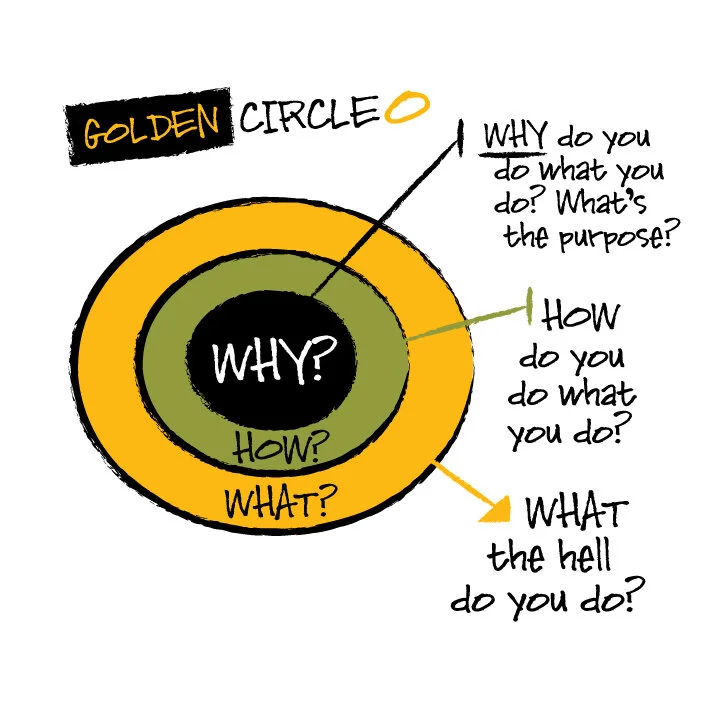
Simon Sinek’s Golden Circle
Everyone knows about it, yet many people actually apply it and do something with it.
Here’s how we used it.
What - what do you do?
You might create scheduling software, workforce planning software… Think about the actual product/service you offer. Don’t fall into the trap of using fluffy words or shoving the odd ‘innovative’ in there. Nuts and bolts - what do you create?
How - how do you do it… that’s different to your competitors?
That’s the important part here. You’re likely to have the same features as your competitors. But think about what makes you different.
Is it the way you develop your software? Do you have a customer success team? What do you have that your competitor doesn’t?
Bonus points: what do you have that your competitor doesn’t... that’s not easily replicable?
Why - why do you do all this? ‘What gets you up in the morning (!)’
Now, if you’ve answered to make £3 million by year 3 you’ve misinterpreted this whole exercise. Yes, money can be part of it but what if there’s something bigger at stake?
What if you’re trying to create a new standard in an industry? Completely rewrite the rulebook to benefit a particular part of society?
Whatever your answer here, is precisely what drives your storytelling, your pitches… It's what motivates people to put their confidence in a startup versus a big corporate.
Positioning resource 2 - Dig DEEP into your ideal customer.
Who is your customer?
Spoiler: it’s not your mate who tells you they love your product, it’s the customer who’ll actually pay for your product. Trust me, there’s a BIG difference.
Years ago when I was in my first marketing role, I noticed our lead generation efforts started to plummet. I was early in my career, and didn’t want to come across as a smart ass, but I asked my boss who I was marketing to… because I wasn’t content with being given just a job title and industry.
I asked, and he replied: ‘Everyone! Everyone needs [this particular type of software]. Everyone in the UK. We’re changing an industry here.’
At the time, that equated to like 1.6 million businesses.
And, as you can imagine, we wasted a lot of money and time trying to market and position ourselves to everyone.
Here’s the thing: you can’t be everything to everyone. It just results in meh. You need to be good at one thing; that one area that no one else is tackling/serving.
To the marketers reading, I totally get that I’m preaching to the converted. But I think sometimes you’ve got some work ahead of you in trying to convey this to a first time founder.
To the first time founders, I can tell some of you are skeptical and thinking why close off ‘a potential market’. The thing is, startups are a race to find the best possible fit.
The scattergun approach is never something to boast about.
Positioning resource 3 - The Positioning Canvas (April Dunford)
April Dunford is the creator of The Positioning Canvas, which is one of the most useful tools I’ve used when working with startups.

It literally tells you, step by step, how to work out what your selling point is, amongst your competitors. All with the aim of creating your positioning.
Here’s my recommendations on how to fill it in.
If you want another fantastic example of how another SaaS business filled it in, check out Userlist’s article on this very subject.
Product name and one line description
Here is where you put the product and what it is/does. Refer back to the Sinek activity.
Market category (and subcategory)
This could be recruitment software, then applicant tracking systems.
This could be L&D software and then, micro-learning.
Competitive alternatives
What would customers use if your product did not exist?
***This is tied to whether or not your customers are aware of the fact they’ve got a problem that needs your product.
You’ve got direct competitors - those that are in the same category as you, e.g. software.
Then you’ve got indirect competitors - those that are similar but operate in a different market, but people will piece these together to try and make something fit.
And lastly, replacements - those solutions your customer will use, that you never even contemplated being a competitor. Think Excel.
Unique attributes - what features/capabilities does your product have that the alternatives do not?
Again, think about what you have over and above the competition. Is it a niche community? A different way of developing your tech?
Value - what value do those attributes enable for customers?
Okay, so look at how you answered the above question, and now try and answer this one.
That’s right, if you’ve added ‘innovative’ or ‘game-changing’ adjectives to any of your answers - wash your mouth out. With soap.
Get real - what is it you do / offer that makes your customer better at their job? Happier? More productive?
Who cares a lot? What are the characteristics of a customer that makes them care a lot about the value you deliver?
You know what buyer persona that marketing consultant gave you?
Print it out, let it accompany you over to a trip to the bin and shred it.
I don’t want to hear about job titles or industries… Well, it’s a start I guess, but think deeper than that. Your product isn’t going to be right for at least 90% of the market - yet. So what unites these ‘early adopters?’
E.g. When I worked at Careercake, a video learning SaaS platform, our audience who cared a lot - typically - was a People Director, who had a team that was mainly aged 25-40.
Who used a combination of systems, but who bought into our vision - to power learners via content that didn’t speak down to them. As you can see there’s a mix of criteria you are going to need to dig into.
What do you do with all this early-stage startup positioning stuff?
You’ll need to work through the exercises, preferably with the rest of your founding team. Arrange a session to run through, but ask someone to facilitate it. You’re going to be biased in this process (sorry, not sorry).
The decisions you make will help you in the following ways:
You’ll have an idea of how to describe what you do, giving your team confidence when sharing what your startup does (aligned messaging!)
You’ll have wording to put into your sales literature and website
You can make a list of potential customers to check-in with your messaging
You can manage your customers’ expectations by ensuring they don’t compare you to a behemoth business.
This all helps you to sharpen your positioning and ultimately, give you confidence to stop using other brands to describe what it is your startup does.