“I don’t want to do sales” shouldn’t be the reason your startup pursues product-led-growth.
“I’d rather the platform do all the work; I don’t want to hire and manage a sales team. Just let the user hit the platform, fill in their credit card details and boom, we’re done”.
This isn’t the first time I have been privy to a conversation like this.
When talking with startup founders about their go-to-market strategy, I’ll come across those who openly admit they aren’t comfortable with selling and that they’ve ‘chucked a load of cash at the product’ so why not let it do the hard work?
Oh dear.
Just because you’re not confident selling doesn’t mean your customer will be able to navigate your product effectively and carry out what they need to do that’ll instantly guarantee monthly renewals.
Just because the idea of arranging ten face-to-face meetings fills you with utter dread and makes you all clammy, doesn’t mean the market conditions and size of market is ready to support you.
There are many factors that can influence whether your startup’s idea is suited for a product-led growth strategy: how complex your product is, the type of growth strategy you’re pursuing, the average order value… these are just a few. (By product-led I mean using your product as the main method to acquire, attract, and retain customers).
When some people think of sales, they instinctively conjure up ideas of Harry Wormwood or those shocking cold outreach campaigns that hit your inbox with some marketing bro with your logo as a tattoo on their arm/leg/face/cat/cat’s arm/cat’s leg/cat’s face.
It’s because of this bad rep, and let’s not forget, the fact they’re under a ton of pressure, that some founding teams can make the mistake of shying away from exploring the right go to market strategy.
They adopt product-led because it suits them, they’d rather do what’s comfortable.
I am not saying all startups should be sales-led. Far from it. If anything I think the way the market is going is that product-led will soon be the norm.
But I think you need to be aware of the basics to understand if it’s right for your customer. Whether it matches how they research and subscribe/buy this type of product usually.
We wanted to be cool enough to be a product-led startup
(IMGFlip)
After a pretty in-depth customer development process (aka when we ripped up everything and changed our whole go to market strategy, market and customer segment)... Careercake’s plan was to pursue a differentiated SaaS growth strategy.
This is the strategy that you’d typically explore if you’re in a bit of a David and Goliath situation. We were this small, niche startup, looking to take on an industry giant by using its strength against it.
Initially, we decided to explore and pursue a product-led growth strategy. We felt that the sales approach didn’t really suit the brand. The marketing was focused on inbound, and anything that seemed overly salesy just didn’t feel right. It felt misaligned.
The platform allowed users to sign up, would onboard them, and then allowed them to watch videos within two minutes.
That’s all you need, right?
The acquisition tool was a free trial. At that time we really loved the idea of using freemium but let’s get real: we didn’t have the numbers coming through nor the luxury to wait for 1% to convert into paying customers.
We’d also signed up and implemented a range of tools to help us move towards product-led growth. (Intercom, ProfitWell, and HotJar). We thought once we’d go live, people would sign up for a free trial and then… POOF.
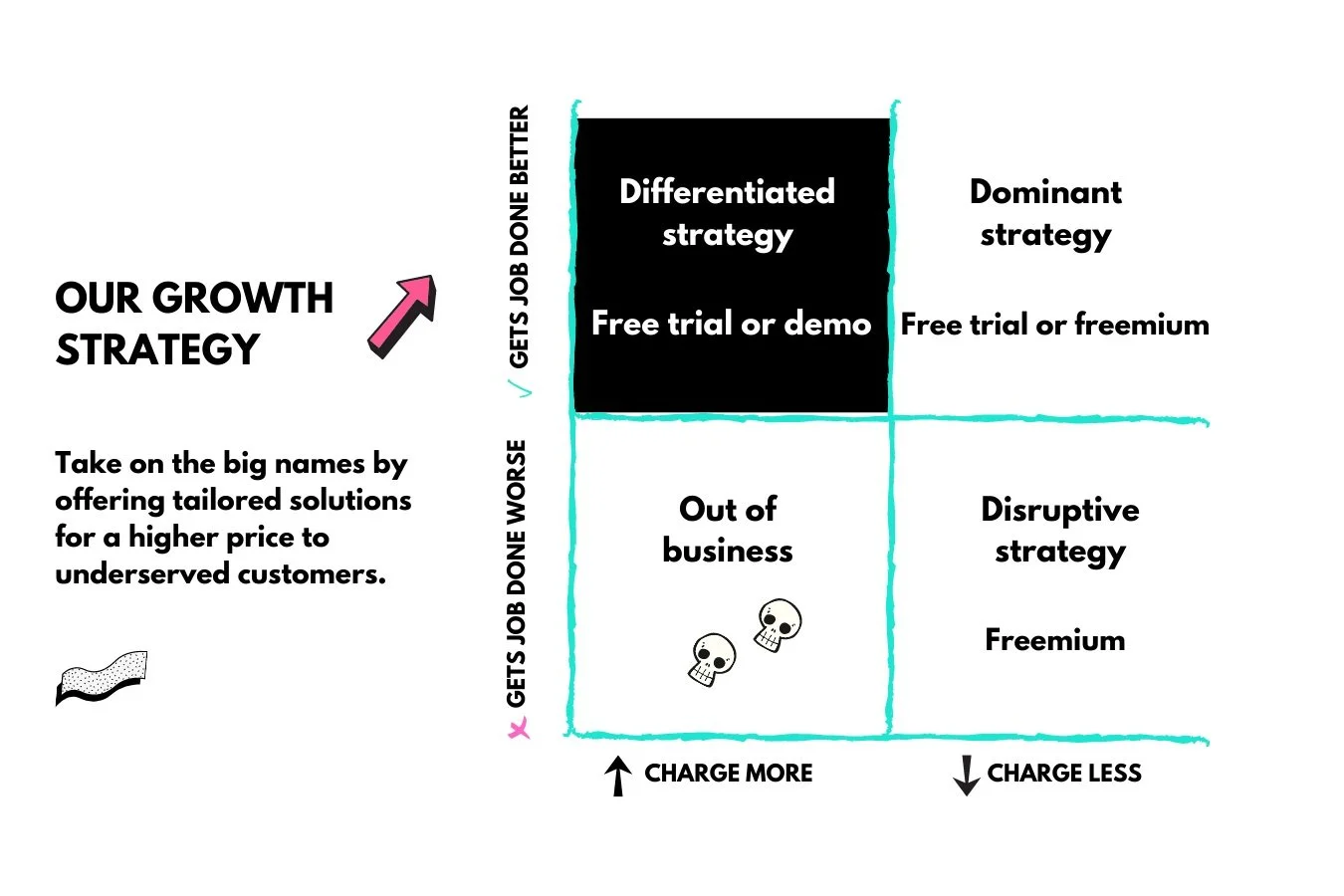
Jobs-to-be-Done Growth Strategy Matrix
Unsurprising spoiler alert: turns out it didn’t quite work out the way we intended.
We’d give our ‘best fit’ leads access to free trials to watch the content. Those prospects seemed really interested and then - silence.
Maybe they’d activate their trial, but the engagement was lacking. Turns out, we’d not done enough to really understand what they needed in that moment to get real value (also known as time to value).
The emphasis was just getting leads in, and not what was really important: retention.
Exploring sales-led growth got us to being product-led focused
For a period of six months we decided to follow up all leads and on-board them personally. It was really useful, because it turns out - we were severely overcomplicated what was a really simple product.
An enquiry would come in, we’d ask for a discovery call and to be fair, the majority of the leads that came in agreed as they could see what we were trying to achieve. This helped alleviate some of the stress.
On reflection, this approach was such a great idea - it was onboarding masquerading as customer development and provided us with a great chance to story tell and try out different value propositions. It also helped get rid of some of the nerves.
We eventually got into a bit of a rhythm and began to look at automating the process because it wouldn’t have stacked up long term to do it this way.
If we’d continued this way, we wouldn’t have been able to scale it. The cost per acquisition would have gone through the roof. The lesson here? Your selling strategy has to align with your go-to-market strategy.
Plus, we noticed that actually we were naturally attracting users that favoured a bottom-up approach. Our product was being used by end users who would share with their friends.
We went back to the product-led growth strategy knowing that it wasn’t about just sign ups, armed with subtle and big changes to make to our sign up, onboarding and engagement stages.
Why product-led growth made sense for our startup:
We went back to the product-led growth strategy knowing that it wasn’t about just sign ups, armed with subtle and big changes to make to our sign up, onboarding and engagement.
By the way, a lot of what I am describing you’ll find in Wes Bush’s awesome book, Product-Led Growth. It is such an awesome resource and I totally recommend watching it.
Here are some of the benefits we experienced from this approach, which support a ton of theory that’s out there, kids.
Sign-ups coming in to try the product. By offering a free trial and a product that would help you achieve the job you wanted it to do so (in this case get your confidence up and go for a promotion by watching our online learning) we were able to show more people what we could offer them. This gave us more data to experiment with the different user types.
The data we got was awesome. We could look at the conversion rate by lead source, by calendar month. We could start filling in our revenue with relative confidence. Our onboarding was tailored to the job each segment was trying to achieve! (If there are any marketers reading this, you’ll know that this was hugely exciting!)
We reduced the acquisition costs: by offering, what was in effect, a self-serve model, we took that expensive part out from the overall cost (i.e. people).
What we learned from trying product-led a second time around:
1. The free trial worked for us over freemium because we didn’t have the TAM for a freemium model.
By pursuing the free trial we were able to experiment which helped us to increase conversions. For example we increased our free trial from 7 days to 14 days. Turns out that we needed that extra time to allow people to get a feel for the system and learn at their own pace.
2. Engagement isn’t all about activation.
For us our North Star metric was something as simple as creating a playlist of videos and not necessarily watching 100% of the online courses we offer. (Who knew!)
Our metrics switched from looking at signups and activations to the entire customer experience. By switching the resources from a sales-heavy touch to improvements to the platform, we were able to speed up the time people saw value. If you want to learn more about this process, check out customer-led growth for startups.
One last thing…
There are many businesses out there that are successfully pursuing a product-led growth strategy, and it’s awesome to see.
But don’t be tempted just to copy them: speak to your customers, see what your competitors are and get to grips with the size of the market. These will help you get one step closer to what strategy you should pursue.
But most importantly, push past that comfort zone. Sales isn’t bad - think of it as customer research :)