

How to use your product as a marketing engine (B2B edition).
SPOILER: this wasn’t created with ChatGPT ;)
I’ll let you into a secret. Understanding how to make your product found by more of the right people is something that affects all types of businesses. You can have the most fancy process and a mahoosive budget, but if you create content that’s misaligned with the problem you’re trying to solve… it will still fail.
Well, that was a cheery start.
Last week, I “upped” my public speaking game and presented on the topic, How to use your product as a marketing engine, to the Business of Software community. It was an interesting conference that helped product and product marketing people look at their customers through a different lens.
My talk looked at how to connect your content and parts of your product to problem aware audiences - those earlier on in “the process”™.
Some of you may be reading this thinking “we’re in a recession/it’s bloody tough at the moment - I haven’t got the time to spend marketing my product to problem aware audiences”.
And that’s cool. But… that’s where the problem stems.
When businesses freak out and ask marketing to turn on the magic lead tap ‘cos they need leads, leads, leads.
Things get tough so they cut the “brand awareness” stuff in search for sales-ready leads to ensure the revenue keeps coming in.
But, by doing so and neglecting the stages that come before can play havoc with your pipeline and sales cycle. I promise. I’ve seen it.
Cutting top of the funnel activity isn’t cutting the cutesy nice to have parts of your marketing, it’s cutting off marketing to those who are unaware they have a problem. Tomorrow’s customers. (Or next year’s, depending on how long your sales cycle is).
Fear not. I’m going to try and convince you by showing you how you can be more in tune with the different types of marketing and ways to make your product found much more easily. Some stuff you may apply today, others you may look at next quarter.
How to use your product as a marketing engine - an approach for b2b product companies.
The matrix that shows you "what" people are saying when they're bucketed by marketers into frameworks.
How to create demand with content - Grammarly case study
We’ll dig into how Grammarly creates content for problem un/aware audiences. For example, creating posts around "accept versus except" "practice versus "practise"... and how they create demand early on.How to capture demand with product hooks
Aka: engineering as marketing. Specifically, how to create useful tools to solve early-stage problems that can capture demand before the free trial or freemium kicks in.
1) The matrix that will unlock how to think about your product and customer
If you can take anything away from this article, it’s an appreciation for the the below matrix.
Once you see them, you’ll reframe the way you look at how your marketing and product can connect with customers.
Problem Awareness Matrix - Eugene Schwartz
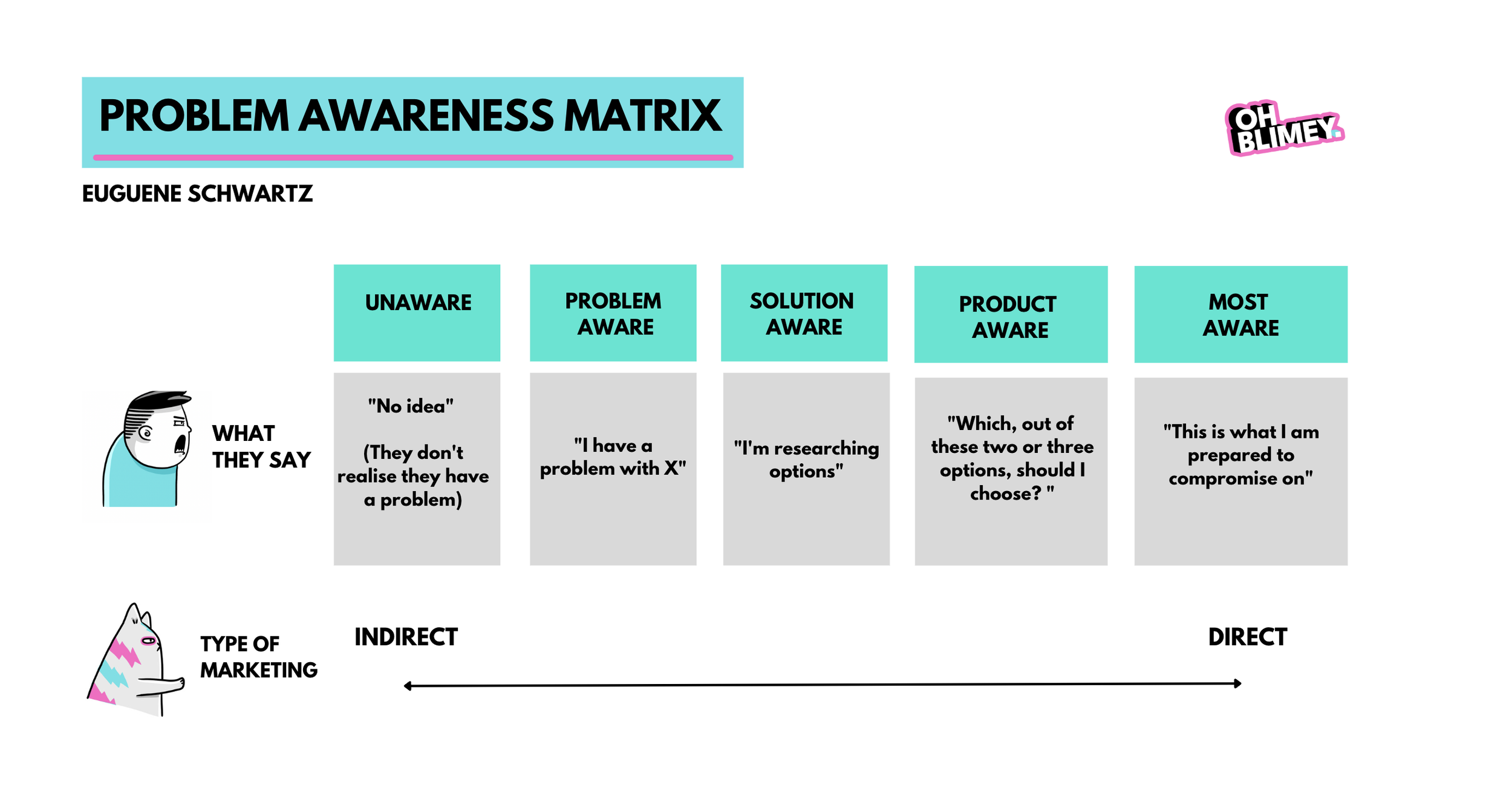
The problem awareness matrix shows you the stages of awareness someone goes through when purchasing a product or signing up to a new software.
Along the top we have the stages of awareness, from problem unaware through to most aware.
Directly underneath, we have the articulation of what someone is “saying” when they find themselves in this stage.
For example, if someone says “I have a problem with my accountancy software” they’re likely to be “problem aware”. They know there’s a problem but they don’t have the language, they haven’t learned the language that comes when you naturally learn more. If someone says, “I’m stuck between Xero or Quickbooks” they are likely to be solution aware. They know the brand names but then they’ve also dug into the features and can see what they may need to compromise on.
The bit at the bottom “Marketing Type” is my favourite part. It shows that as you learn more about a solution, marketing’s focus needs to change. When you are problem unaware you are more likely to respond to indirect marketing - such as stories. Whereas, when you’re product aware, the marketing that’s likely to get to you take action is more likely to be personalised, directed.
The intent changes.
I dug into this topic and why some startup’s sales demos aren’t working recently.
2) How to create demand with content
In other words: how to make your product discoverable to problem UNAWARE audiences using content.
To recap, a “problem unaware” audience is just as it sounds. Someone that doesn't know they have a problem yet. It's our job to try and find those people who are on the brink of realising they need to make a change.
We do this by creating marketing that's indirect - via stories or by answering questions - to provide value at the point of pain. Our aim is to identify early stage problems and use content to create demand organically.
Creating demand at this stage means creating brand awareness and attracting more traffic to your site. Leads aren't the goal here. But you need this part in place to help with lead generation later on.
Formats
We know that at this stage we need to consider indirect marketing, for example stories or answering high level Q&A. According to Hubspot, last year (2022) the most effective formats for b2b audiences were video, blogs and images.
Think about it, and how you use these channels in your day to day life and to answer “work” questions.
I’ll hop onto YouTube to search for a tutorial, for example “how to measure website traffic”, and end up watching a video on how to set up GA4. Okay, there’ll be the slight distraction - of which cat videos will appear - but at no point have I typed in a physical brand name.
This could be the reason why YouTube is #1 most visited website in the US by organic traffic (Ahrefs).
Or what about Google? How many times have you asked a question, and someone's just told you to "Google it?"
69% of marketers invest in SEO (Hubspot) because they know this is where the first stage of searching for a solution happens. Of course this comes with its caveats, because it really does depend on your audience and the channels THEY use to research.
Example: Grammarly.
Every blog is tied to a problem; their content strategy is optimised around beginner problems.
In my opinion, free online writing tool, Grammarly is the GOAT on how to build visibility towards a product unaware audience and, in turn, build an effective marketing engine.
Last year, it saw:
- 17.4 million google visits a month
- of which a third had navigational intent
- and the remaining two thirds were from organic visits.
These are people who are on the cusp on realising they have a problem but are unaware of Grammarly’s brand.
So, how does Grammarly do it? How do they leverage content for the problem unaware audience?
Their aim is to get everyone to the website. They’ve invested in the work to make their freemium customer acquisition model and product extensions work.
Every blog is tied to a problem: their content strategy is optimised around beginner problems.

Every blog is tied to a problem: their content strategy is optimised around beginner problems.
For example, top articles include:
“how to sign off an email”
”accept vs except”
”practice vs practise”.
(I still get confused).
These are the type of queries you'd quickly Google search for. These are all organic, top of the funnel searches. People don't know who or what Grammarly is yet. What they are doing is building its authority and trust, right before someone realises "dam, my spelling is a bit poor and I've got that big presentation to hand in".
Read more about marketing traction channels and where they sit for your startup.
3) How to capture demand with product hooks
Let’s look at how you can use parts of your product to make the most of the above step. This part is largely based on a concept known as Engineering as Marketing - by Gabriel Weinberg and Justin Mares. Check out this article from UserList that sums it up nicely.
Engineering as Marketing is all about creating useful tools for your audience to solve an early-stage problem. All you have to do* is to find data you have connected to your audience's problem and identify if you can provide an immediate pain relief that's easy to automate.
*Hark at me implying it’s that easy…
It's about capturing demand earlier on in the process, and it comes before your free trials/freemium etc.
This isn't necessarily new, but with the rising advertising costs, I think it’s an effective way to really open your funnel, create assets that are good to share on SEO, social etc.
Typical examples include: pricing calculators, widgets, free apps, or downloads.
Examples in the market include:
Canva’s colour wheel. A tool that lets you find a complementary colour to your existing brand palette. Just pop in your hex code and boom!
Sprout Social’s social media re-sizer. This lets me optimise my posts for different social channels, all whilst positioning their scheduling software.
To make this concept work, there are a few best practices:
The product hook has to be complementary to your product; you need to be able to monetise it
It has to be super easy to use
It has to be free - super important!
It has to be for one specific audience for someone to truly get value from it.
The benefits when it comes to building visibility are great.
Obviously, you need to create something that's genuinely useful and tied to a problem, but if you do, the results can be very interesting:
1) You boost your SEO.
Take the Grammarly case study.
Their product hook, the Grammar Checker alone gets 2 million visits a month
They have over 1730 indexed pages
They attract a ton of high value backlinks.
What about Hubspot’s Website Grader?
At its peak, in 2018, it had 34,000 organic visits a month
8400 referring domains
complementary brands linked to it: Moz, Netlify etc
At present, it ranks for 3269 keywords - site grader, seo grader, grade my website, marketing audit... all connected to those early stage problems You can grow your audience.

2) You can grow your audience.
If you gate your tool (i.e. ask for an email address) you can grow your audience by sending emails that nurture them until they’ve solved their problem.
…. Wait, there… can only “fun” industries do this?
There's this misconception that it's only "fun" industries that can pursue this. I don't think there's such a thing as a boring industry. It's a mindset thing. And I say that as someone who’s worked in data, VoIP, recruitment.
To me it comes down to your brand, the ability to solve a genuine early-stage problem, all whilst ensuring your b2b product feel like a b2c product. ‘Cos that’s what we expect, ya know.
Look at Zoopla’s home valuation tool. Or Diplo’s AI speech writing tool for diplomats and practitioners to ensure CyberSecurity is spoken about correctly.
Summary
If you’re looking for ways to make your product discoverable, here are my suggestions:
- Think about what your ideal customer's early stage problem is
- Consider what part of your product you can offer for free to capture demand
- Consider if there’s a consultative element of your product that you can automate
- Think back to when you recently purchased a product - where did you go to learn more, and what channels did you use?
Want to chat about ways to launch product marketing for your startup? Hit me up!
