

Email marketing strategy: from ugly baby scatter tactics to super sleek strategy.
Back in the day, I worked in a business that used email marketing as a mass sales tool. We’d email a database of contacts every week, around 50,000 of them, asking them if they wanted to save 90% on their advertising fees.
We’d send our promotional email out, process any leads that came in and, after dealing with the messages/bounce backs etc we’d pat ourselves on the back until the next week, when we’d start the process again.
It was tough work. There was no repeatability and no process but, as the source of the majority of our leads, it was something we put a lot of time and energy behind - especially as a small business with very limited marketing resources.
Yet, everything I learned in marketing courses told me that we weren’t doing it properly. We were bending a sales tool and squeezing it into a marketing process.
In the short-term, yes it “worked”.
But without being too pedantic, it depends on what your definition of “worked” meant. We’d secure around 20 appointments for the sales team to then follow up, with around four converting to a sale. At the same time, we’d annoy the database of subscribers… a lot. Our sender reputation wasn’t pretty - we spent a lot of time firefighting.
And our brand reputation took a hit.
I was once at a networking event and when I said I’d worked for this company they looked at me and said, “oh, you work for the spammers!”
It wasn’t until one day we realised that we couldn’t allow email marketing to be the sole lead source. The process we were following wasn’t scalable. I spent some time with our FD, and, after looking at the figures, we learned some hard truths:
We were spending 80% of our time working on this channel, but the revenue only made up about 10% of the results.
Those leads who came and bought, actually had a lower cumulative spend than say, a lead coming in from SEO.
We were sat on a ton of leads who, despite not being ready at that specific time the salesperson contacted them, weren’t ever really contacted.
We worked out the cost to send each email and when you added all the extras - resends, leads we never followed up, switching email platforms, the cost to get a customer via this method just didn’t make sense.
Moving from a tactical to a strategic approach to email marketing
The trigger that changed it all.
When the business made the strategic decision to change its focus from the small business to the enterprise customer, it was decided that the old way of gaining interest wasn’t going to cut it.
Acquiring an enterprise lead was going to be an expensive business, so there was no point in harming our efforts and reputation.
But the real win for me in this process was going from using email marketing at the top of the funnel to using it throughout the entire customer journey with our product.
As soon as you see the value in email marketing and its use being about changing behaviours; that’s when an email marketing strategy kicks off. We went from using it as a disruptive short-term tool to something that assisted our customers along their buying timeline, nudging them towards getting the most from the service.
TLDR: we also increased our average revenue, increased retention and grew our audience in a way we could call upon when looking for customers to interview.
Was this easy? Hell no. The marketing team and I went from supporting a sales team that relied on these inbound leads to complement their targets. The day I had to tell them that it’s not about the sale, it’s about understanding where the prospect was in the timeline and supporting them… well, that wasn’t easy.
But - the approach we refined is one I use today when helping organisations to add a bit of fuel to their customer acquisition and lead generation campaigns.
A crash course in email marketing
Email marketing as a channel
Let’s start with this question: is email marketing the right channel for your customer?
There are something like 40+ marketing channels available. Everything from SEO to email, paid advertising to engineering as marketing. You name it.
And selecting it as part of your marketing strategy ultimately depends on two things:
1) how your customers research and buy a service like yours
2) the type of sales process you have.
If you’re super new to email marketing, check out how to grab new subscribers with email tactics.
Generally speaking, email marketing can complement all B2B go-to-market traction strategies.
As a reminder, these are sales-led, content-led, performance, and viral. Email’s aim may be slightly different in each, however, it can be used across all to nurture users. Read how to choose the right traction channel.
The types of email marketing
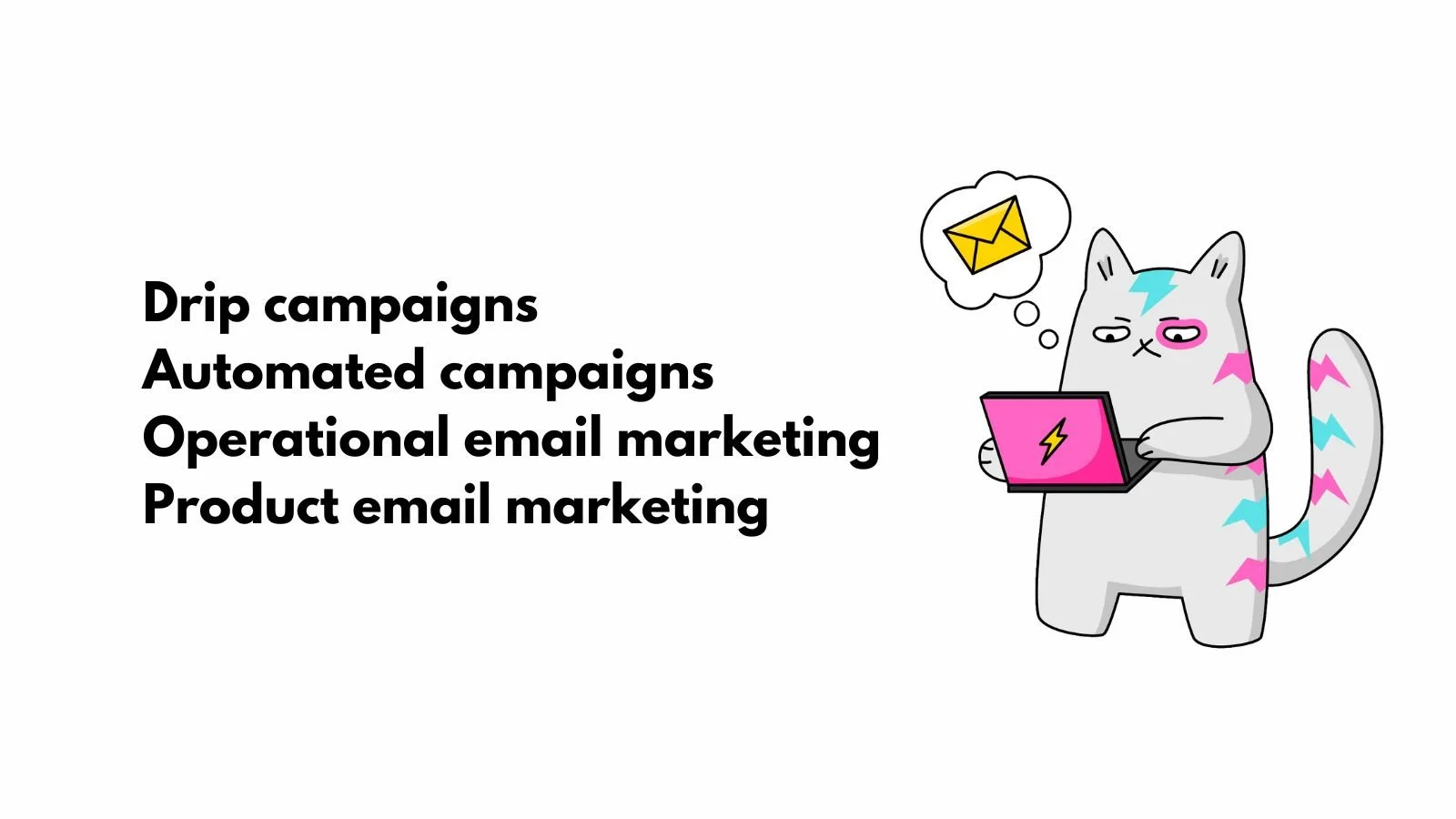
I like to group these four types of marketing emails under the lifecycle campaign umbrella.
Drip campaigns
Automated campaigns
Operational email marketing
Product email marketing
Drip campaigns.
Typically, someone will engage with your website - for example, they’ll sign up for an email masterclass or sign up for a free trial and they’ll then be on the receiving end of automated emails. You know the type, likewelcome emails or case studies that typically reach your inbox on day 1, 7 and 14. These are drip campaigns.
Automated campaigns - also known as nurturing.
These are usually automated emails based on an action you have performed - or not performed. For example, let’s say that you decided not to renew your trial and you get a message asking you to come back for a discount. Or, let’s say you had downloaded a whitepaper and then visited a pricing page… a day later, you may get an email that’s more around commercial aspects.
Operational email marketing.
These are your standard, boring but highly important comms. Typically these are things like confirmation of your order or perhaps a message about how the company has updated their terms.
Product email marketing.
These are the emails that are sent when you are a subscriber of a product and the company is trying to nudge you to a specific feature or to take a specific action.
Examples of email marketing objectives
Here are some examples of objectives I have used in the past to help illustrate what you should be working towards if you’re developing your email marketing strategy.
When I say email marketing objective, it’s likely your mind went to open rates or views on mobile. Of course, these are good metrics, but the companies I partner with that use both strategic and tactical objectives are the ones that really make this work.
Examples of strategy objectives:
Increase cumulative spend by segment X from £ to £ within 8 months
Increase additional spend of X product from Y segment by September
Increase the time to convert from free trial to paid subscriber within cohort X
Examples of tactical objectives:
Increase click through rates from X to Y within 6 months
Increase the average engaged audience from X to Y
Keep the number of unsubscribes under 0.3%
Steps to take when writing your email marketing strategy
I usually recommend following these steps as a starting point.
Segment your ideal customers. You may wish to do this by demographics - for example, Head of HR, an organisation with 250 staff, multi-site.
Arrange customer interviews or a survey to extract why these paying customers signed up with you. Also, use this to trace exactly the questions they had throughout the buying process. This info is going to determine your content marketing strategy.
Create your content marketing strategy, with a specific focus on how email marketing complements your two other marketing channels. That’s right, I wouldn’t use it in isolation.
Map out the types of emails you need to acquire, capture and grow business from your ideal clients.
Use the right email marketing provider. Some people use the one included in their CRM. Others will use a dedicated marketing platform. I suggest the latter.
Have a testing plan. And by this, I mean commit to recording your tactical KPIs such as open rate, best day to send, click through, information collected, delivered. Don’t worry, I am not going to dig into the specifics for this point.
Record and see how this helps you to reach the strategic goals. I know this is SUPER fluffy, however, what I mean by this is… don’t get annoyed if you don’t see a sale immediately. This stuff takes time.
Summary
Of course, you can get super nuanced with this stuff. But what I am trying to show you is that you don’t just batch and blast these emails. You need to consider how your ideal clients find you and what questions they ask themselves. This will help you to create email content that resonates and doesn’t end up in the bin/junk folder.
Email marketing is a strategic tool. It’s a marketing tool. It’s not a mass-blasting comms tool. People who use it in this way will quickly see that their working day is consumed with firefighting. Instead, consider how email fits with your other marketing channels and helps your customer to see value in your offering.
Want to see how I can help you get your email marketing strategy up and running? Contact me.
