

Don’t you just love it when the chairman's marketing advice trumps customer evidence?
"So, what's the plan to get more leads in?"
It’s a few years ago, and I’m sat in a board meeting. I’m three slides into my update.
Budget spent: £10,200. Results: modest but measurable. The Head of Sales is nodding… (I think we’re friends at the moment.)
As I’m talking, I look briefly at the Chairman. He has that look. You know… the look like it’s time for a massive tangent.
Uh-oh.
"Well," I start, "we're seeing good traction from an organic traffic perspective, and the email marketing is coming along nicely — ".
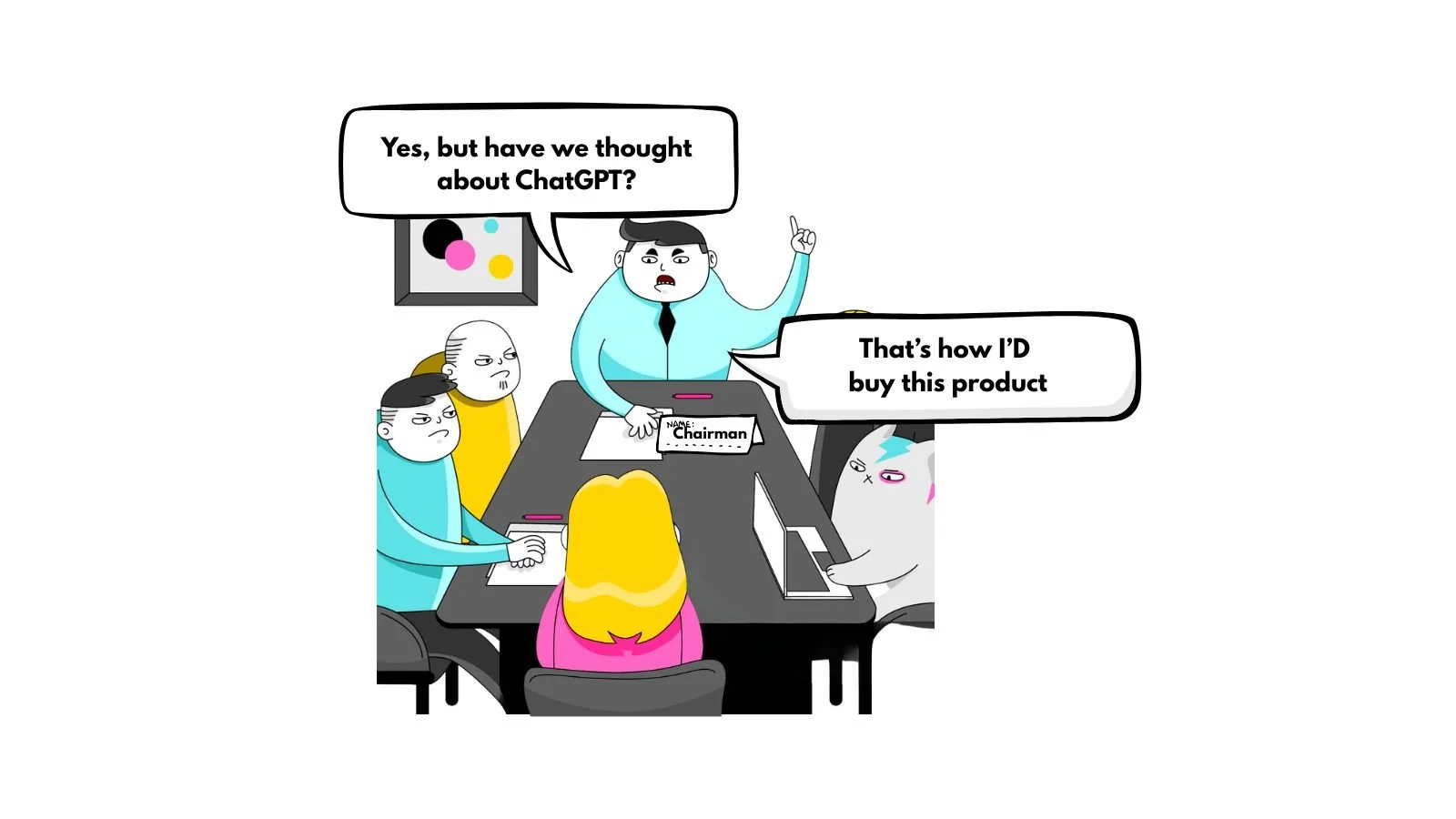
"Have we thought about Twitter?" he interrupts. "Surely we should be doing something there? It’s how I’d buy our product.”
I smile. Politely. "Of course we don’t want to discount the use of Twitter(!) to buy our product, but in terms of customer acquisition-"
"And why don't we have more likes on our Facebook? I was looking at it yesterday, and I’m sure we could be doing so much more".
The Head of Sales shifts uncomfortably. I know what's coming.
"We just need marketing to work a bit harder. The budget's tight, but if you think outside the box, we’ll get a few more sales and then I can open up more budget”.
Right. Got it.
The thing is, here’s what I wish I’d said back in that room.
“You, respectfully, aren’t the customer. You’ve not found yourself facing a problem, researched it, sat on a load of demos, been hounded by a sales team, attended a few events, and then subsequently signed up. All whilst trying to manage the chaos.”
Yet, for some reason, we’re spending what feels like 60% of the meeting talking about “what you’d do”.
But it’s not the first time I have been in this situation.
A senior leadership meeting I was in turned into chaos when I said customers shopped this way. “No they wouldn’t - I wouldn’t do it that way, that’s madness!”
And that's where it all goes a bit sideways.
I’m not saying in both instances that the Chairman wasn’t adding value, not in the slightest, but what I am alluding to is this: basing decisions, at an early stage, on what-ifs will lead to a turnover in the marketing department.
👋 Love the blog but need actual human help?
Don't you worry. Beyond the free advice, I work directly with early-stage founders to sort out their growth. You can bring me in as a fractional CMO to build and grow your foundations, lean on me for a methodical approach to see if there's a market for your product (startup validation) before you spend a fortune building the wrong thing, or design a custom (go to market strategy) to launch aligned to the stage you're at.
The only marketer in the room has the job of navigating what-ifs to evidence-based recommendations
Being the first marketing hire is odd. About half of what you learned in your last role applies here. The other half? Bin it.
You arrive thinking you know what you’re doing. Build awareness, nurture leads, enable sales. Except there is no sales team. There's a founder who's very good at talking to people they know, and that's about it.
You've got brand guidelines that need reworking.
There’s a website that loads like it's 2015.
And you’ve got a CRM; but no-one uses it ‘cos they store everything ‘up there’.
Every agency you speak to wants a £10k retainer. Every tool you need wants £200 a month.
Everyone's looking at you like you're supposed to have this sorted by next Tuesday. I've written before about what it's like to join a startup as its first marketer – spoiler: it's chaotic, brilliant, and occasionally makes you question your life choices.
The biggest marketing challenge: building a scalable process after you’ve spent years relying on word of mouth
The first twenty customers came through referrals. Someone knew someone. A founder's mate needed the product. An investor made an introduction.
Lovely.
Brilliant… but it doesn't scale.
Breaking out of that cycle is much harder than anyone admits. Because those early customers aren't just customers – they're believers. They took a punt on an unproven product because they trusted the person, not the company.
Now you need strangers to care. Strangers who've never heard of you, don't know your founder, and are being stalked by 47 other companies selling something vaguely similar.
Going from "my mate Dave said you're good" to "I found you through search and your website convinced me" is a different game entirely.
And it costs money.
“We need to have a chat” - marketing budgets
When starting out, building a marketing function or making the transition from referrals to ‘cold marketing’ - you need about 15% going to marketing. This is because you're trying to build a brand from nothing while competing against companies who've been at this for years.
You may have read that and gone “ouch” or you may have sworn. Global brands operate on about 10% of the budget, with some going down to 7.7% according to that Riston chap.
That budget isn't just for ads or content. A chunk of it is for testing. For finding out what doesn't work so you can bin it quickly and try something else.
Of course, the reality of this is very different. There was one business I worked with; I was told to be considered lucky to get 8%, and then got a stern talking-to when the budget wasn’t delivering the lead flow they expected. Creating a proper marketing plan requires actual resources, not just good intentions.
(Also, when did testing become a luxury?!)
Everything's changed and nobody's sure what to do about it
Remember when go-to-market strategies were straight-forward? Sales-led. Product-led. Partner-led. Pick your poison, execute, measure, refine. Etc etc.
Now? It's chaos.
Organic LinkedIn has become a full-time job just to understand what's happening. The algorithm changes weekly. What worked last month doesn’t even tempt my Mum to like and engage with the post.
Everyone's either posting three times a day or they've given up entirely.
Events? Attendance is down. Way down. People are tired. Burned out from ‘hot takes’ and opinions based on hear-say and not the real-thing.
We're all fighting for attention in channels that are actively hostile to being fought over.
Let’s face it: marketing is bloody hard at the moment
The cycle used to be simple: build a list, do some outreach, get a few email demos booked, prove it's working, ask for more budget.
That doesn't work anymore. Inboxes are graveyards. Cold outreach gets you blocked. Calendars are full. Nobody wants another demo that could've been a PDF.
The other day I saw someone say the new marketing was “community”. I wasn’t sure whether or not to eye-roll or accept it for what it is: the harsh reality that digital channels are getting harder and more expensive to do anything with.
So what now?
I don't have answers. I'm not going to give you five steps to transform your startup marketing or three hacks the chairman doesn't want you to know.
What I do know is this: if the people holding the purse strings haven't bought anything recently, haven't felt the pain of marketing a product organically, haven't experienced how exhausting it is to get anyone to care about anything new – their instincts about what'll work could in fact be wrong.
Maybe it's time we stopped listening to people who aren't in the arena and started trusting the ones who are.
About the Author
Lucy Heskins
Growth advisor and fractional CMO who helps early-stage startups scale without the usual tears, tantrums, or burning through piles of investor cash. When she isn't shouting into the void about product validation and go-to-market strategy, she's usually sharing brutal-but-fair startup marketing reality checks on LinkedIn.
