A super quick guide to picking your startup’s marketing tech stack.
How did you pick your marketing tech stack?
By ‘marketing tech stack’ I mean the tools you use to optimise your customers’ experience.
And by ‘tools’, I’m referring to things like the CRM you signed up for because there was an offer going as part of the startup accelerator you’re in.
Still scratching you head slightly? Think back to when you last sat down with your accountant or finance person to see where you could shave some costs.
You’ll see a software licence subscription that you don’t recall…
...your accountant will nudge and wink at you,
...and you’ll both hit the cancellation button, thinking you’ve just made a saving.
Uh-oh! Chances are, that made up part of your stack. (This isn’t an accounts bashing, promise).
As you look to hire a startup marketer and hand over the reins, they’ll most likely wish to create their own stack to help them hit their objectives.
So here’s a super duper quick crash course on what is a marketing tech stack and, when the time comes, how to answer or challenge your marketer when they come onboard.
TL’DR:
Start with strategy first, tools selection second.
Tools have to work in harmony to avoid headaches for your and your customers.
What is a marketing tech stack?
When I talk about marketing tech stacks I am talking about the marketing software you use to acquire, retain and grow your customer relationships. (It can also be referred to as Martech).
It is the live chat bots in the corner of your site and the CRM you use to segment active customers.
It is also the analytics tool you use to see why that lead STILL hasn’t activated fully - despite that one person telling you they LOVE your product.
It’s important to get your head around this.
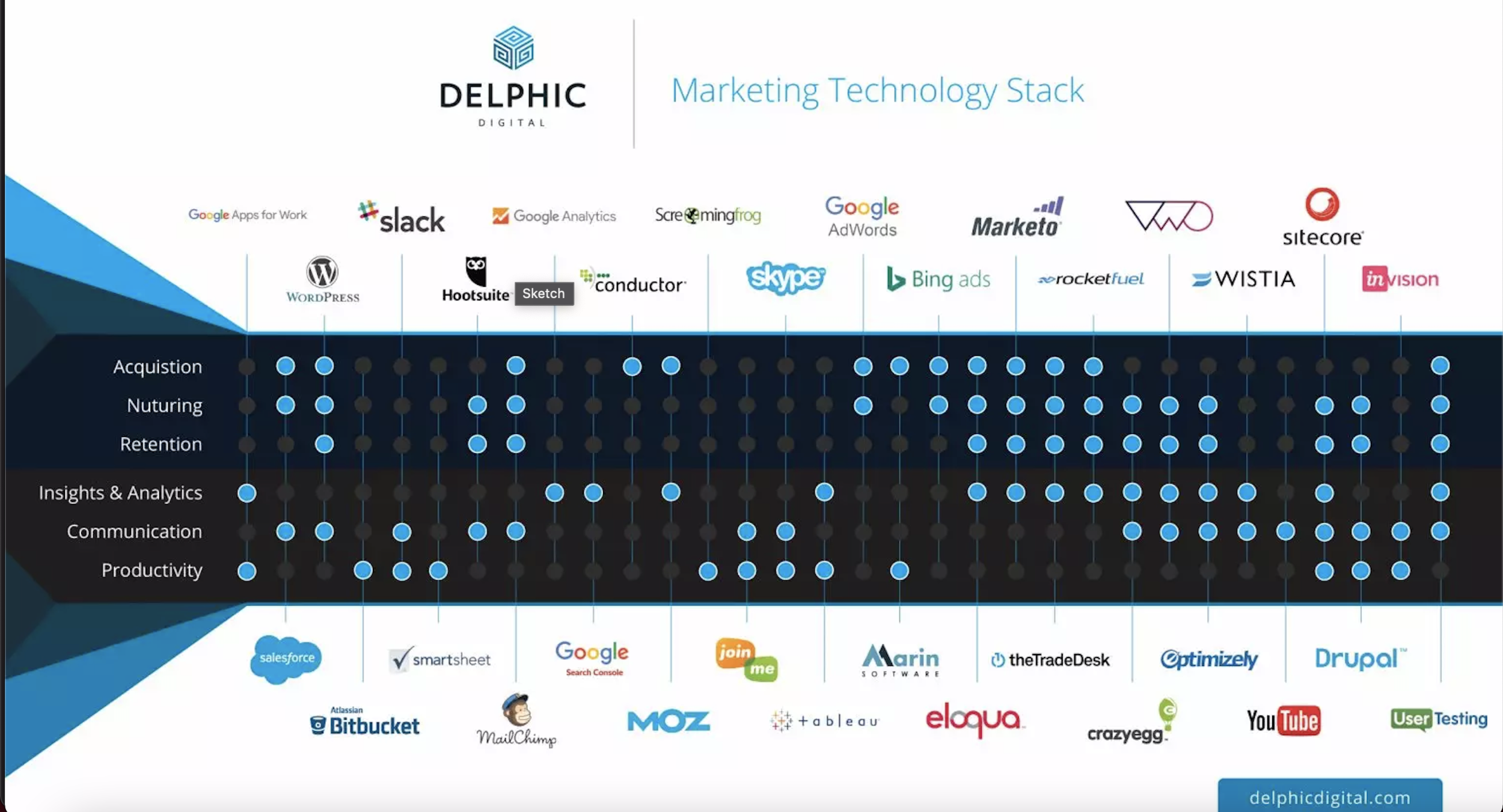
Delphic’s Marketing Tech Stack. Ain’t she a beauty?!
Your marketing tech stack is something that you’ll use to help scale your startup. We’re talking about building the foundations and growth.
And do you know what? Lots of people love talking about this subject. I’d recommend checking out Klint’s 60 Marketing Tech Stack examples. Oh, and of course, Intercom’s Ultimate Marketing Technology Stack guide.
But there’s a lot to get your head around. You may have seen the infamous martech infographic by Brinker that reflects over 8000 marketing software companies, all competing to become part of your marketing tech stack.
It makes for some scary reading. And I say that as a marketer. Not only does it show just how competitive it is out there for SaaS tools, but if you’re new to this process, it can be overwhelming.
How to select your startup’s marketing tech stack:
Map out the customer's journey.
Break the journey down into clear buying phases.
Look at examples of marketing tech that is aligned by stage.
Look at the tech you use currently to capture/convert, and identify any gaps that’ll help you to hit your growth goals.
Map out your customer’s journey

An example of a CX Map I use with startups.
This is what you're looking to create.
Strategy first, please. Pick your shiny tools second.
First up, map out the customer’s ‘perceived’ journey.
In its most basic terms, if you’re new to the concept, a CX map (customer experience map) gives you visibility into your customers’ journey, from prospect to paying / renewing customer.
It will require you to plot a customer’s entry point to your platform, how they subscribe, how they’re onboarded, how they’re expected to use the solution, right through to the renewal or cancellation stage.
You’ll get this information from a number of different sources. I’d start by mapping it down yourself and with your founding team. These conversations can really highlight blind spots. The next source to get this information from is… yes, you’ve guessed it… you’ll need to talk to your customers.
Break the customer journey into buying phases.
Next, ensure your CX map includes the main phases of your buying process.
These could be:
Struggle, evaluation and growth (as shown in the picture above)
Top of the funnel, middle of the funnel, bottom of the funnel, retention
Acquisition, activation, retention, revenue and referral (PIRATE metrics)
It’s whatever works for you and the customer.
Look what’s out there as examples of marketing tech aligned by stage.
As I mentioned earlier, there are over 8,000 tools available within the martech space. Hurray!
To help guide you through this, I’ve included examples of marketing tech I’ve used at previous businesses to give you an idea of where things may sit.
You’ll realise very early on, that you probably have a lot of this already, you’ve just not thought about it in this way before.
The basics:
A CMS - Wordpress, Contentful
Analytics - HotJar, MixPanel, Google Analytics
Customer development:
Acquisition:
Create social assets - Canva
Ad tech - Google Ads, AdRoll
Live chat and targeted messages - Intercom
Social media monitoring - Hootsuite
SEO ranking and optimisation - Moz
Lead scoring and nurturing - HubSpot
Activation:
Subscription Payment - Chargebee, Profitwell
Growth:
These are just a few examples, based on how we got started with our SaaS product’s marketing tech stack up at a previous business. Other startups will use different tools in different ways depending on what their marketing objectives are.
Look at the tech you use currently to capture/convert, and identify any gaps that’ll help you to hit your growth goals.

Examples of marketing tech aligned by stage, to help you identify any gaps. I’m hoping that many of those brands I included above are familiar in some shape or form, which means you’re already dropping the brands into your CX map.
Very quickly, you may see gaps in your CX map and, indeed, your customer experience. Determining what to address and what to act upon will depend on your strategy.
But this exercise should also help to work out if you can use a tool at multiple stages and, indeed, get more for your money. For example, HotJar can be used within multiple stages of the customer journey.
So what next?
When you find gaps in your customer experience - and, by gaps, I mean blind spots into your customer activity, issues with your conversion etc - look out for tools that’ll complement this. Try searching for tools that already integrate with your existing martech licences for less headaches.
The real aim is to get a marketing tech stack that’s made up of tools that complement one another.
So this has been a super quick guide to picking your startup’s marketing tech stack.
At the most, I hope it’s given you a different way to think about the customer’s experience and how your tech engages within them.
At the least, I hope it will make you think twice before cancelling a subscription when talking to accounts next.
Interested in learning more about marketing tech stacks or how to create a CX map? I love talking marketing for tech startups, get in touch! Or, if you’re looking for product-led growth strategy support for your startup, find out more.