Customer-Led Growth for Startups: rethinking the right strategy
Think about your startup’s product experience, what does ‘good’ look like?
(Side note: how you are quantifying what ‘good’ means can wait for another post.)
Look at the metrics you’re working towards, where’d they come from?
Are they based on your previous experience?
Are they based on a book you read that a startup founder recommended?
Maybe you’ve been advised by your board to use a particular framework.
Now, think about that time you tried to apply them to the business. You followed the advice, you set up your revenue pipeline, spent time using the right naming conventions but then a few weeks later… nothing. You start to think maybe it’s the product, maybe you’re not any closer to product-market fit.
If you work in a startup, chances are you get a lot of advice thrown at you. Much of it with great intention, some of it less-so. And, because there’s just so much advice out there, working out what to listen to - especially if you’re a first-time founder - can be seriously overwhelming.
So what can you do to avoid using the wrong strategy when growing your startup?
Every startup is different, which means it’s super easy to make the big mistake of using someone else’s metrics and strategy because you’ve seen it work elsewhere.
If you find yourself uncertain which strategy to pursue, you may find yourself wanting to emulate another business that’s doing it really well by using their approach.
You’ll no doubt be aware of product-led, sales-led and engineering-led strategies being thrown around.
But if you think you can jump straight into this, you’re missing the point.
We’re all missing the point!

The image above shows you a range of strategies available to businesses, many I am sure you’re aware of.
However, you’ll note that there’s a strategy above them that drives their focus.
To get to being product-led or marketing-led you need to invest in the step before.
With this I mean, customer-led strategy or rather, as it’s better known, customer-led growth.
What is customer-led growth?
Customer-led growth is a strategic approach that leverages customer insights to qualify and quantify customer value, then operationalise and optimise the end-to-end customer experience.
In other words, it’s a strategy that is the responsibility of all departments/functions because it looks at the customer’s unique experience.
It views your product through the lens of a customer with the aim of working out how value is delivered to them ‘whenever, wherever and however they need it’.
It’s supported by an accredited framework, created by Forget the Funnel, that ultimately helps businesses to gain clarity on and operationalise how your best customers achieve value, achieve their own goals and in turn - helps your business to grow.
Gia writes about her experience of using this strategy to grow revenue nearly 900% in the SaaS company she was marketing lead for.
(Side salesy point: I was lucky enough to be part of the beta cohort for the programme, for which I am now a fully accredited practitioner. Whoop!).
Why using customer-led growth for startups will give you the starting point you need.
Really thinking about how your customers derive value from your product and changing the way things are done can be an uncomfortable experience, but it can also be extremely rewarding.
Rethinking it this way can mean:
No more turning to sales and saying, ‘what’s the plan for growth?’
No more looking at product and assuming by adding this extra feature you’ll see an increase in upgrades.
And it also means using KPIs just because someone said so is a thing of the past.
It literally means looking at the customer experience, from acquisition right through to expansion, and asking yourself - what do they find of value and how can we optimise this so we can - let’s face it - start making some money?
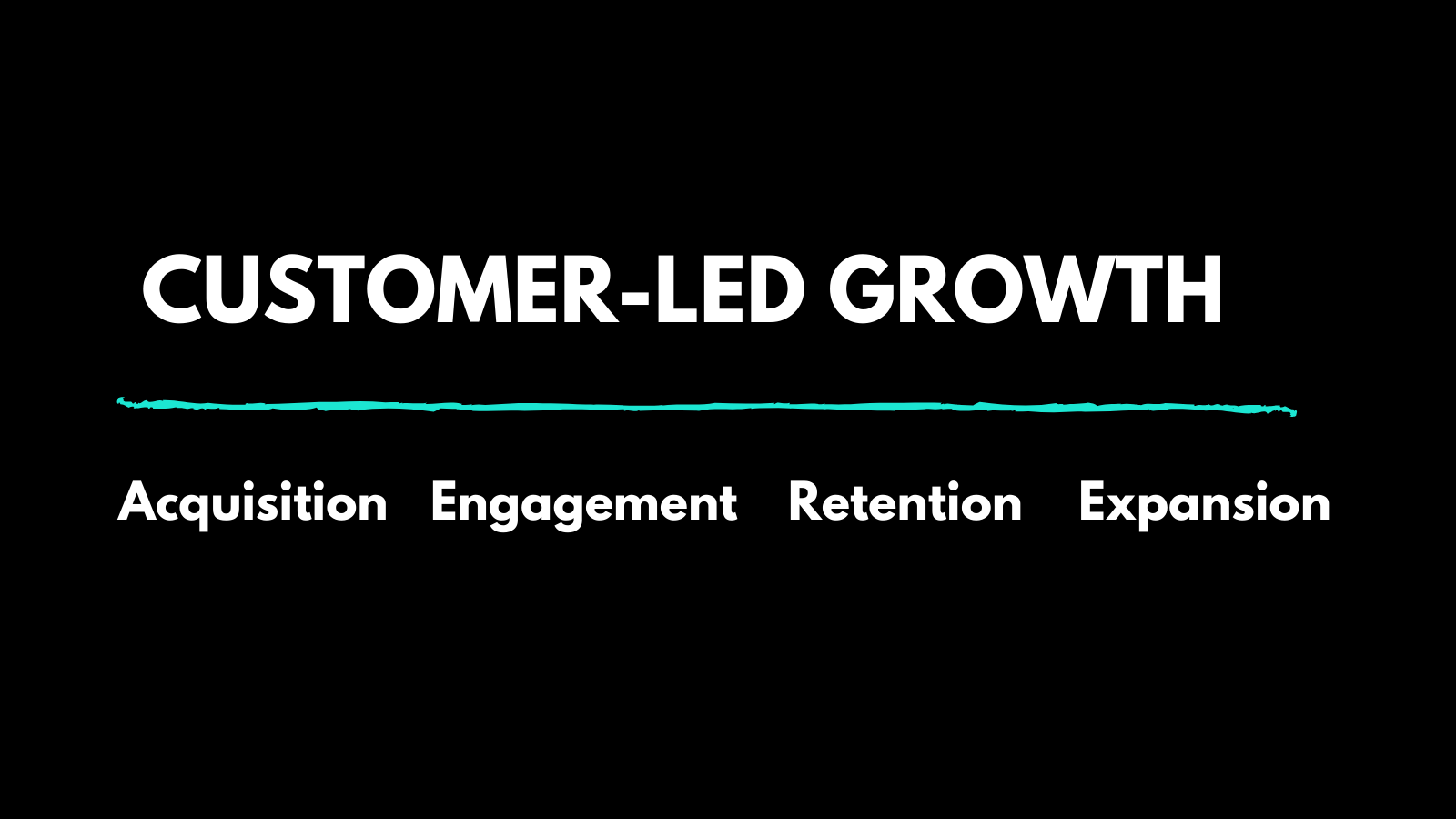
No longer is growth siloed to just one department, it becomes a shared responsibility for all departments. Which means metrics change, but more crucially, a lot of work with your customers needs to be carried out.
What is the process when launching a customer-led growth strategy for your startup?
Some of the signs you should be using customer-led growth right now:
You’ve just invested in a rebrand website without speaking to any customers and leads are down
Your subscribers are churning way to quickly
You’ve got so many ideas and markets you want to break into, but where to start!?
You’re considering moving to freemium, but don’t know what to put behind a paywall
In its most simplest of terms, a customer-led growth strategy should be made up of a series stages.
Customer discovery:
Interviewing your customer segments, through interviews/surveys - whatever resources you have available - to determine the struggle a customer faced when searching for and purchasing a solution like yours.
The last part of that sentence is the important bit as it’ll help you with key messaging, positioning and what metrics to assign.
Customer Jobs to be Done statement:
Jobs to be Done is a framework assumes that people don’t buy products randomly, rather they hire products to help them to solve a challenge/problem. Your customer base may be made up of a number of segments that you’re not sure who to prioritise. This helps you get one step closer to this unlocking who to focus on first.
Customer experience (CX) mapping:
This is a visualisation of the steps your customer will take to use and renew their use of your product. I appreciate this is a hugely generalised way of putting this - as this step is typically the stage whereby businesses realise the true value of this work.
In essence, you are deconstructing the different steps a customer undergoes to search for, sign up and use your product.
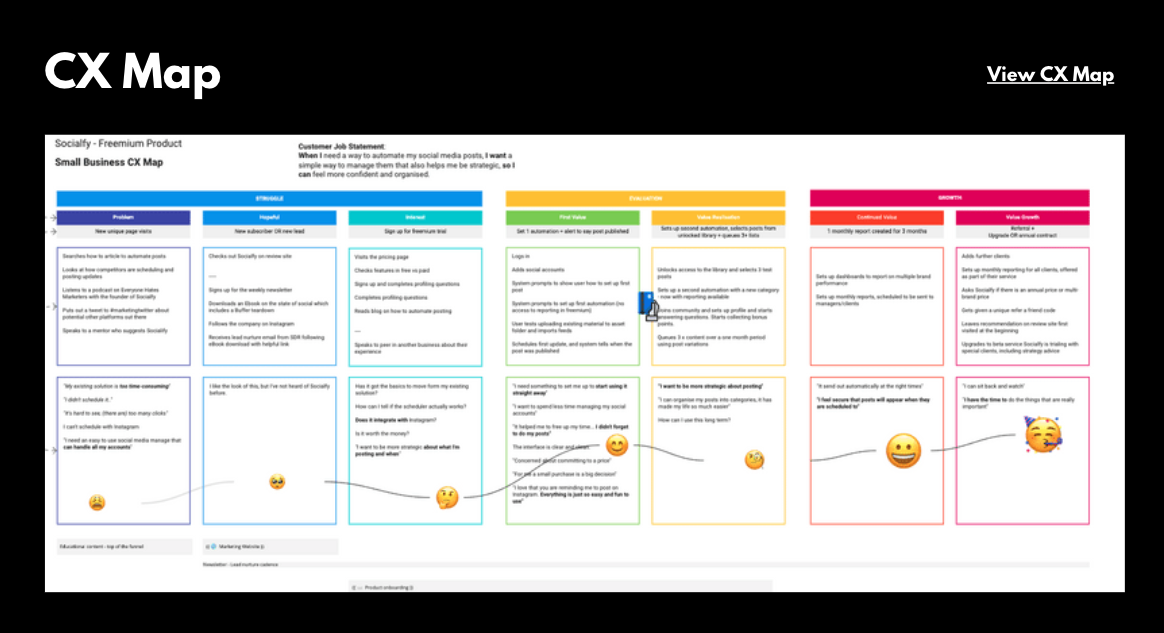
Example CX Map detailing the different stages a customer may go through
Why a startup is the perfect environment for embedding a customer-led growth strategy
You can see just why a growing startup is the perfect environment because - you’re not governed by the archaic attitude of ‘that’s the way it has always been done’.
You may not have enough of a team who neatly fit into their siloed departments. Maybe you’re still a small knit founding team, where every opinion and idea counts.
But let’s also face it. It just makes complete sense.
Thinking about how your customers derive value from your product and aligning it with your own success milestones is, well, just a bit obvious isn’t it?
Plus, it gives you tremendous direction. Now you’ve got a foolproof way to determine the actual metrics you need to measure and the projects and customers to prioritise to grow.
Want to learn more about Customer-Led Growth for Startups?
Contact me to discuss how it could help your startup to realise growth using the framework.