

Can’t stand your website? Some hard truths to face if you’re always questioning what marketing does
“I can’t even bear to look at it”.
“I’ve stopped sending people to the website, it doesn’t say what we do”.
“Why on earth did marketing create that? I’m not sharing that.”
There was a time I heard a director balk at the cost of a website redesign following a meeting with an agency. He wasn’t expecting the price proposed and so, in a bid to keep costs down, announced he would write the copy himself because - and I quote - “how hard can it be?”
Despite all intentions, said director got pulled back into their actual focus, and the role of creating the copy was delegated to a junior. This junior, who had “studied English literature”, was someone who’d never spoken to a customer in their life… and certainly hadn’t written website messaging before.
12 months later… and they were back to square one. The same director was complaining. This time, though, it was a really tough pill to swallow as they’d lost an entire year to messaging they felt didn’t speak to their true customers.
All because they wanted to cut costs and because they didn’t realise they could have short-cut the process by using their customers’ words.
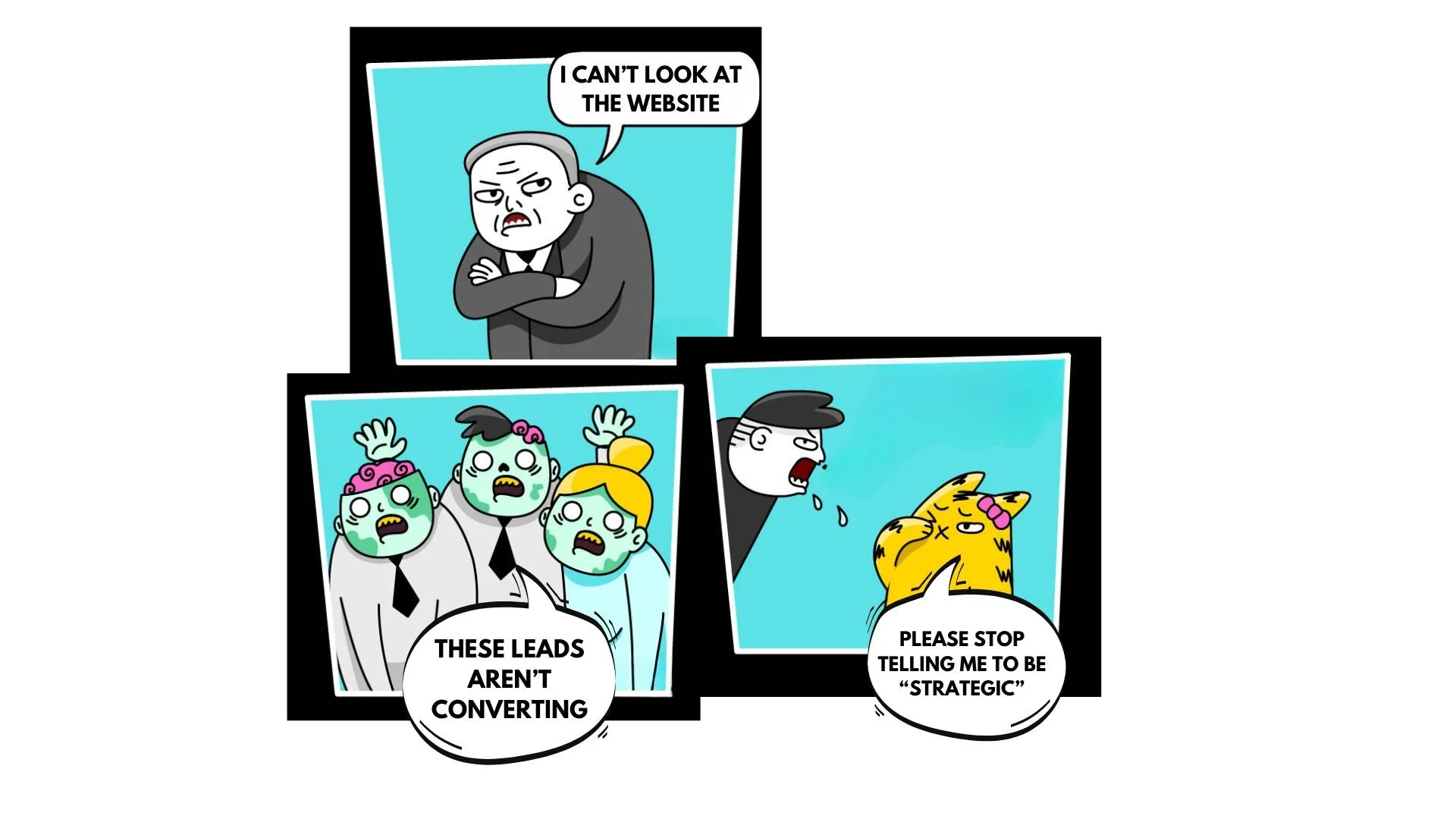
Newsflash: tour website isn’t for you, it’s for your customer.
Let’s say you also hate your website or wince every time someone pulls it up to review. Before you go charging into your unsuspecting marketing person or tell your boss you hate it, make sure you have the full facts about what its purpose is. (Then you can go and moan or change it).
Your website’s there to help educate a customer. Which is marketing jargon for: it’s there to help them understand what you do, why you’re right for them, and how to sell it internally.
How do you educate a customer in the most effective way? You use their language. You use their words to describe their problem and the solution they need to increase your chances of resonating.
Another thing to consider is this, the business model you operate will determine how you sell your product. This alone will determine what website pages you have, what to write on them, and what content to create first.
Fed up with your website copy? Try this:
The most effective way to write content for your website is to use the words of your customers. If a prospect can see content written from their perspective, using their language - guess what, they’re more likely to resonate with it. Here’s a case study with Native on how they used their customers’ words to completely change their website messaging strategy.
Oh, and sense check the words you’re using. No customer has ever said the word: innovative. So, get that word off your website. Ditch any reference to “ground-breaking” whilst you’re there too.
But what do you need to ask them, and where do you put it on the website?
The questioning needs to reflect what you’d ask them when validating the need for a service like yours. What problem were they facing when they realised they needed something like your product? What questions did they ask themselves at each stage of the buying process? Your website’s structure needs to match stages of the buying process.
Questions to ask yourself if your website is bugging you:
Look at the copy on your home page. How many instances are there where you use “we” from the business’ perspective? If there’s more than one - it’s time to change your copy.
Look at the use cases on your home page. How many, in one sentence, communicate what a client can do as a result of using your product? If you’ve answered zero - it’s time to revisit your copy.
What percentage of your call to action buttons say “Talk to Sales” or “Contact Us”? If it’s more than 50% - it’s time to rewrite your website copy.
Do you refer to your offering as a one-stop-shop when you offer a specialist service? There could be a positioning challenge you need to address.
When leads are down and you turn on marketing:
“We spent £15,000 on the website and it’s not generating any leads.”
“We’ve not had an inbound lead in six months.”
“We’re chucking all this money at marketing, but we’ve nothing to show for it.”
When times get tough, and perhaps there’s a dip in sales/marketing activity, the go to position for some people is to look at costs and misinterpret why things aren’t working.
Take this example. One day, a director said to me he was frustrated with the website and marketing activity. He saw the cost of the website rebrand and, because things had gotten a little quiet for the business, started to question the marketing expenditure.
Yes, they had invested in a new website but they hadn’t invested in a go-to-market strategy or marketing plan.
If I was to use an analogy to explain what I mean by this is: they’d bought the car but didn’t buy the petrol or a sat nav.

It’s like buying a car but not buying any petrol or a sat nav.
Let’s say you are a bricks and mortar shop. You can’t just launch by opening the shop, you need a plan to attract and keep customers. So why’s a website any different?
Questions to ask yourself if you’ve found yourself questioning marketing activity:
Look at the 2-3 channels being used to attract prospects and drive enquiries. Where these selected because your customers told you that’s what they used to research and sign up to your services? If not, why are you using them?
Look at the channels you’re using - what constitutes a conversion? If you’ve answered “leads” for all of them - it’s time to reconsider the marketing channels you’re using and how you are using them.
Look at the marketing channels you are using. Which are unscalable and which are scalable? Which are organic and which are paid for? If you don’t know - ask your marketing team to share their latest customer acquisition report.
When you’ve got leads coming in, but you keep losing out to your competitor or worse still, the prospect ghosts you
“They said they wanted a proposal. I sent it, but I haven’t heard from them in 3 weeks.”
“They’ve asked for three meetings to discuss the proposal but keep coming back with objections.”
“Our competitor keeps undercutting us, but we can’t discount that heavily.”
These again are all statements I’ve heard in meetings, both working inhouse and as a marketing consultant. It’s a common frustration with businesses with a sales team who are reliant on speaking to the customer and putting together a proposal based on their unique needs.
This drop in conversions can happen for many reasons.
Firstly, your proposal isn’t actually including the information your prospect needs. This could be because they’re actually at a very different stage of the buying process. It could be because there’s actually something else at play.
Things change. How your customer derives value from products change.
It’s a timing issue. Seasonality can also play a big role.
Questions to ask yourself if your conversion rates are low:
Are you collecting information on the 2-3 competitors you’re up against? If not... go on.
Once you have, look at which competitor comes up more frequently and revisit your value proposition against them. What is the one or two things you do ‘better' for the customer and want they want to achieve?
Should you really have created and sent someone a proposal… maybe they were too early?

Summary
The bottom line is, if you can’t look at your website that’s not a bad thing. If anything, it highlights that you’ve learned more about your ideal customer or the competitive market you’re operating in… and the need to realign it all again.
Contact me for an audit of your website or your marketing. I can advise you and your team whether there’s actually a problem with your offering or… if you’re just being a little to precious.
