

Going to market? Pick one competitor and forget the rest
When you're selling something new, the temptation is to sell it to everyone.
I totally get it. There's a fine line between finding your first paying customer and spreading yourself too thin.
When you've only got six weeks' runway, narrowing down and choosing a niche can feel like turning money away.
Keeping your options open feels like the safer option, but it can actually do more harm than good.
Here's something I learned over the years: when you're launching a new product, you only need to compete against one type of competitor.
Not one company… one type.
That's because each type of competitor requires a different sales story. Each has a different set of objections, different proof, and different reasons to make the switch from their current solution.
You know the advice: if you sell to everyone, you sell to no one. This is that advice in action.
Sell to too many customer types, against too many competitor types, and you make less progress than if you'd picked one lane. No matter how much A/B testing you ran on those 14 people who visited your sales page ;)
Here’s a useful quote from Peter Druker that can help reframe this further.
People rarely buy what your company thinks it's selling.
As companies, we've got this misconception that people are OBSESSED with our products. That they live and breathe them, and spend a lot of time thinking about us. But it's rarely the case. And this frame of mind means a lot of the marketing, sales and product work gets developed from our point of view - the supply side - when it really should come from the customer's - the demand side.
Which means we often get it wrong when we think about who our competitors are.
Your customer decides who your competitor is. Not you.
So who are you up against? Let's start with a little competitor 101 theory.
You have three types of competitor:
Direct — same category, same job.
Indirect — different category, same job.
Replacement — no product at all, same job.
The thing is, all three solve the customer's problem.
Let me show you an example with Netflix. (Netflix's CEO once told analysts the company's biggest competitor was sleep. He wasn't joking. This report is years old, but it’s not coincidence that the company offers sleep programmes).
But before you even think about competitors, the key is understanding the Job the customer is selecting you for or the problem you're solving.
Because that, and context, are what matter here.
What this looks like for Netflix
Let's use Netflix, because the Job is easy to picture:
"I'm bored, I'm watching my money, I need something to do tonight."
Direct — Prime Video. Same category, same job. In theory, a streaming service offering you a range of films, series and so on to watch.
Indirect — BBC iPlayer. Different funding model, same job, already paid for through the licence fee. Offers films, series and the rest — not always as blockbustery (yeah, that's a word), but still a nice range.
Replacement — an early night. Free, no effort, and genuinely tempting on a wet Tuesday. It can still take market share from Netflix, because the job is about giving the customer something to do.
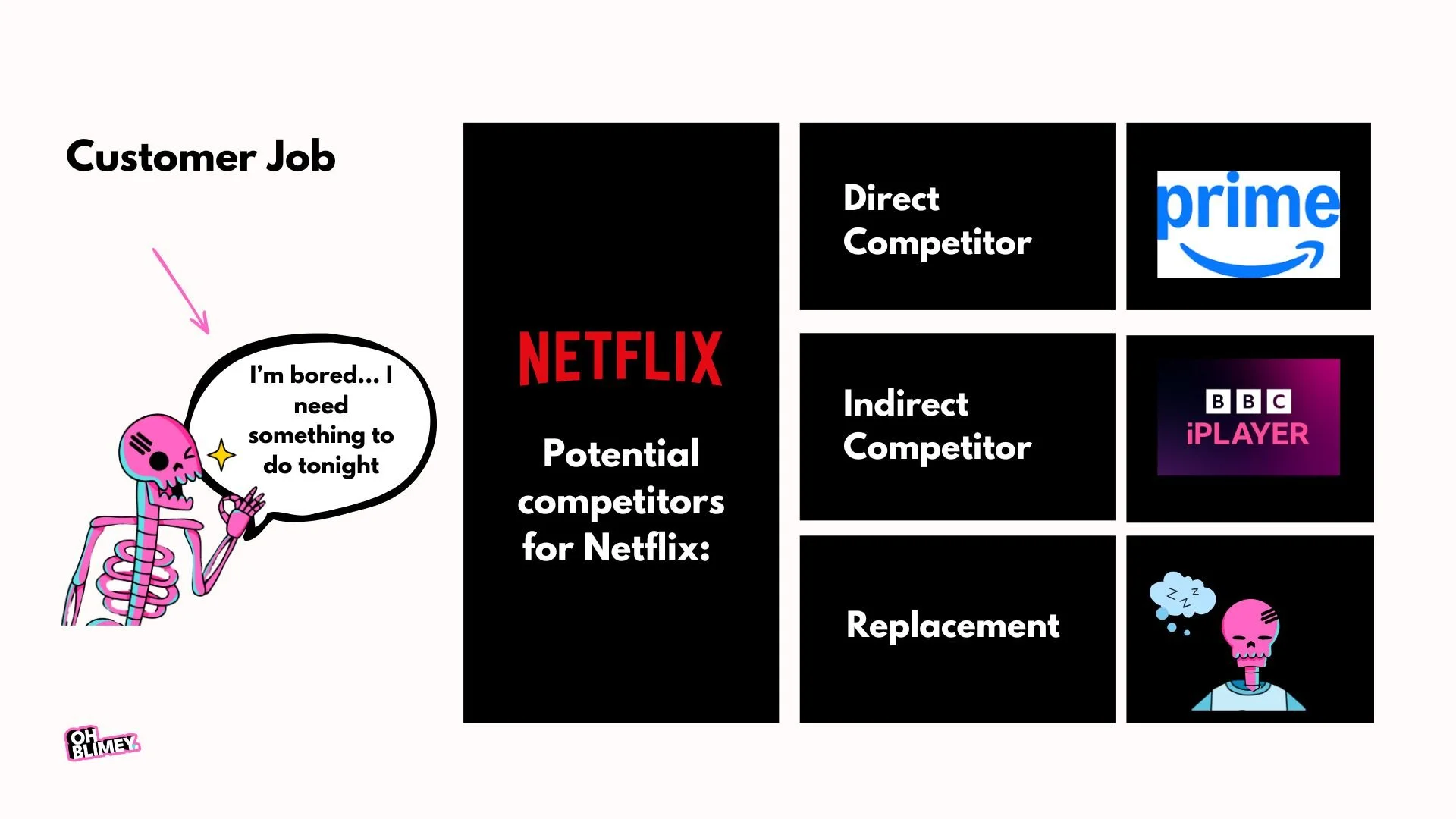
You don't get to pick your competitors, and neither does Netflix.
But what you can choose is the competitor to take on.
We've covered that you don't need to take on all three competitor types, so you hone in on one.
And the one you choose is the one where you're most confident you can solve your customer's problem better than anyone else.
It's here that the discussion around features starts to rear its head, as you learn what's actually important and what's a trade-off.
Want to learn how to uncover your true competitors so you can position your go to market launch more effectively? Let’s chat.
